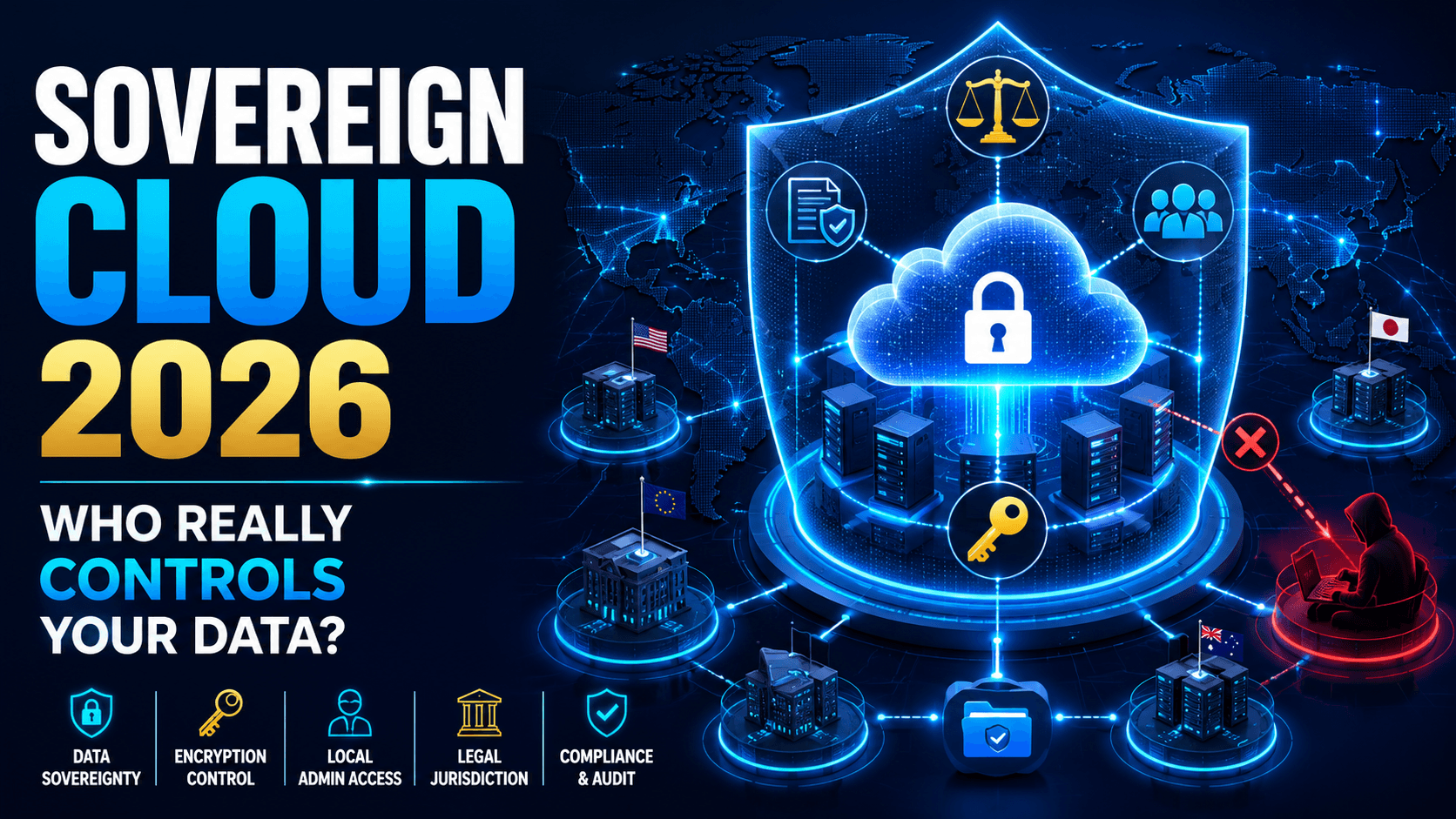
Sovereign Cloud in 2026: Why Businesses Need Greater Control Over Data and AI
Storing data in a local region does not automatically create digital sovereignty. Learn how businesses can gain stronger control over cloud data, encryption, operations and AI workloads.
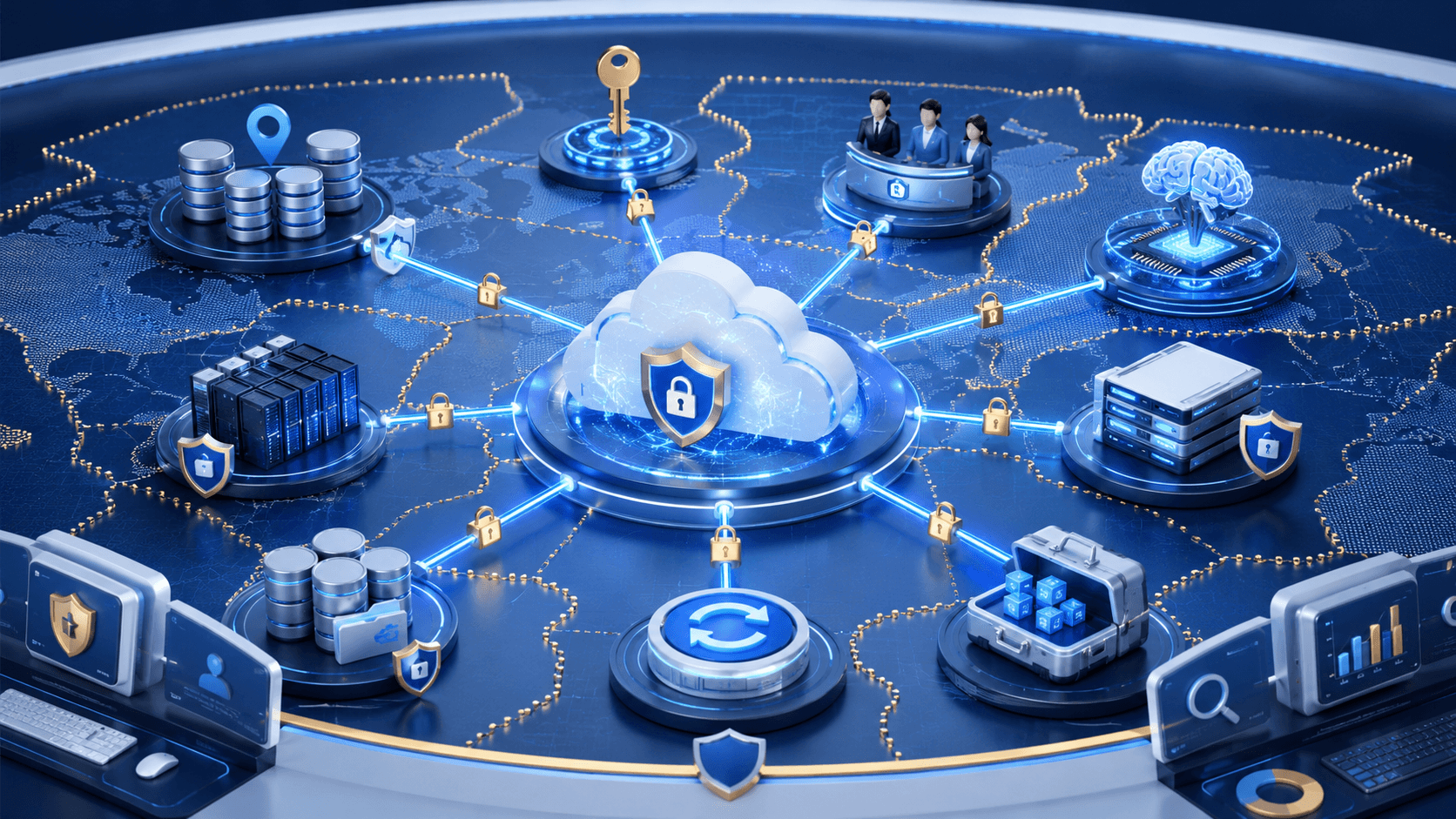

Cloud computing has transformed how businesses store information, run applications, collaborate with employees and deploy artificial intelligence.
Companies no longer need to purchase and maintain physical servers for every new application. They can launch cloud databases, customer platforms, analytics systems and AI tools within hours.
This flexibility creates major business value.
However, it also creates an important question:
How much control does the business retain after its data and critical applications move into the cloud?
A company may know the country where its information is stored but remain uncertain about which administrators can access it, which laws apply to the provider, whether services can continue during an international disruption and how easily workloads can be moved to another platform.
These concerns are increasing the demand for sovereign cloud.
Sovereign cloud is designed to provide stronger control over data location, legal jurisdiction, administrative access, encryption, operations and technology dependencies.
In 2026, this topic has moved beyond government agencies and highly classified environments.
Healthcare organisations, financial institutions, manufacturers, AI companies and businesses handling sensitive customer information are increasingly evaluating whether their cloud architecture provides sufficient control and resilience.
The European Commission introduced a detailed Cloud Sovereignty Framework containing 48 assessment criteria across eight categories: strategic, legal and jurisdictional, data and AI, operational, supply chain, technological, security and compliance, and environmental sustainability.
At Arrowhead DigiTech, we help businesses assess cloud risks, modernise infrastructure and build secure cloud and AI environments aligned with their operational and data-control requirements.
What Is Sovereign Cloud?
A sovereign cloud is a cloud environment designed to meet defined requirements related to data control, jurisdiction, operations and technological independence.
Depending on the organisation’s needs, sovereign controls may include:
Keeping data within an approved country or region
Restricting administrative access to authorised local personnel
Giving customers control over encryption keys
Applying local legal and regulatory requirements
Maintaining independent operational capabilities
Providing detailed audit and access records
Supporting workload portability
Reducing dependence on foreign infrastructure
Continuing critical services during connectivity disruptions
Sovereignty does not always require a completely isolated national cloud.
Businesses may use public cloud, private cloud, hybrid infrastructure, locally operated platforms or partner-managed sovereign environments.
The correct design depends on the sensitivity of the workload and the level of control required.
A customer-support website may not require the same sovereignty controls as a national healthcare database, defence system or AI platform processing confidential financial information.
Data Residency Is Not the Same as Data Sovereignty
Data residency explains where information is physically or logically stored.
For example, a cloud provider may allow a company to select a data centre located in Germany, the United Kingdom, the United Arab Emirates or another approved region.
This is an important control, but it does not answer every sovereignty question.
A business should also understand:
Which legal entity provides the service
Which national laws apply to that entity
Who can perform administrative actions
Where encryption keys are controlled
Whether support personnel outside the region can access systems
Whether the platform depends on infrastructure outside the approved boundary
What happens during political or network disruption
The European Commission’s framework treats legal jurisdiction, operational control, supply-chain dependencies, technology autonomy and data protection as separate but connected sovereignty areas.
This means a local data-centre location should be treated as one requirement rather than complete proof of sovereignty.
Why Sovereign Cloud Is Becoming Important in 2026
Three major developments are increasing business interest in sovereign cloud.
Growing Regulatory Expectations
Governments and regulators are paying closer attention to where sensitive data is stored, processed and accessed.
The European Commission awarded a €180 million sovereign-cloud procurement contract in April 2026 for European Union institutions and used its Cloud Sovereignty Framework to assess participating providers.
The framework introduced different assurance levels and a structured scoring method that public and private organisations can use when assessing sovereignty and resilience.
Greater Dependence on Cloud Providers
Businesses now depend on cloud platforms for communication, customer management, payments, identity, cybersecurity, software development and AI.
An interruption affecting one major provider can therefore affect many business departments at the same time.
Sovereignty planning helps organisations understand their critical dependencies and determine how operations would continue during a provider, network or geopolitical disruption.
Expansion of Artificial Intelligence
AI systems require large quantities of data and computing capacity.
Businesses may want to use advanced models while keeping prompts, training data, model weights and generated outputs within an approved operational boundary.
Microsoft announced support in 2026 for running large AI models inside fully disconnected sovereign environments through its local cloud infrastructure.
Sovereign AI is therefore becoming an important extension of cloud sovereignty.
What Is Sovereign AI?
Sovereign AI refers to the ability of an organisation or jurisdiction to control how artificial-intelligence systems, data and infrastructure are operated.
A sovereign AI environment may provide control over:
Training and fine-tuning data
Customer prompts
AI model deployment
Model weights
Inference activity
Processing location
Administrative access
Encryption keys
Supporting cloud infrastructure
Audit and monitoring information
This can be valuable when AI processes:
Medical information
Government records
Financial documents
Legal information
Intellectual property
Employee records
Confidential customer data
Industrial research
Businesses should not assume that selecting a local model automatically creates sovereign AI.
The underlying cloud, storage, identity, networking and monitoring systems must also meet the organisation’s control requirements.
The Main Dimensions of Cloud Sovereignty
Data Sovereignty
Data sovereignty focuses on how information is stored, processed, transferred, deleted and recovered.
Businesses should know whether backups, temporary files and application logs remain inside the approved boundary.
Legal and Jurisdictional Sovereignty
This examines which laws apply to the provider, its parent company and the customer’s information.
A locally located server may still be operated by a company subject to laws from another jurisdiction.
Organisations handling regulated or highly sensitive information should obtain appropriate legal guidance regarding these issues.
Operational Sovereignty
Operational sovereignty concerns who manages the environment.
Important questions include:
Who can access infrastructure?
Where are administrators located?
Who provides technical support?
Can operations continue without external control systems?
Can the customer suspend provider access?
AWS states that its European Sovereign Cloud is physically and logically separate from its existing regions, with infrastructure located within the European Union and day-to-day operations controlled by EU-based personnel.
Cryptographic Sovereignty
Cryptographic sovereignty gives the organisation stronger control over encryption and keys.
Businesses should understand:
Who creates the encryption keys
Where those keys are stored
Who can request them
Whether the provider can decrypt information
How keys are rotated
What happens when access is revoked
Customer-managed or externally managed encryption keys can reduce dependence on provider-controlled security.
Technological Sovereignty
Technological sovereignty concerns dependence on proprietary platforms, software and infrastructure.
A business may have complete control over its data but still be unable to operate without one vendor’s APIs, databases or management tools.
Open standards, portable applications and documented integrations can improve flexibility.
Supply-Chain Sovereignty
Cloud services depend on hardware, software, networks, subcontractors and support providers.
A sovereign-cloud assessment should therefore examine dependencies beyond the primary cloud company.
Security and Compliance Sovereignty
The organisation needs evidence that security controls are implemented and monitored.
This may include certifications, audit reports, access logs, vulnerability management and incident-response processes.
Environmental Sovereignty
Data centres require energy, water, cooling and physical infrastructure.
The European Commission includes environmental sustainability as one of the eight categories in its cloud-sovereignty framework.
This shows that sovereignty planning also involves long-term infrastructure availability and sustainability.
Public, Private and Hybrid Sovereign Cloud
Sovereign Public Cloud
A sovereign public cloud provides scalable cloud services with additional residency, administrative and operational controls.
It may be suitable for organisations that need advanced cloud capability without building their own infrastructure.
Sovereign Private Cloud
A private sovereign environment runs inside infrastructure dedicated to one organisation.
It may operate in the customer’s data centre, a controlled facility or a disconnected environment.
Microsoft’s 2026 sovereign-cloud expansion includes connected, intermittently connected and fully disconnected deployment options for infrastructure, productivity and AI workloads.
Hybrid Sovereign Cloud
A hybrid model combines public cloud, private infrastructure and local systems.
For example:
Public website workloads may run in a standard cloud
Customer records may remain in a sovereign environment
Highly sensitive AI processing may run on private infrastructure
Backups may be stored in a separate approved location
This risk-based approach can provide greater flexibility than forcing every workload into one environment.
Sovereign Cloud Does Not Automatically Mean Better Security
A sovereign environment can provide stronger control, but it is not automatically secure.
Businesses remain responsible for important areas such as:
User access
Application security
Password and identity management
Data classification
Backup configuration
Software updates
Monitoring
Employee behaviour
Incident response
A poorly configured sovereign cloud may be less secure than a properly managed standard cloud environment.
The business should therefore combine sovereignty requirements with recognised cybersecurity practices.
Vendor Lock-In and Cloud Portability
Sovereignty includes the ability to make meaningful technology choices.
A business may become dependent on one cloud provider when applications use proprietary databases, APIs, AI tools and identity services that are difficult to replace.
This can create problems when:
Prices increase
Regulations change
Services are discontinued
A region becomes unavailable
The provider no longer meets business requirements
The organisation needs to move data quickly
The EU Data Act has applied since 12 September 2025 and includes rules intended to make switching between cloud and other data-processing services easier.
Businesses should still design portability into their own architecture.
A regulation cannot make an application portable when it has been built entirely around proprietary technology without an exit plan.
What Businesses Should Do Now
1. Classify Data and Workloads
Businesses should identify which information requires the strongest control.
Categories may include:
Public information
Internal operational information
Confidential business data
Customer personal data
Financial data
Medical information
Intellectual property
Highly restricted information
Not every workload needs the highest sovereignty level.
Classification helps prevent unnecessary complexity and cost.
2. Map Data Locations
Document where information is:
Collected
Stored
Processed
Backed up
Logged
Transferred
Deleted
Include cloud applications, SaaS platforms, mobile devices and third-party integrations.
3. Identify Applicable Jurisdictions
Review the legal entities and jurisdictions involved in cloud delivery.
This may include:
Provider headquarters
Local subsidiary
Data-centre location
Support operations
Subcontractors
Backup regions
Disaster-recovery locations
Qualified legal and compliance professionals should review high-risk cases.
4. Review Administrative Access
Ask who can access the cloud management layer and under which circumstances.
Businesses should look for:
Role-based permissions
Just-in-time access
Customer approval
Local operator controls
Detailed access logging
Emergency access procedures
5. Control Encryption Keys
Determine whether the organisation needs provider-managed, customer-managed or externally managed encryption keys.
The strongest option is not always necessary for every workload, but key ownership should be an intentional decision.
6. Evaluate Operational Independence
Ask what happens when the environment loses connection to the provider’s global control systems.
Critical organisations may require local or disconnected operations.
Standard businesses may instead focus on multi-region recovery and reliable offline backups.
7. Build an Exit Strategy
Document how the business would move:
Data
Applications
User identities
Encryption keys
Logs
Backups
AI models
Integrations
The plan should identify expected migration time, cost and technical limitations.
8. Use Open and Portable Architecture
Where practical, businesses can use:
Open data formats
Containers
Infrastructure as code
Standard APIs
Portable databases
Documented integrations
Portability does not require avoiding every proprietary service.
It requires understanding where proprietary dependencies exist and deciding whether they are acceptable.
9. Monitor Cloud and AI Activity
Sovereignty controls should be continuously verified through:
Access logs
Configuration monitoring
Data-transfer alerts
Encryption reports
Administrator activity
AI usage monitoring
Backup testing
Compliance reviews
10. Review Providers Regularly
Cloud platforms, contracts and regulatory requirements can change.
Vendor assessments should be repeated rather than completed only during the initial purchase.
Questions to Ask a Sovereign Cloud Provider
Businesses should ask potential providers:
Where will primary data, backups and logs be stored?
Which legal entity provides the service?
Who can perform administrative access?
Can personnel outside the approved region access systems?
Who controls encryption keys?
Can services operate during international disruption?
Which external infrastructure is required?
Can the customer move workloads to another provider?
Which audit reports and certifications are available?
How are AI prompts and models handled?
How are subcontractors assessed?
What happens when the contract ends?
Provider statements should be supported by technical, contractual and audit evidence.
Sovereign Cloud for Small Businesses
Small businesses may not require a fully isolated government-grade cloud.
However, they should still understand where their information goes.
A practical small-business sovereignty strategy may include:
Selecting appropriate regional data storage
Enabling multifactor authentication
Restricting administrator access
Using encrypted backups
Reviewing SaaS provider locations
Avoiding confidential data in unapproved AI tools
Maintaining exportable copies of critical data
Documenting an alternative provider
Reviewing contracts and deletion policies
Sovereignty should be matched to actual business risk.
The objective is not to create expensive infrastructure that the company cannot maintain.
The objective is to prevent one provider, account or jurisdiction from becoming an uncontrolled point of dependency.
Common Sovereign Cloud Mistakes
Assuming Local Storage Solves Everything
Data location does not automatically provide legal, operational or cryptographic control.
Moving Every Workload to the Highest-Control Environment
This can create unnecessary cost and reduce access to useful cloud services.
Ignoring SaaS Applications
Business information may leave the approved cloud through CRM, email, analytics and productivity tools.
Depending on Marketing Labels
The term “sovereign” should be supported by specific controls and evidence.
Forgetting Backups and Logs
Primary data may remain local while backup copies or monitoring information move elsewhere.
Having No Exit Plan
Cloud portability should be considered before the organisation becomes dependent on a platform.
Ignoring AI Infrastructure
A sovereign storage system provides limited protection when AI processing occurs outside the approved boundary.
What Arrowhead DigiTech Is Doing
At Arrowhead DigiTech, we help businesses build cloud environments that provide appropriate control without creating unnecessary complexity.
Our services include:
Cloud Sovereignty Assessments
We review data locations, cloud providers, legal entities, access controls and infrastructure dependencies.
Data and Workload Classification
We help organisations determine which applications require standard, enhanced or highly controlled cloud environments.
Secure Cloud Architecture
We design public, private and hybrid cloud solutions aligned with business and security requirements.
Sovereign AI Readiness
We assess where AI data, models, prompts and outputs are processed and recommend appropriate boundaries.
Encryption and Key Management
We help businesses implement controlled encryption and secure key-management processes.
Cloud Migration and Modernisation
We migrate outdated applications into maintainable and secure cloud environments.
Portability and Exit Planning
We document dependencies and design practical strategies for data export, recovery and provider switching.
Backup and Disaster Recovery
We create secure backup systems and test whether critical services can be restored.
Access and Identity Management
We limit administrative permissions and improve authentication, logging and accountability.
Ongoing Cloud Monitoring
We monitor configuration, access, security and performance as infrastructure changes.
Our objective is not to recommend one cloud provider for every business.
We help organisations determine the level of sovereignty, control and resilience that each workload genuinely requires.
A Practical Sovereign Cloud Roadmap
Businesses can divide implementation into five stages.
Stage One: Discovery
Identify data, applications, providers, jurisdictions and critical dependencies.
Stage Two: Classification
Assign risk and sovereignty requirements to each workload.
Stage Three: Architecture
Select public, private, hybrid or disconnected environments and define encryption and access controls.
Stage Four: Migration
Move priority workloads, test integrations and verify data handling.
Stage Five: Continuous Assurance
Monitor access, jurisdiction, provider changes, portability and recovery readiness.
This phased approach allows businesses to improve control while continuing normal operations.
Final Thoughts
Cloud sovereignty is becoming an important part of business risk management.
The issue is no longer limited to where information is stored.
Businesses must also understand who controls infrastructure, which laws may apply, where encryption keys are managed and whether critical operations can continue during disruption.
The European Commission’s 2026 Cloud Sovereignty Framework has turned these ideas into measurable assessment categories. The proposed Cloud and AI Development Act also aims to expand European data-centre capacity and support highly secure cloud capacity for critical use cases.
At the same time, major cloud providers are expanding regionally controlled, partner-operated and disconnected sovereign-cloud options.
Businesses should not respond by moving every application immediately.
They should begin by classifying information, reviewing providers, controlling administrator access, protecting encryption keys and creating an exit strategy.
Arrowhead DigiTech helps businesses build this foundation through cloud assessments, secure architecture, AI workload reviews, migration, backup planning and ongoing monitoring.
True cloud control is not achieved simply because a provider says that data is local.
It is achieved when the business can prove where its information is, who can access it, how operations will continue and how the organisation can move when circumstances change.
Frequently Asked Questions
What is sovereign cloud?
Sovereign cloud is a cloud environment designed to meet specific requirements for data location, jurisdiction, administrative access, operational control and technology independence.
Is data residency the same as data sovereignty?
No. Data residency describes where data is stored. Sovereignty also considers legal authority, operational access, encryption control and technology dependencies.
What is sovereign AI?
Sovereign AI refers to operating AI models, data and infrastructure within defined legal, geographic and operational boundaries.
Do small businesses need sovereign cloud?
Not every small business needs a dedicated sovereign environment, but every business should understand where its data is stored, processed and accessed.
Can a public cloud be sovereign?
Yes. Public cloud providers may offer regional restrictions, local operations, encryption controls and partner-managed sovereign environments.
Does sovereign cloud eliminate cybersecurity risk?
No. Businesses must still manage identities, applications, backups, monitoring, software updates and employee access.
What is cloud portability?
Cloud portability is the ability to move data and applications between providers or environments without unreasonable disruption.
How can Arrowhead DigiTech help?
Arrowhead DigiTech provides cloud sovereignty assessments, secure architecture, migration, AI workload reviews, encryption planning, backups, portability and ongoing cloud support.
This article provides general technology and business information and should not be treated as legal or regulatory advice. Organisations handling regulated or highly sensitive information should consult qualified legal, privacy and cybersecurity professionals.