
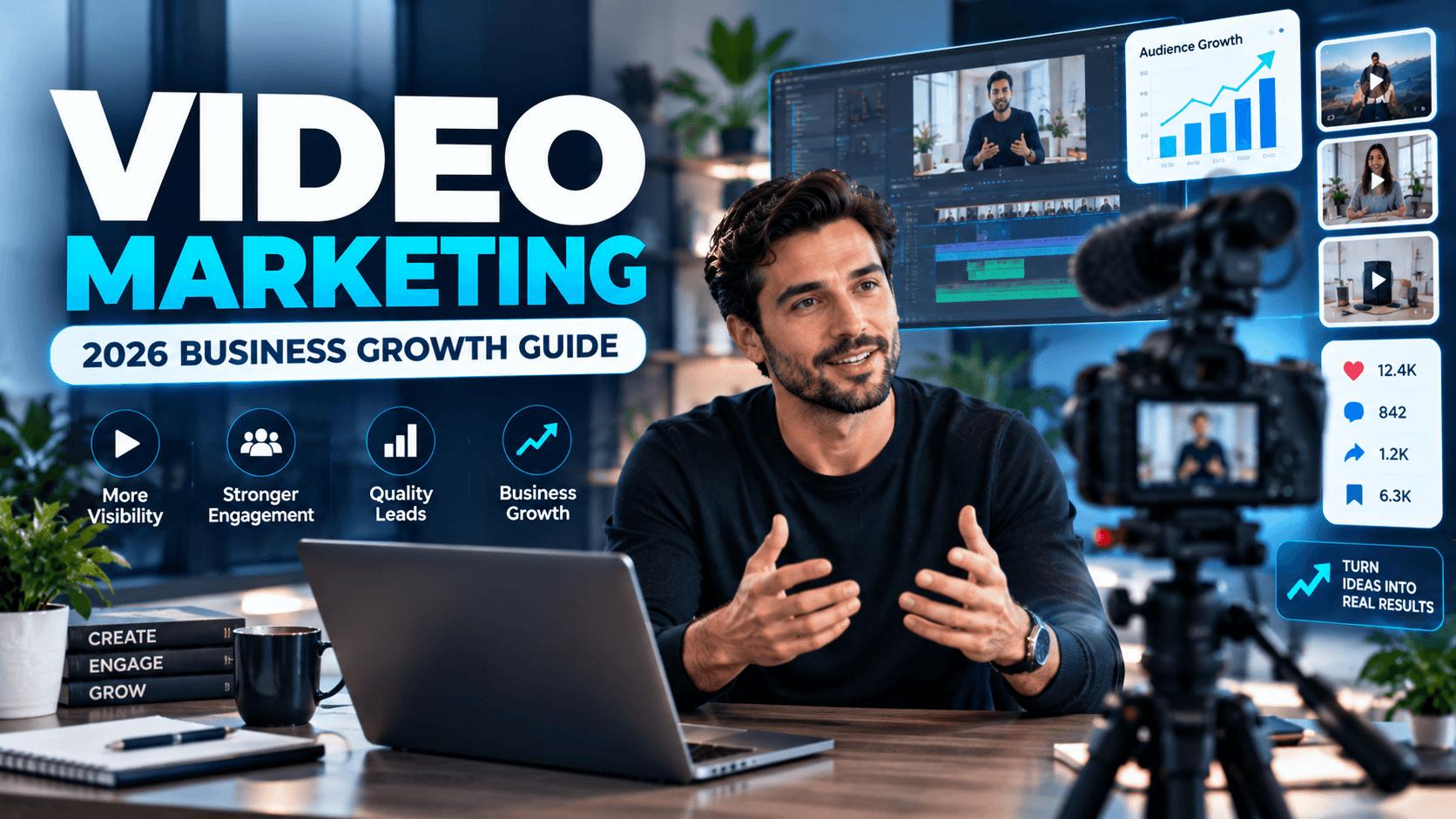
Video Marketing in 2026: How Businesses Can Use Video to Grow Online
Video has become one of the most powerful ways for businesses to communicate online. Learn how a strong video marketing strategy can build trust, increase engagement and create more opportunities for business growth.


People don't just search for businesses anymore—they watch them.
From short social media videos to product demonstrations and customer stories, video has become an important part of how audiences discover, understand and evaluate brands.
For businesses, this creates a major opportunity.
A well-planned video marketing strategy can communicate an idea faster than a long piece of text while giving potential customers a better sense of the people, products and services behind a brand.
What Is Video Marketing?
Video marketing is the use of video content to promote a business, communicate with customers and achieve specific marketing goals.
Businesses can create different types of videos depending on their audience and objectives, including:
- Short-form social media videos
- Product demonstrations
- Service explainers
- Customer testimonials
- Educational videos
- Brand videos
- Promotional campaigns
- Behind-the-scenes content
The goal isn't simply to produce more videos.
It's to create useful and engaging content that supports the customer journey.
Why Video Marketing Matters in 2026
Online audiences are surrounded by content.
A business has only a short opportunity to capture attention and communicate its value.
Video can combine visuals, voice, movement and storytelling in one format, making it useful for explaining complicated ideas and creating emotional connections.
For businesses, video can also be adapted across multiple platforms, allowing one strong concept to support different marketing campaigns.
Video Can Build Customer Trust
Customers often want to know who they are buying from before making a decision.
Professional video can help businesses show their personality, expertise and real-world operations.
For example, a service business could create a short video explaining how its process works. A product company could demonstrate how a product is used. A professional service provider could answer common customer questions.
These videos can make a business feel more transparent and approachable.
Short-Form Video Is Powerful
Short-form video has become a major content format across social platforms.
Businesses don't necessarily need expensive productions for every campaign.
A simple, well-planned video with:
- A strong opening
- One clear message
- Useful information
- Good visuals
- A relevant call to action
can be more effective than a complicated video that tries to communicate too many ideas.
The key is clarity and relevance.
Video Can Support Lead Generation
Video marketing shouldn't stop at views.
The bigger business opportunity is turning attention into action.
A video can encourage viewers to:
- Visit a website
- Request a quote
- Book a consultation
- Contact the business
- Explore a product
- Subscribe to updates
- Make a purchase
A clear call to action helps connect video content with measurable business objectives.
Different Videos for Different Customer Stages
Not every customer needs the same message.
Awareness
Educational or entertaining videos can introduce your business to new audiences.
Consideration
Explainer videos, demonstrations and comparison content can help potential customers understand your offering.
Decision
Testimonials, case studies and product-focused videos can help build confidence before a purchase.
Retention
Tutorials, helpful tips and customer education can continue providing value after the sale.
This makes video useful throughout the customer journey, not just at the awareness stage.
Video Marketing for Small Businesses
Small businesses sometimes assume video marketing requires expensive equipment and large production teams.
That's not always the case.
A smartphone, good lighting, clear audio and strong creative planning can be enough for many types of content.
The most important investment is often the strategy behind the content.
Businesses should know:
- Who they are targeting
- What problem they are addressing
- What message they want to communicate
- Which platform they are targeting
- What action they want viewers to take
Create a Consistent Video Strategy
Posting one video and disappearing for several weeks rarely creates a strong content system.
Consistency helps businesses build recognition.
A practical strategy could include a combination of:
Educational Content + Promotional Content + Brand Stories + Customer-Focused Content
This gives audiences different reasons to continue engaging with the business.
Repurpose Your Video Content
One video can often become multiple pieces of content.
A longer educational video could be transformed into:
- Short social clips
- Quote graphics
- Blog content
- Email content
- Website sections
- FAQ videos
This allows businesses to get more value from the original creative investment.
Measure What Actually Matters
Views are useful, but they aren't the only metric.
Businesses should also consider:
- Watch time
- Engagement
- Website traffic
- Leads
- Enquiries
- Conversions
- Cost per result
The right metrics depend on the campaign objective.
A video with fewer views but several qualified enquiries may be more valuable than a viral video that generates no business results.
Final Thoughts
Video marketing has become an essential opportunity for businesses that want to compete for attention online.
The most successful strategy isn't necessarily about producing the biggest or most expensive videos.
It's about creating relevant content, communicating clearly and giving viewers a reason to take the next step.
In 2026, businesses that combine strong storytelling with a consistent video strategy can build greater trust, reach new audiences and turn digital attention into meaningful business growth.
FAQs
What is video marketing?
Video marketing uses video content to promote a business, educate audiences, build trust and generate customer actions.
Is video marketing useful for small businesses?
Yes. Small businesses can create effective videos using relatively simple equipment when the content has a clear strategy and purpose.
What type of videos should businesses create?
Businesses can use educational videos, product demonstrations, testimonials, promotional videos, explainers and short-form social content.
Can video marketing generate leads?
Yes. Videos can direct viewers toward websites, contact forms, consultations, bookings and other conversion actions.
How often should a business post videos?
There is no universal posting frequency. A consistent schedule that the business can maintain is generally more useful than posting frequently without a strategy.