AI Chatbot Development in 2026: How Businesses Can Improve Customer Support
Customers expect quick answers and easy communication. AI chatbots can help businesses respond instantly, capture leads and provide consistent customer support while reducing repetitive work.


Customers don't always contact businesses during working hours.
They may have questions early in the morning, late at night or while browsing a website during a busy day. If they cannot get an answer quickly, they may simply move to another business.
This is one reason AI chatbot development has become an important digital service in 2026.
Modern business chatbots can do much more than display simple predefined answers. When properly designed and integrated, they can help customers find information, answer common questions, qualify leads and guide visitors toward the next step.
What Is an AI Chatbot?
An AI chatbot is a software-based conversational system that interacts with customers through a website, application or messaging platform.
Instead of requiring a team member to manually answer every common question, a chatbot can handle routine conversations automatically.
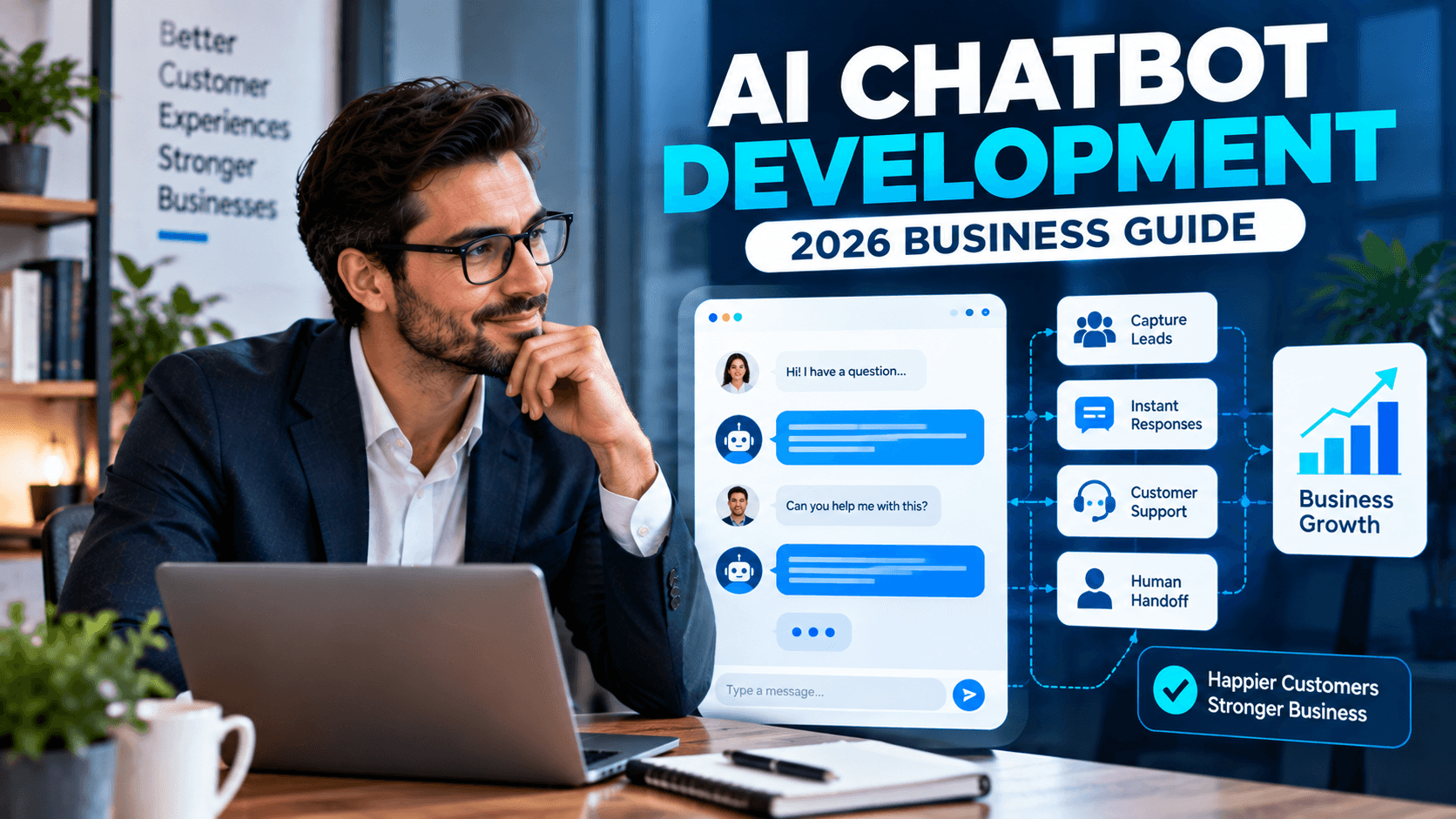
Depending on the business, a chatbot can help with:
- Frequently asked questions
- Product or service information
- Lead collection
- Appointment enquiries
- Customer support
- Basic troubleshooting
- Order or service guidance
- Business information
The goal isn't necessarily to replace human support.
The goal is to make customer communication faster and more efficient.
Why Businesses Need AI Chatbots in 2026
Customer expectations have changed.
People are accustomed to getting information quickly, and slow responses can create friction during the buying process.
An AI chatbot can provide an immediate first response, helping visitors continue their journey instead of waiting for an employee.
For businesses, this can also reduce the amount of time teams spend answering repetitive questions.
AI Chatbots Can Generate and Qualify Leads
One of the most valuable uses of a business chatbot is lead generation.
Instead of simply displaying a contact form, a chatbot can start a conversation with a website visitor.
For example, it might ask:
What service are you interested in?
Then:
When would you like to get started?
Based on the answers, the system can collect relevant information and pass qualified enquiries to the appropriate team.
This creates a more interactive lead-generation experience.
Improve Customer Support
Many customer questions are repetitive.
Customers may frequently ask about:
- Business hours
- Pricing information
- Services
- Delivery
- Booking procedures
- Locations
- Policies
A chatbot can handle many of these basic questions instantly.
When a conversation requires human expertise, the chatbot can guide the customer toward a human support representative.
This creates a useful combination:
AI for routine conversations + Humans for complex problems.
Chatbots Can Support Sales
An AI chatbot can also become part of the sales process.
A website visitor may be interested in a service but unsure which option is appropriate.
A well-designed chatbot can ask relevant questions, provide useful information and direct the visitor toward a consultation, product page, booking form or enquiry.
This can reduce the gap between website traffic and business opportunities.
The Importance of Chatbot Integration
Building a chatbot is only one part of the process.
The real value often comes from integrating it into the business's existing digital ecosystem.
Depending on the company's needs, chatbot integration can connect with:
- Business websites
- CRM systems
- Lead forms
- Booking systems
- Customer support workflows
- Email marketing
- Analytics platforms
When these systems work together, customer information can move more efficiently through the business.
What Makes a Good Business Chatbot?
A chatbot shouldn't feel complicated.
The best experiences usually have:
Clear Conversations
Customers should immediately understand what the chatbot can help with.
Useful Responses
Answers should be relevant and easy to understand instead of unnecessarily long.
Human Handoff
Customers should have a clear path to human assistance when needed.
Mobile-Friendly Design
Many website visitors use smartphones, so the chatbot experience should work smoothly on smaller screens.
Business-Specific Knowledge
A chatbot should be built around the company's actual services, products, policies and customer questions.
Don't Automate Everything
More automation doesn't always mean a better customer experience.
If a customer is dealing with a complex issue, forcing them through an automated conversation can create frustration.
Businesses should identify where automation genuinely adds value and where human interaction is more appropriate.
A successful chatbot strategy focuses on helpfulness rather than automation for its own sake.
How Businesses Can Get Started
Businesses interested in AI chatbot development can start with a simple process:
- Identify the most common customer questions.
- Define what the chatbot should and shouldn't handle.
- Create useful conversation flows.
- Connect relevant business systems.
- Test conversations with real scenarios.
- Provide a clear human-support option.
- Track conversations and improve the experience over time.
Starting with a focused chatbot is often better than launching an overly complicated system.
Final Thoughts
AI chatbots are becoming an important part of modern customer communication.
For businesses, they can provide faster responses, support lead generation, reduce repetitive work and create more convenient customer experiences.
But technology alone isn't enough.
A successful chatbot needs good strategy, useful information, thoughtful conversation design and the right integrations.
In 2026, businesses that use AI to make customer interactions easier—not simply more automated—can create a stronger digital experience and more efficient customer journey.
FAQs
What is AI chatbot development?
AI chatbot development involves designing and building conversational systems that can interact with customers and assist with specific business tasks.
Can an AI chatbot generate leads?
Yes. Chatbots can ask qualifying questions, collect customer information and guide potential customers toward an enquiry or sales action.
Can chatbots replace customer support teams?
Not completely. Chatbots are most effective when they handle routine questions while human teams manage complex or sensitive issues.
Can an AI chatbot be added to an existing website?
Yes. Chatbots can be integrated into many existing business websites and connected with other digital systems depending on technical requirements.
Is AI chatbot development useful for small businesses?
Yes. Small businesses can use chatbots to provide faster responses, handle common questions and capture enquiries without requiring staff to respond manually to every visitor.