
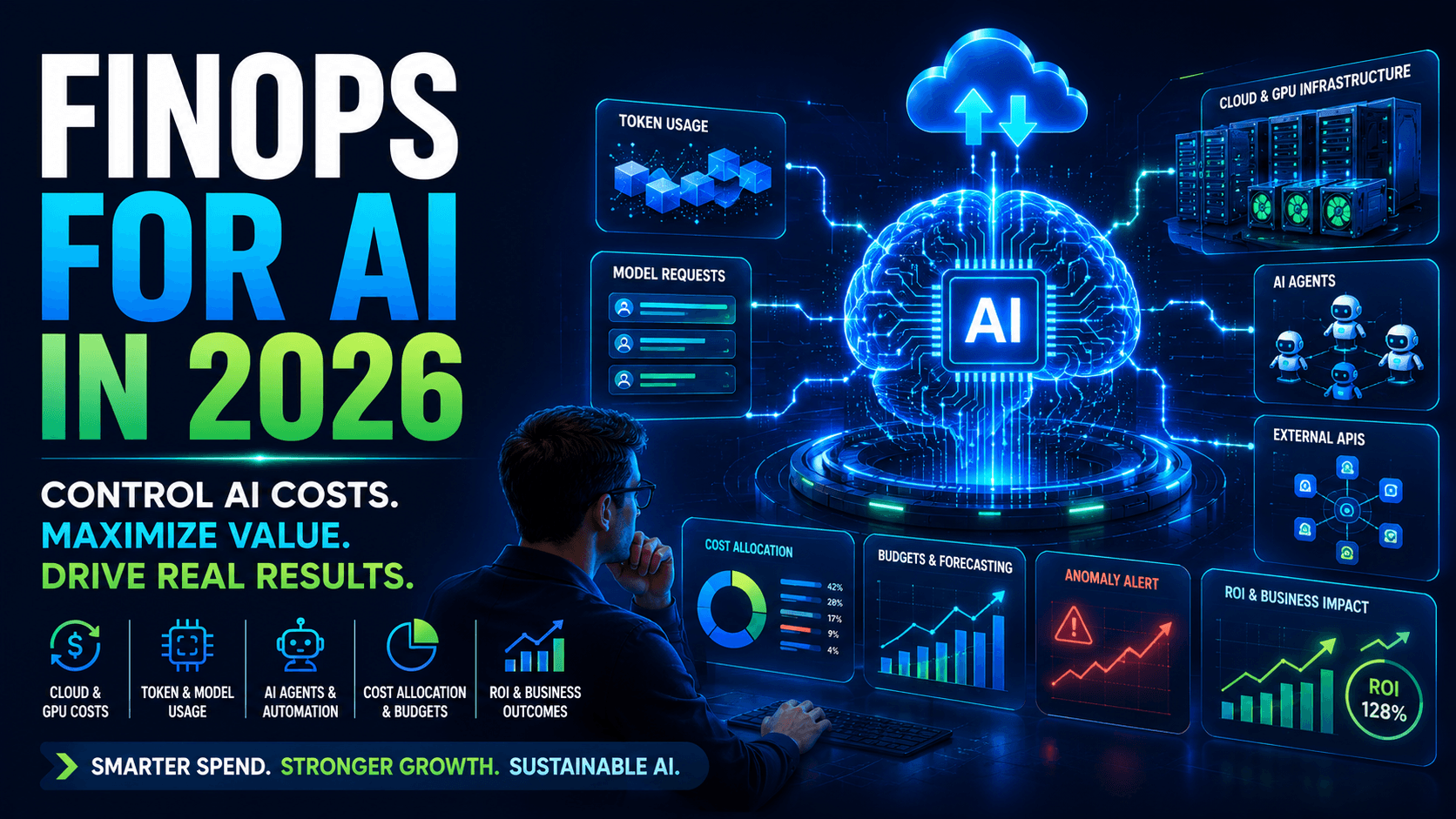
FinOps for AI in 2026: How Businesses Can Control Cloud, GPU and Token Costs
AI applications can become expensive after moving from a small pilot to full production. Learn how FinOps helps businesses control costs without slowing innovation.
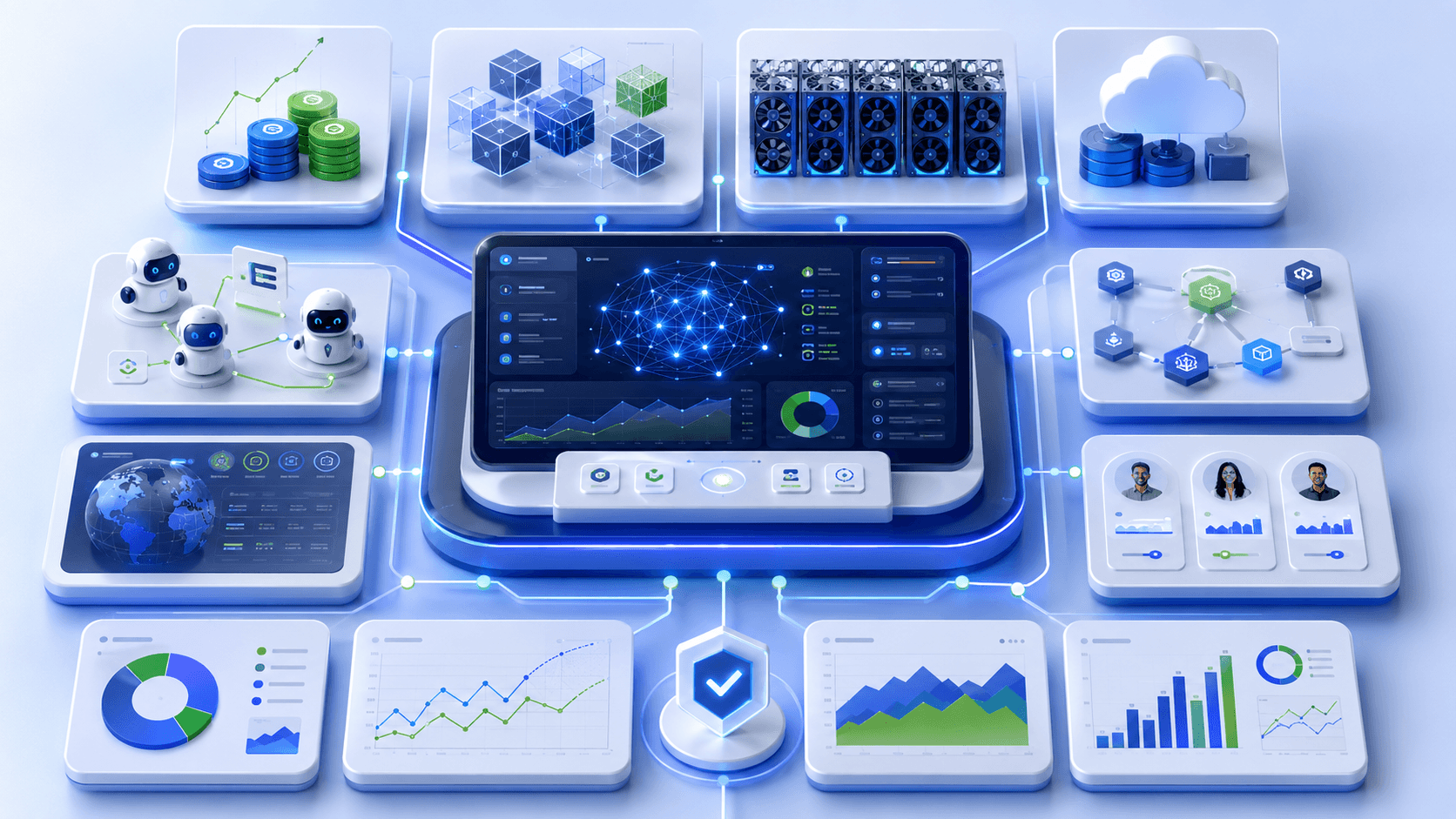

Artificial intelligence is moving from experimentation into everyday business operations.
Companies are deploying customer-service assistants, document-analysis systems, recommendation engines, predictive models and autonomous agents. These systems can improve productivity and create valuable customer experiences, but they also introduce a new financial challenge.
AI spending does not always behave like traditional software spending.
A conventional software subscription may have a predictable monthly price. An AI application may generate costs according to tokens, model requests, GPU hours, storage, retrieval, external tools and the number of steps completed by an agent.
A successful pilot used by twenty employees may appear affordable. When the same system is opened to thousands of customers, the monthly bill may grow far faster than expected.
This is why FinOps for AI has become an important business priority.
The FinOps Foundation’s 2026 industry survey found that 98% of respondents now manage AI spending, compared with 31% only two years earlier. AI cost management was also identified as the leading skill that FinOps teams need to develop.
At Arrowhead DigiTech, we help businesses design AI and cloud systems that are measurable, scalable and connected to real business outcomes—not simply exciting technology demonstrations.
What Is FinOps?
FinOps is a collaborative practice that brings finance, engineering, operations, product teams and business leaders together to manage the value of technology investments.
It is sometimes described as cloud financial operations, but the discipline has expanded beyond public-cloud billing.
Modern FinOps can cover:
- Artificial intelligence
- Cloud infrastructure
- SaaS subscriptions
- Software licensing
- Private cloud
- Data centres
- Technology labour
- External APIs
The objective is not simply to reduce every technology bill.
The objective is to make informed decisions about where technology creates value, where resources are being wasted and which investments should be expanded or redesigned.
The FinOps Foundation’s 2026 findings show that the discipline is shifting from reactive cost reduction toward wider technology-value management and executive decision-making.
Why AI Costs Are Different
AI costs can vary according to both technical design and user behaviour.
A business may pay for:
- Input tokens
- Output tokens
- Model requests
- GPU or accelerator hours
- Model training
- Fine-tuning
- Data preparation
- Vector databases
- Document retrieval
- Cloud storage
- Network transfers
- Monitoring
- Security controls
- External agent tools
- Human review
The cost of one interaction may also depend on its complexity.
A simple classification request may require a short prompt and one model response. An autonomous agent may analyse the request, search several systems, call external tools, verify the result and retry failed steps.
One customer request can therefore trigger many billable events.
FinOps guidance for AI recommends tracking metrics such as token usage, API requests, GPU allocation, cost per inference and business return rather than relying only on the final monthly cloud invoice.
The Pilot-to-Production Cost Gap
Many AI projects begin as small proofs of concept.
During a pilot, the team may focus mainly on whether the model can perform the required task. Usage remains limited, promotional cloud credits may cover some expenses and developers manually review most results.
The economics can change significantly after production deployment.
Production systems may require:
- Higher request volumes
- Faster response times
- Continuous availability
- Additional security
- Backup infrastructure
- Customer support
- Logging and monitoring
- Compliance records
- Human escalation
- Several model providers
A project that appears inexpensive during experimentation may become difficult to sustain at scale.
The FinOps Foundation recommends estimating AI costs throughout development, pilot and production stages while balancing cost, model quality and performance.
Businesses should therefore create realistic usage scenarios before launching broadly.
These scenarios may include expected users, requests per customer, tokens per interaction, agent steps, storage growth and human-review requirements.
The Hidden Costs of AI Applications
Data Preparation
AI systems depend on usable information.
Businesses may need to clean records, remove duplicates, label examples, convert documents, improve metadata and establish access permissions.
These activities require software, infrastructure and employee time.
Retrieval Infrastructure
A business AI assistant may use retrieval-augmented generation to search approved documents before responding.
This can introduce costs for:
- Document processing
- Embedding generation
- Vector storage
- Search requests
- Re-indexing
- Permission management
The model invoice represents only one part of the complete application.
Monitoring and Evaluation
Production AI should be monitored for accuracy, security, model drift, unsafe outputs and unexpected behaviour.
Evaluation systems, logs, dashboards and human reviewers add operational costs, but they are necessary for reliable deployment.
Security and Compliance
Sensitive AI workflows may require encryption, private networking, access controls, audit trails, data masking and region-specific infrastructure.
The FinOps Foundation notes that privacy, security, retention and regulatory requirements should be included when estimating the total cost of AI systems.
Agent Tool Usage
An AI agent may call search systems, databases, CRM platforms, email services and paid third-party APIs.
Each tool can have its own pricing model.
Without controls, the cost of external tool usage may exceed the cost of the primary AI model.
Human Oversight
Important outputs may require employees to verify recommendations or approve actions.
Human-review time should be treated as part of the operating cost rather than ignored because it does not appear on the cloud invoice.
What Should Businesses Measure?
Cost Per AI Interaction
This measures the total operating cost divided by the number of AI interactions.
It provides a useful starting point, but businesses should define what qualifies as an interaction.
A single interaction may contain multiple model calls and agent steps.
Cost Per Inference
Cost per inference measures how much the business spends each time a model processes an input and generates an output.
The FinOps Foundation recommends this metric for production applications such as chatbots, recommendation engines and image-analysis systems.
Cost Per Token
Token-based models commonly charge according to the amount of information processed and generated.
Tracking input and output tokens helps identify:
- Excessively long prompts
- Large conversation histories
- Repeated instructions
- Unnecessary output
- Expensive customer journeys
Cost Per Successful Outcome
A cheaper interaction is not valuable when it fails to complete the customer’s task.
Businesses should connect spending with outcomes such as:
- Customer issue resolved
- Appointment booked
- Qualified lead generated
- Report completed
- Fraudulent transaction detected
- Employee hour saved
This creates stronger AI unit economics than measuring requests alone.
GPU Utilisation
Businesses operating hosted or private models should monitor whether expensive GPU capacity is actively being used.
Provisioned hardware that remains idle for long periods can create substantial waste.
Resource utilisation efficiency compares actual usage with provisioned capacity and helps teams evaluate autoscaling and hardware allocation.
Cost Per Agent Task
Agentic systems should track the complete cost of completing a task, including:
- Planning calls
- Model inference
- Tool requests
- Retries
- Delegated agents
- External APIs
- Human approval
A low-cost individual model call can still become an expensive workflow when the agent performs too many steps.
AI Return on Investment
AI ROI compares the financial or operational benefits produced by the system with its total cost.
Benefits may include increased revenue, fewer support hours, reduced processing time or lower error rates.
The FinOps Foundation emphasises connecting AI spending with measurable business value rather than treating usage growth as success by itself.
How Businesses Can Control AI Costs
1. Assign Every AI Workload an Owner
Each AI application should have a named technical and business owner.
The owner should understand:
- Why the application exists
- Which team uses it
- What data it processes
- How much it costs
- Which outcome it should improve
- Who approves expansion
Unowned AI projects can continue consuming resources even when their business value is unclear.
2. Tag and Allocate AI Spending
Cloud resources, APIs, models and datasets should be tagged or mapped to the relevant team, product, customer or project.
Useful allocation fields may include:
- Department
- Application
- Environment
- Customer
- Model provider
- Business owner
- Cost centre
- Production status
Shared infrastructure should be allocated through an agreed method instead of remaining in one unidentified central bill.
3. Establish Budgets and Quotas
Budgets should be created before production deployment.
Controls may include:
- Monthly application budget
- Team-level token allowance
- Cost per customer limit
- Maximum requests per minute
- Agent tool-call limit
- GPU usage quota
- Daily anomaly threshold
A budget alert received after an unexpected bill is useful for reporting but too late for prevention.
High-volume systems may need real-time controls capable of slowing, rerouting or pausing activity.
4. Use the Right Model for the Task
The most advanced model is not automatically the best choice for every request.
Simple tasks such as classification, extraction, formatting or basic summarisation may be completed by smaller and less expensive models.
More powerful models can be reserved for tasks requiring advanced reasoning or higher quality.
Model routing can evaluate the request and direct it to the least expensive model capable of meeting the required quality.
This should be supported by testing rather than based only on price.
5. Reduce Unnecessary Context
Long prompts and conversation histories increase token usage.
Applications should send the model only the information required for the current task.
Teams can reduce unnecessary context through:
- Prompt cleanup
- Conversation summarisation
- Relevant-document retrieval
- Output-length limits
- Removal of duplicated instructions
- Structured data extraction
The objective is to reduce cost without removing information required for an accurate answer.
6. Cache Repeated Results
Some AI systems repeatedly process similar or identical requests.
Caching can reuse approved results instead of calling the model again.
Suitable use cases may include:
- Product descriptions
- Policy explanations
- Common support questions
- Document embeddings
- Repeated classification
- Standard summaries
Cached information should be refreshed when the underlying data changes.
7. Limit Agent Loops
Autonomous agents may retry tasks, call several tools or delegate work repeatedly.
Businesses should establish:
- Maximum steps
- Retry limits
- Time limits
- Spending limits
- Tool restrictions
- Human approval points
An agent should not continue consuming resources indefinitely because it cannot complete a task.
8. Optimise GPU Infrastructure
Organisations operating their own models should monitor idle capacity, memory usage, queue time and workload scheduling.
Possible improvements include:
- Autoscaling
- Right-sized instances
- Shared GPU pools
- Batch processing
- Scheduled shutdown
- Quantised models
- More efficient inference engines
Long-term infrastructure commitments should normally be considered only after usage patterns become sufficiently stable.
9. Manage Data Retention
Training datasets, prompts, outputs, logs and model checkpoints can produce significant storage costs.
Businesses should define:
- What must be retained
- Why it must be retained
- How long it is needed
- Who can access it
- When it should be archived
- When it should be deleted
Retention should reflect security, business and regulatory requirements.
10. Detect Spending Anomalies
Anomaly detection can identify sudden changes caused by:
- Application errors
- Agent loops
- Abusive usage
- Stolen API keys
- Traffic spikes
- Configuration mistakes
- Model-routing failures
Alerts should be connected to a person or team that has authority to investigate and contain the problem.
Cost, Quality and Speed Must Be Balanced
Selecting the cheapest model may reduce the invoice while increasing errors, customer frustration or human-review work.
Selecting the most expensive model for every task may deliver excellent outputs but make the application financially unsustainable.
AI architecture usually requires balancing three factors:
- Cost
- Quality
- Performance
The FinOps Foundation’s AI cost-estimation guidance describes these factors as an interconnected set that should be evaluated together.
Businesses should test several model and infrastructure options using realistic workloads.
The final decision should be based on total business value—not only the lowest price per token.
Standardising Technology Cost Data With FOCUS
Businesses using several cloud, SaaS, AI and infrastructure providers may receive billing data in different formats.
This makes comparison and allocation difficult.
The FinOps Open Cost and Usage Specification, known as FOCUS, provides a standard format for normalising technology billing information across cloud, AI, SaaS and data-centre providers.
FOCUS version 1.4 was ratified on 4 June 2026. The release expanded invoice, billing-period and commitment data to support more consistent reconciliation and cross-provider cost analysis.
A common cost model can help businesses:
- Compare providers
- Combine billing datasets
- Allocate shared expenses
- Reconcile invoices
- Evaluate commitments
- Build unified dashboards
FOCUS does not automatically optimise spending.
It improves the quality and consistency of the information used to make decisions.
Shift AI Cost Decisions Left
Cost management should begin during design—not after deployment.
The 2026 State of FinOps findings identify earlier financial visibility and pre-deployment architecture guidance as important priorities.
Before launching an AI feature, developers and business leaders should estimate:
- Expected users
- Requests per user
- Tokens per request
- Model mix
- Agent steps
- Tool usage
- Storage growth
- Human-review effort
- Peak demand
- Compliance requirements
These estimates will not be perfect.
Their purpose is to identify major cost drivers and create realistic limits before customers begin using the application.
AI FinOps for Small Businesses
Small businesses do not need a large FinOps department before managing AI costs.
A practical starting approach can include:
- One owner for each AI tool
- A monthly AI budget
- Usage dashboards
- Application-level API keys
- Token and request limits
- Model comparison
- Monthly value review
- Alerts for unusual spending
The business should also review paid AI subscriptions.
Several departments may purchase overlapping tools that perform similar tasks.
Consolidating approved platforms may reduce cost, improve security and simplify employee training.
Common AI Cost Management Mistakes
Measuring Only the Model Invoice
Data, storage, APIs, security and human review may represent a significant part of the total cost.
Starting Governance After Production
Cost ownership, budgets and monitoring should be designed before broad deployment.
Using One Model for Every Task
Different tasks may require different levels of model quality and cost.
Ignoring Agent Retries
A single customer request may produce several hidden model and tool calls.
Optimising Cost Without Measuring Quality
Lower cost is not an improvement when errors and customer complaints increase.
Buying Long-Term Capacity Too Early
Commitment discounts may create waste when usage remains uncertain.
Treating More AI Usage as More Business Value
Usage should be connected with revenue, productivity, customer outcomes or risk reduction.
What Arrowhead DigiTech Is Doing
At Arrowhead DigiTech, we help businesses build AI and cloud systems with financial visibility built into the architecture.
Our approach includes:
AI Cost Assessments
We review current models, APIs, cloud infrastructure, SaaS platforms and supporting data systems.
AI Usage and Cost Dashboards
We help businesses track tokens, model requests, tool calls, GPU usage, application costs and business outcomes.
Model Selection and Routing
We evaluate different models and route tasks according to quality, speed, privacy and cost requirements.
AI Agent Cost Controls
We implement step limits, tool restrictions, budgets, retry controls and human approval for expensive or high-impact actions.
Cloud Cost Optimisation
We identify idle resources, oversized infrastructure, unnecessary storage and inefficient deployment patterns.
Application-Level Cost Allocation
We connect technology spending with departments, products, customers and business owners.
AI Architecture and Development
We build AI assistants, automation workflows and custom applications designed for scalable production use.
FinOps Governance
We establish ownership, budgets, approval processes, forecasting and regular value reviews.
Continuous Optimisation
We use production data to improve prompts, caching, infrastructure, retrieval and model selection.
Our objective is not simply to make AI cheaper.
We help businesses spend the right amount on systems that produce measurable and sustainable value.
A Practical AI FinOps Roadmap
Businesses can introduce AI FinOps through five stages.
Stage One: Discover
Identify AI applications, models, providers, owners and total costs.
Stage Two: Allocate
Connect spending with teams, products, customers and business outcomes.
Stage Three: Control
Implement budgets, quotas, anomaly alerts and agent limits.
Stage Four: Optimise
Improve model selection, prompts, caching, data and infrastructure.
Stage Five: Measure Value
Compare total AI cost with revenue, productivity, customer experience and risk reduction.
This phased approach allows businesses to improve cost control without blocking useful AI experimentation.
Final Thoughts
AI can create real competitive advantages, but an application that cannot operate economically will be difficult to scale.
Businesses need visibility into more than the price of one model call.
They need to understand tokens, requests, GPU capacity, storage, external tools, monitoring, compliance and human oversight.
The 2026 State of FinOps report shows that AI spending management has become a normal responsibility rather than a specialist concern. Almost every surveyed organisation now manages AI expenditure, while AI value management has become a leading capability requirement.
FinOps gives businesses a structured way to connect technical usage with financial responsibility and measurable outcomes.
Arrowhead DigiTech helps organisations establish this foundation through AI cost assessments, cloud optimisation, usage dashboards, secure automation and scalable application development.
The most important question is not:
“How much does this AI model cost?”
It is:
“How much business value does the complete AI system produce for every dollar we spend?”
Frequently Asked Questions
What is FinOps for AI?
FinOps for AI is the practice of bringing finance, engineering and business teams together to manage the cost and value of AI applications and infrastructure.
Why are AI costs difficult to predict?
Costs may depend on tokens, requests, GPU usage, agent steps, external APIs, storage and changing user demand.
What is cost per inference?
Cost per inference is the average cost of processing one model request and producing its output.
Should businesses always use smaller AI models?
No. The model should be selected according to the quality, speed, privacy and cost required by the task.
How can businesses control AI-agent costs?
They can implement maximum steps, retry limits, tool restrictions, budgets, usage monitoring and human approval points.
What is FOCUS?
FOCUS is an open specification that standardises technology cost and usage data across multiple providers.
Can small businesses use FinOps?
Yes. Small businesses can begin with clear ownership, monthly budgets, application-level reporting and regular value reviews.
How can Arrowhead DigiTech help?
Arrowhead DigiTech provides AI cost assessments, dashboards, model optimisation, agent controls, cloud cost management and custom AI development.