
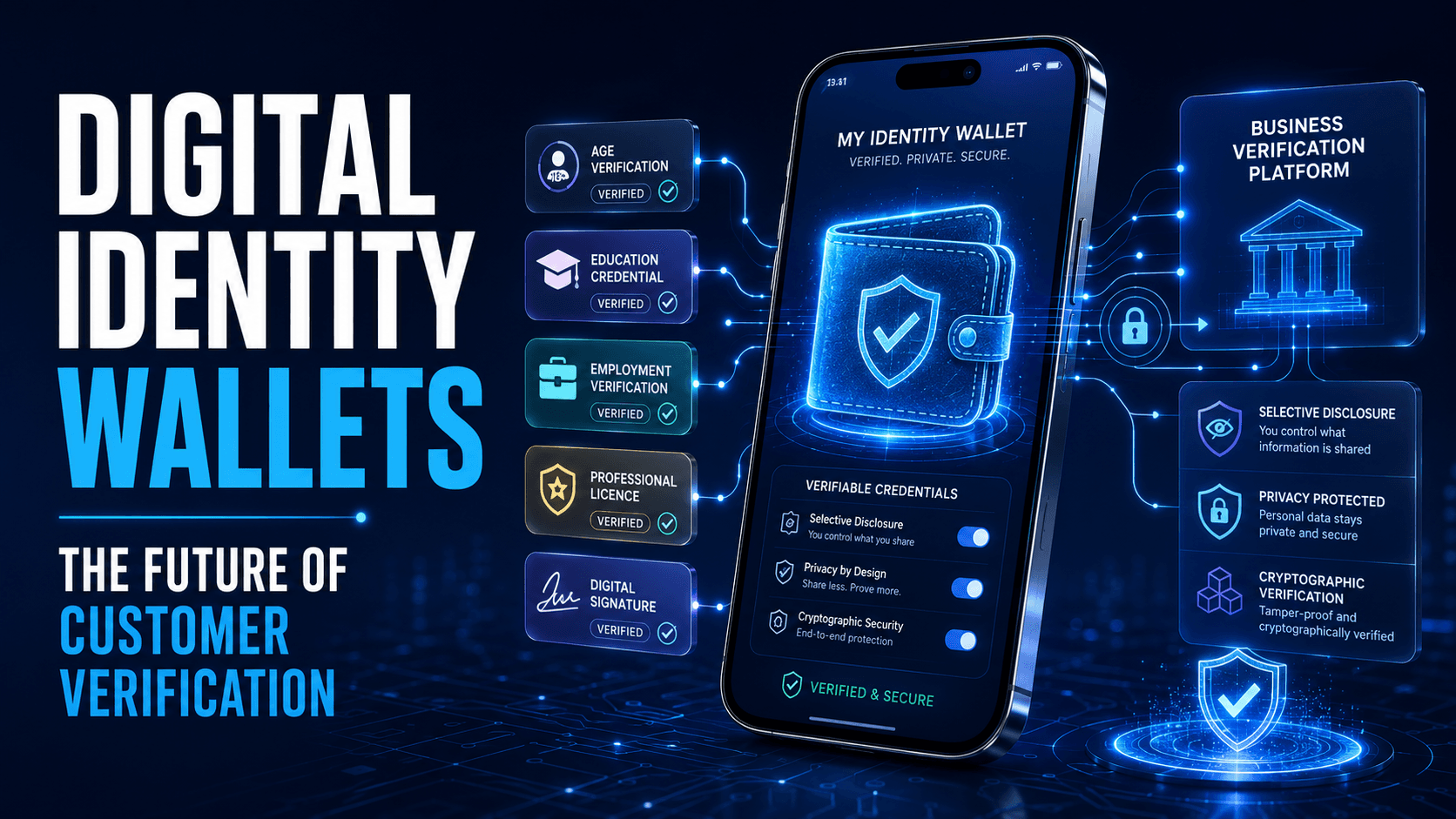
Digital Identity Wallets in 2026: How Businesses Should Prepare for Verifiable Credentials
Digital identity wallets are changing how customers prove who they are, share qualifications and access online services. Learn how businesses can prepare for wallet-based identity.
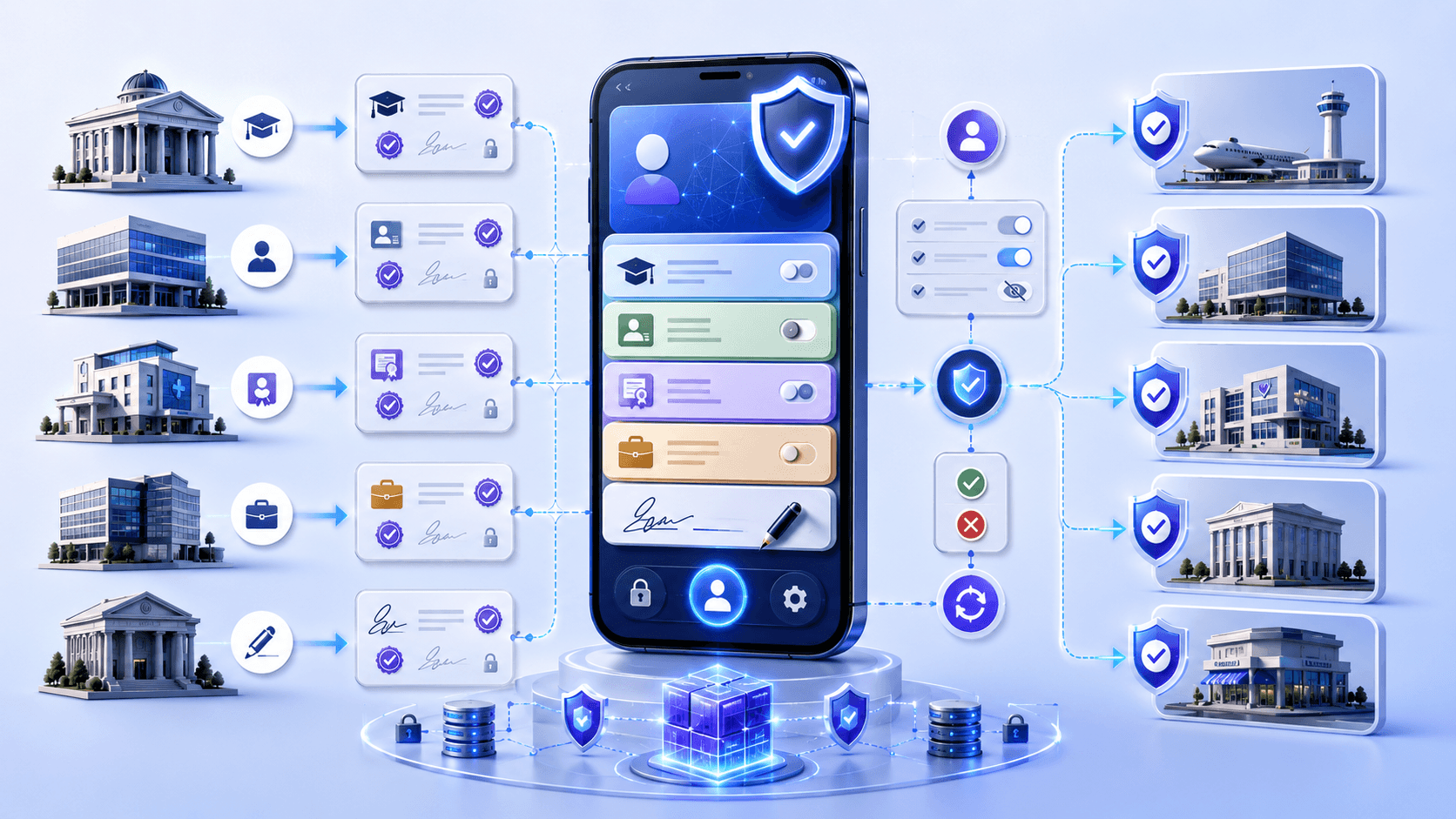

Businesses regularly ask customers to prove facts about themselves.
A bank may need to confirm identity and address. An employer may verify a qualification. An online retailer may need evidence that a customer meets an age requirement, while a healthcare platform may need to confirm insurance or professional credentials.
Today, these processes often depend on uploaded photographs, scanned documents, passwords, manual checks and disconnected identity-verification providers.
This creates friction for customers and significant work for businesses.
Documents can be altered. Customers may upload more personal information than the company actually needs. Employees may need to review files manually, and sensitive identity records may remain stored long after verification is complete.
Digital identity wallets offer a different approach.
Instead of repeatedly uploading complete documents, a customer can hold digitally signed credentials in a secure wallet and present only the information required for a particular transaction.
A customer may prove that they are over a required age without revealing their exact date of birth. A job applicant may prove that a recognised institution issued a qualification without sending a scanned certificate. A business representative may digitally prove their authority to sign a document.
This transition is becoming particularly important in 2026.
The European Digital Identity Framework requires EU Member States to provide European Digital Identity Wallets by the end of 2026. The wallets are intended to support secure identification, digital documents, signatures and cross-border access to public and private services.
At Arrowhead DigiTech, we help businesses prepare their websites, applications and customer-verification systems for secure, wallet-based digital identity.
What Is a Digital Identity Wallet?
A digital identity wallet is an application that allows a person or organisation to securely store, manage and present digital identity information.
Depending on the wallet and jurisdiction, it may hold:
- Personal identification information
- Driving licences
- Educational qualifications
- Professional licences
- Employment credentials
- Medical or insurance information
- Payment-related credentials
- Business-authority records
- Digital signatures
The wallet is not simply a folder containing photographs of physical documents.
A properly designed wallet holds credentials that can be cryptographically verified.
The business receiving the credential can check whether it came from an authorised issuer and whether its contents have been modified.
The EU Digital Identity Wallet is designed to allow users to identify themselves, store digital documents and prove specific attributes across EU Member States while controlling which information they share.
What Is a Verifiable Credential?
A verifiable credential is a digitally signed collection of claims made by an authorised issuer.
For example:
- A university issues a digital degree.
- A government issues a digital driving licence.
- A professional body issues a certification.
- An employer issues an employment credential.
- A financial institution confirms an account relationship.
The credential can later be presented to a business that needs to verify the information.
The World Wide Web Consortium published the Verifiable Credentials 2.0 family as official Web Standards in May 2025. The standards define credentials that are cryptographically secure, machine-verifiable and capable of supporting privacy-preserving presentation.
A verifiable credential generally involves three roles.
Issuer
The issuer creates and signs the credential.
A university, government agency, employer, bank or professional organisation may act as an issuer.
Holder
The holder receives and stores the credential in a wallet.
The holder may be a customer, employee, student, contractor or business representative.
Verifier
The verifier requests and validates the credential.
A verifier may be a bank, employer, website, e-commerce store, healthcare provider or government service.
The EU Digital Identity Framework commonly refers to organisations requesting wallet information as wallet-relying parties.
Why 2026 Is an Important Year
Digital identity wallets have existed in different forms for several years, but 2026 represents a major transition toward wider adoption and cross-border interoperability.
EU Member States must provide at least one compliant wallet by the end of 2026. These wallets are intended to be recognised across the European Union, although using a wallet will remain voluntary for users. Certain public and private services will be required to recognise them.
The European Commission has also adopted implementation rules covering important areas such as:
- Wallet protocols and interfaces
- Credential issuance and verification
- Credential revocation and suspension
- Relying-party registration
- Wallet certification
- Security breaches
- Cross-border identity matching
- Remote user onboarding
In July 2026, the Commission confirmed the adoption of Implementing Regulation (EU) 2026/1731, updating several technical requirements required for interoperable wallets and relying-party communication.
At the wider international level, standards organisations are also working to harmonise digital credential exchange.
The OpenID Foundation established a new working group in June 2026 to develop a harmonised request protocol supporting different credential formats, including mobile-document credentials and selectively disclosable credentials.
These developments suggest that digital identity wallets are moving from isolated pilot projects toward practical business infrastructure.
Digital Wallets vs. Password Managers
A password manager stores login credentials such as usernames, passwords and passkeys.
An identity wallet stores digitally verifiable claims about a person or organisation.
A password manager may help a customer sign in.
An identity wallet may help the customer prove:
- Who they are
- That they are above a certain age
- That they hold a valid licence
- That they completed a qualification
- That they represent a registered company
- That they are authorised to complete a transaction
The two technologies can work together.
A customer may use a passkey to authenticate to their wallet and then present a verified credential to the business.
Identity Verification vs. Authentication
Identity verification confirms who a person is.
Authentication confirms that the returning user is the same authorised person or account.
A business may perform identity verification when a customer first opens an account.
The customer may then use a passkey, biometric or wallet-based credential to authenticate during future visits.
Businesses should avoid requesting full identity documentation every time a customer signs in.
A better architecture separates initial identity proofing from routine authentication.
NIST’s current Digital Identity Guidelines organise identity systems around identity proofing, authentication and federation, helping organisations select controls according to the assurance required by a particular service.
What Is Selective Disclosure?
Selective disclosure allows a wallet holder to share only the information required for a transaction.
Imagine an online business needs to confirm that a customer is over eighteen.
A traditional process may require the customer to upload an identity document containing:
- Full name
- Photograph
- Date of birth
- Document number
- Home address
- Nationality
The company may not need most of that information.
With selective disclosure, the wallet may provide a verified statement confirming only that the customer meets the age requirement.
The customer does not need to reveal their exact date of birth or complete identity document.
The W3C Verifiable Credentials 2.0 standards support presenting a subset of credential information and combining claims from several credentials when required.
This approach can support the principle of data minimisation: collecting only the information necessary for a defined purpose.
How Businesses Can Use Digital Identity Wallets
Customer Account Opening
Financial, insurance, telecom and marketplace businesses often need to verify identity before creating an account.
A wallet-based process may allow customers to present verified information without manually typing the same information into multiple forms.
This can reduce:
- Data-entry errors
- Document uploads
- Manual review
- Abandoned applications
- Fraud involving altered documents
The business must still determine which checks and records are required under applicable laws.
Age Verification
Retailers, gaming platforms, streaming services and other age-restricted services may need to confirm that customers meet a minimum age.
A wallet can provide an age-related credential without revealing unnecessary personal details.
The system should request only the minimum proof required and avoid storing the complete credential when a simple verification result is sufficient.
Recruitment and Qualification Verification
Employers frequently receive CVs, scanned certificates and professional qualifications that require manual verification.
Digital credentials can allow an employer to confirm:
- Qualification issuer
- Course or certification
- Completion status
- Issue date
- Expiration date
- Revocation status
This can help reduce qualification fraud and shorten recruitment processes.
Employee and Contractor Onboarding
Businesses can issue digital credentials to employees and contractors.
These credentials may represent:
- Employment status
- Department
- Job role
- Training completion
- Building-access eligibility
- System-access eligibility
- Temporary project authority
A credential can be suspended or revoked when the employee changes roles or leaves the organisation.
Healthcare Services
Healthcare wallets may support the controlled presentation of insurance coverage, professional licences, prescriptions or patient identity.
Healthcare implementations require particularly careful privacy, security and legal review.
A wallet should not automatically expose a complete medical history when a provider needs only one specific claim.
Banking and Financial Services
Digital wallets may support identity verification, loan applications, account access, transaction authorisation and contract signing.
The European Commission identifies banking, loan applications and payment initiation among the expected wallet use cases.
Financial businesses should integrate wallet verification with existing fraud detection, sanctions screening, risk assessment and regulatory processes.
Education
Universities and training organisations can issue verifiable qualifications.
Students can present these credentials to:
- Employers
- Other universities
- Professional bodies
- Scholarship providers
- Government agencies
Credential verification can take place automatically without contacting the original institution for every request.
Travel and Mobility
Digital identity wallets may support driving licences, travel credentials, rental eligibility and transport services.
A car-rental company may need proof of a valid licence and minimum age without collecting every detail contained on a physical identity document.
Digital Contracts
Wallets can support electronic signatures and seals.
Customers and authorised company representatives may sign digital documents while providing stronger evidence about identity and signing authority.
Business-to-Business Verification
Digital identity is not limited to individual consumers.
A business wallet or organisational credential may prove:
- Legal business identity
- Registration status
- Representative authority
- Tax information
- Professional licence
- Procurement eligibility
- Signing authority
The European Commission has also proposed a separate European Business Wallet framework intended to reduce administrative burdens and support trusted cross-border business identification.
Benefits for Businesses
Faster Customer Onboarding
Verified digital information can reduce repetitive form completion and document review.
Lower Fraud Risk
Cryptographically signed credentials are more difficult to modify than scanned documents.
However, businesses must still verify the issuer, credential status and holder relationship.
Reduced Data Storage
A company may be able to store a verification result rather than a complete identity document.
This can reduce the volume of sensitive information exposed during a security incident.
Improved Customer Experience
Customers can reuse credentials rather than completing a full identity process for every new service.
Cross-Border Verification
Common standards can help businesses recognise credentials issued in another participating jurisdiction.
Automated Verification
Credential validity, signatures and status can be checked through software instead of entirely manual review.
Stronger Auditability
The business can record which credential was requested, when it was verified and which decision followed.
Audit records should avoid unnecessarily storing the full personal information presented.
Becoming a Wallet-Relying Party
A business that requests or verifies information from a digital identity wallet acts as a relying party or verifier.
This role creates several responsibilities.
The business should clearly define:
- Why the credential is required
- Which attributes are necessary
- How the information will be used
- How long it will be retained
- Which system will verify it
- Which employees can access the result
- What happens when verification fails
The European Digital Identity implementation framework includes national registration rules for wallet-relying parties and specifications for communication between wallets and relying-party services.
Businesses serving EU customers should review whether registration, notification or acceptance requirements apply to their service.
Digital Credential Verification
A credential should not be accepted simply because it appears inside a wallet interface.
The verification process should check:
- Issuer authenticity
- Digital signature
- Credential integrity
- Expiration date
- Revocation or suspension status
- Intended credential holder
- Approved credential type
- Required assurance level
The W3C Verifiable Credentials framework uses cryptographic proofs to help verifiers confirm that a credential came from the stated issuer and has not been altered.
A business should also maintain a policy explaining which issuers and credential types it accepts.
Credential Lifecycle Management
Digital credentials change over time.
A professional licence may expire. An employee may leave a company. A driving licence may be suspended, or a qualification may be corrected.
A production identity system needs to support:
- Credential issuance
- Renewal
- Expiration
- Suspension
- Revocation
- Replacement
- Verification history
The EU implementation framework includes technical requirements for credential issuance, verification, revocation and suspension.
Businesses should avoid accepting credentials based only on the date they were originally issued.
Where appropriate, the system should verify their current status.
Main Security and Privacy Risks
Requesting Excessive Information
A business may request a complete identity credential when it needs only one attribute.
Each wallet workflow should apply data minimisation.
Fake Issuers
Attackers may create credentials that appear professional but were not issued by a trusted organisation.
Businesses need approved issuer lists and proper signature verification.
Credential Replay
A valid credential presentation may be captured and reused.
Verification protocols should bind the presentation to the current transaction, verifier or session where appropriate.
Lost or Compromised Devices
A mobile device containing a wallet may be lost or stolen.
Wallet providers should protect access using strong local authentication and support secure recovery or suspension.
Weak Account Recovery
An attacker may attempt to take control of a wallet through its recovery process.
Recovery should not become easier to attack than the wallet itself.
Incorrect Revocation Checking
An expired or revoked credential may continue to be accepted when status checks are not implemented correctly.
Cross-Customer Data Exposure
Identity information from one customer must never appear in another customer’s account, logs or verification workflow.
Untrusted Wallet Applications
Businesses should distinguish recognised or certified wallets from unknown applications.
The EU framework includes certification requirements and a machine-readable list of certified wallet solutions.
Oversharing by Users
Customers may approve a request without understanding how much information is being disclosed.
Businesses should design clear, purpose-specific requests and avoid vague permission screens.
Vendor Lock-In
A company may build its identity process around one proprietary provider or credential format.
Open standards and modular integration can make future changes easier.
What Businesses Should Do Now
1. Identify Verification Workflows
List every process that asks customers or employees to prove identity or attributes.
Examples include:
- Account opening
- Age checks
- Recruitment
- Licence verification
- Contract signing
- Employee onboarding
- Supplier approval
2. Determine the Minimum Required Information
For each workflow, document exactly which facts the business needs.
Do not request a full identity document when a yes-or-no attribute is sufficient.
3. Classify the Risk
A newsletter registration does not require the same identity assurance as opening a financial account.
Assign controls based on the consequences of accepting the wrong person or credential.
4. Review Existing Identity Providers
Determine whether current onboarding and authentication providers plan to support digital wallets and verifiable credentials.
5. Design a Verifier Architecture
Plan how the business will:
- Request credentials
- Validate signatures
- Check status
- Record consent
- Return an approval or rejection
- Protect verification data
- Handle technical failures
6. Create an Issuer Trust Policy
Define which credential issuers and credential types are acceptable.
The business should not accept every digitally signed credential automatically.
7. Plan Relying-Party Registration
Businesses operating in the EU should review relevant wallet-relying-party registration and notification requirements.
8. Integrate Wallets With Existing Systems
Wallet verification may need to connect with:
- CRM platforms
- Customer portals
- Recruitment systems
- E-commerce stores
- Identity and access management
- Compliance systems
- Mobile applications
9. Protect Verification Logs
Logs should support audits without storing unnecessary credential contents.
Access to identity logs should be restricted and monitored.
10. Create a Manual Review Process
Not every credential will verify successfully.
Businesses need a secure alternative process for customers who cannot use a wallet or whose credential requires investigation.
11. Test Accessibility and User Experience
Wallet requests should clearly explain:
- What information is requested
- Why it is required
- Who will receive it
- Whether it will be stored
- What happens after approval
12. Begin With a Controlled Pilot
Start with one focused use case, such as employee qualification verification or age confirmation.
Measure completion rate, verification errors, customer satisfaction and operating cost before expanding.
What Small Businesses Should Understand
Small businesses do not need to become identity issuers or build a complete wallet platform immediately.
Many can begin as verifiers.
A small business may use a supported verification provider to confirm:
- Customer age
- Professional certification
- Employee training
- Business registration
- Signing authority
The business should still understand which information it requests and how the provider handles that data.
Using a third party does not remove responsibility for customer privacy or access control.
Common Digital Identity Wallet Mistakes
Treating the Wallet as a Document Upload Tool
The value comes from cryptographic verification and selective disclosure—not simply storing document images.
Collecting Complete Credentials
Request only the attributes required for the transaction.
Ignoring Credential Status
Credentials may expire, be suspended or be revoked.
Using Wallet Verification Without Strong Authentication
The system should confirm that the person presenting the credential is the authorised holder where the use case requires it.
Depending on One Format
Credential standards and wallet ecosystems continue to develop.
Modular architecture reduces unnecessary technical dependency.
Having No Failure Process
Customers need an alternative when a wallet, device or credential cannot be used.
Storing Too Much Data
Businesses should evaluate whether they need to retain the credential or only the verification outcome.
Confusing Verification With Trust
A credential may be technically valid but issued by an organisation the business does not trust.
What Arrowhead DigiTech Is Doing
At Arrowhead DigiTech, we help businesses modernise identity verification and customer onboarding.
Digital Identity Readiness Assessments
We review existing account creation, authentication, onboarding and document-verification processes.
Wallet-Relying-Party Integration
We connect websites and applications with supported digital identity and credential-verification services.
Verifiable Credential Platforms
We develop systems that can issue, manage and verify approved digital credentials.
Customer Onboarding Automation
We streamline customer forms, document checks, approval workflows and CRM updates.
Selective Disclosure Design
We help businesses request only the minimum information required for each transaction.
Passkey and Passwordless Authentication
We integrate stronger authentication methods with customer and workforce applications.
API and System Integration
We connect identity workflows with CRM, HR, healthcare, education, financial and e-commerce platforms.
Credential Lifecycle Management
We build processes for credential issuance, renewal, expiration, suspension and revocation.
Security and Privacy Controls
We implement access restrictions, encryption, audit logs, data-retention controls and monitoring.
Mobile and Web Application Development
We create customer-facing applications capable of supporting secure wallet-based interactions.
Our objective is not to collect more identity information.
We help businesses verify the right information while storing less sensitive customer data.
A Practical Implementation Roadmap
Stage One: Discovery
Identify customer, workforce and business-verification processes.
Stage Two: Data Minimisation
Define the smallest set of attributes required for each process.
Stage Three: Architecture
Select credential formats, verification services, trust policies and integration points.
Stage Four: Pilot
Implement one controlled wallet-verification workflow.
Stage Five: Scale and Governance
Expand use cases while maintaining security, accessibility, monitoring and credential-lifecycle controls.
Final Thoughts
Digital identity wallets are changing how people and businesses prove facts online.
Instead of repeatedly uploading complete identity documents, users can present digitally signed credentials and disclose only the information required for a particular service.
The European Digital Identity Wallet launch planned for the end of 2026 is likely to accelerate this transition across banking, employment, education, healthcare, travel and public services.
International standards are also becoming more mature.
W3C Verifiable Credentials 2.0 provides a common model for issuing and verifying credentials, while OpenID and other standards organisations are working to harmonise how credentials are requested and presented across wallets and platforms.
Businesses should begin by reviewing where they request identity documents, which information they genuinely need and how wallet-based verification could reduce customer friction and data exposure.
Arrowhead DigiTech helps organisations prepare through identity assessments, credential verification, secure onboarding, API integration, passkeys and custom software development.
The future of digital identity is not about asking customers to share everything.
It is about allowing them to prove exactly what is required—and nothing more.
Frequently Asked Questions
What is a digital identity wallet?
A digital identity wallet is an application that stores and presents verified identity information and digital credentials.
What is a verifiable credential?
A verifiable credential is a digitally signed set of claims issued by an authorised organisation and independently checked by a verifier.
When will EU Digital Identity Wallets become available?
EU Member States are required to provide compliant wallets by the end of 2026.
Will customers be required to use an EU Digital Identity Wallet?
No. Use of the wallet is intended to remain voluntary for users, although certain services will be required to recognise it.
What is selective disclosure?
Selective disclosure allows a user to share only selected information from a credential instead of revealing the complete document.
Can a digital wallet replace passwords?
It can support passwordless authentication and identity verification, but implementation depends on the service and required level of assurance.
Do businesses need to store the complete credential?
Not always. In many workflows, storing the verification result may be sufficient, subject to legal and operational requirements.
How can Arrowhead DigiTech help?
Arrowhead DigiTech provides identity readiness assessments, wallet integration, credential platforms, onboarding automation, passkeys, API integration and secure application development.