
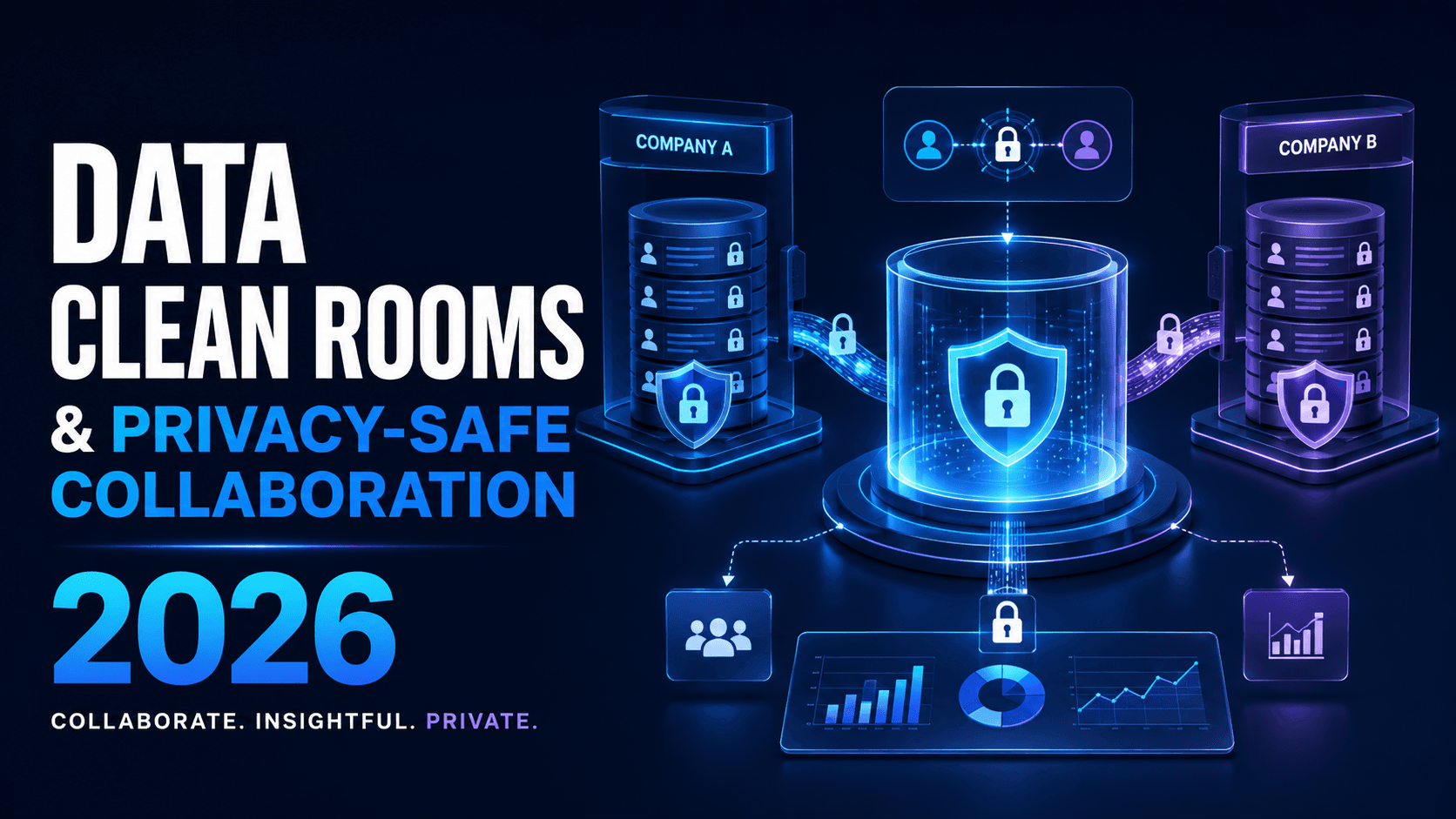
Data Clean Rooms in 2026: How Businesses Can Collaborate Without Sharing Raw Customer Data
Businesses need deeper customer insights, but directly sharing sensitive records creates privacy and security risks. Data clean rooms offer a more controlled way to collaborate.

Businesses increasingly need to collaborate with retailers, advertising platforms, suppliers, healthcare partners and technology providers.
A retailer may want to help a brand understand whether an advertising campaign produced in-store sales. Two healthcare organisations may want to analyse wider trends without exchanging complete patient records. A financial company may want to identify fraud patterns across several datasets.
The traditional approach involves copying information from one organisation to another.
That approach can create significant privacy, security and governance risks.
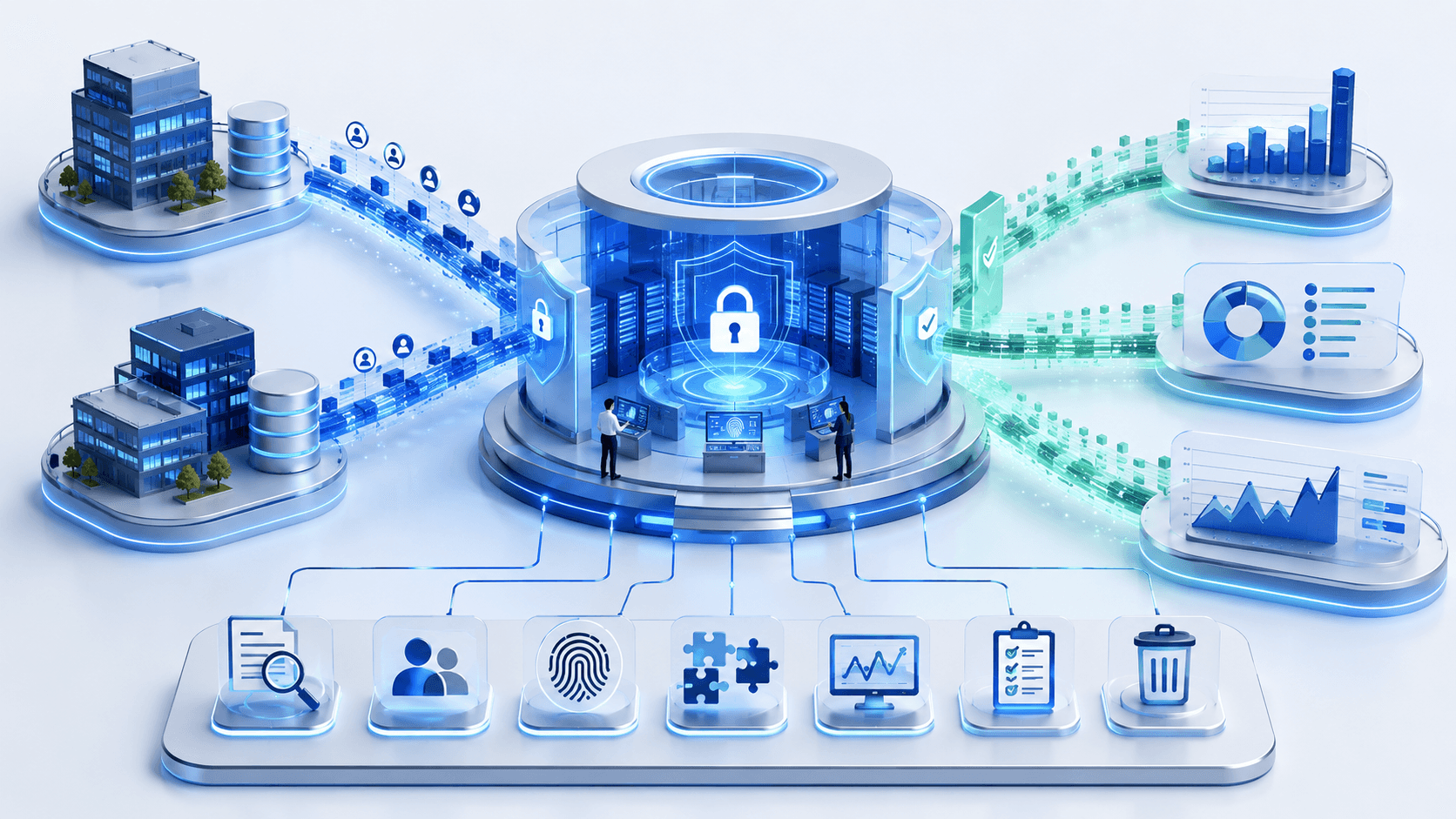
A data clean room provides a more controlled environment in which approved parties can analyse combined or connected datasets without giving every participant direct access to the other organisation’s underlying raw information.
AWS describes its Clean Rooms service as enabling companies to analyse collective datasets without revealing or copying the underlying data between participants.
In 2026, this technology is becoming increasingly relevant as organisations depend more heavily on first-party data while facing stronger expectations around privacy, security and responsible information use.
At Arrowhead DigiTech, we help businesses organise their data, connect approved platforms and develop secure analytics environments that produce useful insights without creating uncontrolled data exposure.
What Is a Data Clean Room?
A data clean room is a protected digital environment designed for controlled data collaboration.
Participating organisations define:
- Which datasets can be used
- Who can run an analysis
- Which queries are permitted
- What level of output can be returned
- Whether individual-level records can be viewed
- How results are monitored and approved
The participating companies may connect customer, transaction, advertising or operational information while applying controls intended to prevent one party from freely downloading the other party’s raw records.
The Interactive Advertising Bureau describes data clean rooms as secure environments used for analytics, measurement, campaign planning and data collaboration while maintaining privacy and security controls.
A clean room is therefore not simply another shared database.
It is a governed collaboration environment with technical and organisational restrictions around how data may be analysed.
Why Data Clean Rooms Matter in 2026
Businesses are attempting to understand customers across increasingly fragmented digital journeys.
A customer may see an advertisement on one platform, research a product elsewhere, visit a physical store and complete the purchase through another channel.
No single organisation may hold the complete journey.
At the same time, companies cannot responsibly combine customer records without considering consent, contractual restrictions, privacy laws and security.
Data clean rooms can help organisations produce aggregated insights without transferring unrestricted copies of their datasets.
AWS expanded Clean Rooms during 2026 with more detailed monitoring for collaboration queries and support for remote Apache Iceberg catalogues, allowing organisations to work with broader data environments while retaining controlled collaboration.
Google’s Data Manager API also includes clean-room identifiers that connect advertiser and publisher relationships across supported clean-room providers. Its documentation was updated during 2026, demonstrating the growing integration of privacy-controlled collaboration into modern advertising infrastructure.
Important Business Use Cases
Marketing Performance Measurement
A brand may know which people received or interacted with an advertising campaign.
A retailer or commercial partner may know which products were purchased.
A clean room can help connect approved data so both parties can measure performance without freely exchanging their complete customer databases.
Possible insights include:
- Conversion rates
- Sales generated by campaigns
- Customer overlap
- Repeat-purchase patterns
- Channel performance
- Audience reach
Retailers and brands have used clean-room environments to support campaign planning, customer analysis and closed-loop advertising measurement.
Retail Media
Retail media networks allow retailers to use their customer and transaction information to support advertising campaigns.
Brands want to understand whether these campaigns generated meaningful results, while retailers need to protect commercially sensitive customer and sales information.
A data clean room can create controlled measurement processes between the retailer, advertiser and advertising platform.
Customer Overlap Analysis
Two businesses may want to understand how many customers they share without revealing complete customer lists.
A clean room can match protected identifiers and return an aggregated result.
This may help businesses evaluate:
- Partnership opportunities
- Market reach
- Audience duplication
- Loyalty programmes
- Cross-selling potential
Fraud Detection
Financial organisations, payment providers and marketplaces may observe different parts of fraudulent activity.
Controlled collaboration can help identify repeated patterns across organisations while limiting unnecessary disclosure of individual records.
Healthcare and Research
Healthcare providers and research organisations may need to analyse combined datasets.
A protected environment can help apply stronger controls around queries, access and outputs.
However, a clean room does not automatically make patient-data processing lawful or compliant. Healthcare projects require specialist security, privacy and legal review.
Product and Business Analytics
Businesses may collaborate with suppliers, distributors or franchise locations to study:
- Demand
- Inventory
- Regional performance
- Product quality
- Customer retention
- Supply-chain efficiency
A clean room can limit each participant to approved analysis rather than providing unrestricted access to all commercial information.
How a Data Clean Room Works
A typical clean-room workflow includes several stages.
Data Preparation
Each organisation identifies the information required for the collaboration.
The data may need to be:
- Cleaned
- Standardised
- Deduplicated
- Classified
- Hashed or encrypted
- Mapped to common identifiers
Poorly structured information can produce unreliable results even when the clean-room technology is secure.
Identity Matching
Participants may need to determine which records refer to the same customer, household or organisation.
Matching can use protected identifiers rather than directly displaying raw personal information.
Google’s Data Manager documentation includes requirements for hashing and encrypting clean-room-provided identity data for supported audience workflows.
Permission Configuration
Participants define which columns, queries and output types are permitted.
For example, a brand may be allowed to calculate total conversions but prevented from viewing every customer transaction.
Controlled Analysis
Approved queries run inside the protected environment.
The platform may enforce restrictions such as:
- Minimum audience size
- Aggregated results only
- Approved query templates
- Restricted joins
- Removal of direct identifiers
- Output review
Monitoring and Audit
The environment should record who performed each analysis, which information was used and what result was produced.
Detailed monitoring helps businesses investigate unusual behaviour and demonstrate that collaboration rules were followed.
Data Clean Rooms Do Not Make Data Anonymous Automatically
One of the most important misunderstandings is that placing information inside a clean room automatically removes every privacy obligation.
It does not.
The IAB warns that data clean rooms involve important compliance questions under US state privacy laws and that organisations must evaluate how information is collected, matched, processed and disclosed.
Data may still be personal or sensitive even when names and email addresses have been replaced with hashed identifiers.
Businesses should consider:
- Whether the data was collected lawfully
- Whether the proposed use matches customer expectations
- Whether consent is required
- Whether contracts permit collaboration
- Which organisation controls the processing
- How deletion requests are handled
- Whether individuals can be reidentified
- How long information is retained
A technical platform cannot replace privacy governance or qualified legal advice.
Clean Rooms Follow a Shared-Responsibility Model
The provider may secure the platform, but the participating businesses remain responsible for configuring appropriate controls.
AWS explains that customers must determine and configure the analysis and output restrictions that apply to their collaborations.
A business can still create risk by:
- Allowing overly broad queries
- Uploading unnecessary information
- Using weak identifiers
- Returning very small audience segments
- Providing excessive user access
- Keeping information longer than required
- Failing to review partner activity
Technology provides the control mechanisms.
The organisation must decide how those mechanisms should be used.
What Businesses Should Do Before Building a Clean Room
Begin With a Clear Business Question
Do not collect and connect large datasets simply because the technology is available.
Begin with a defined question such as:
- Did the advertising campaign generate sales?
- How much customer overlap exists?
- Which region produced the highest conversion rate?
- Are fraud patterns appearing across several partners?
A specific question makes it easier to determine which information is actually required.
Minimise the Data
Use only the fields needed for the approved analysis.
Avoid uploading complete customer profiles when aggregated transaction and campaign information is sufficient.
Identify Data Ownership
Document which organisation owns, controls or provides each dataset.
Each participant should understand its responsibilities before processing begins.
Define Permitted Queries
Participants should agree on:
- Approved analysis
- Prohibited analysis
- Minimum output size
- Available fields
- Export restrictions
- Review procedures
Establish Access Controls
Clean-room access should use:
- Named user accounts
- Multifactor authentication
- Role-based permissions
- Limited administrative access
- Activity logging
- Regular access reviews
Plan Retention and Deletion
The project should define how long datasets, identifiers, models and results will be retained.
AWS documentation notes that certain Clean Rooms ML datasets remain stored while the associated model remains active, making retention planning an important configuration responsibility.
Test With Limited Data
Begin with a small, controlled proof of concept.
This allows participants to review data quality, query restrictions, matching accuracy and output risk before expanding the collaboration.
Data Clean Rooms and Artificial Intelligence
Data clean rooms are also becoming relevant to collaborative AI and machine learning.
Organisations may want to build predictive models using information from several parties without transferring each participant’s complete raw dataset.
Potential use cases include:
- Conversion prediction
- Fraud detection
- Customer segmentation
- Demand forecasting
- Recommendation systems
- Research collaboration
However, machine-learning outputs can sometimes reveal information about the data used to create them.
Businesses should evaluate model privacy, output controls, minimum dataset sizes and the possibility of reconstruction or inference attacks.
Clean-room AI should therefore be combined with strong security, governance and model monitoring.
Data Clean Room vs. Customer Data Platform
A Customer Data Platform, or CDP, helps one organisation combine its own customer information into unified profiles.
A data clean room focuses more heavily on controlled collaboration between separate organisations or datasets.
A business may use both.
The CDP can organise first-party information, while the clean room can support approved analysis with external partners.
Data Clean Room vs. Data Warehouse
A data warehouse stores and analyses business information.
A clean room adds specialised controls for collaboration, query restrictions and output protection.
A standard warehouse may provide powerful analytics but may not offer the same protections against one participant seeing another participant’s underlying records.
Common Data Clean Room Mistakes
Treating the Clean Room as Automatic Compliance
Legal basis, consent, contracts and customer rights still require attention.
Uploading Too Much Information
More data increases exposure and management complexity.
Focusing Only on Technology
The project also requires business ownership, privacy review and partner agreements.
Allowing Small Output Groups
Very small aggregated groups may increase reidentification risk.
Ignoring Data Quality
Secure analysis of inaccurate information still produces inaccurate results.
Having No Success Metric
The collaboration should be connected to a defined business outcome.
Forgetting Ongoing Monitoring
Queries, participants and business requirements can change after launch.
What Arrowhead DigiTech Is Doing
At Arrowhead DigiTech, we help businesses create secure and practical data-collaboration environments.
Our approach includes:
Data Readiness Assessments
We review data quality, storage locations, identifiers, access and business objectives.
Privacy-Safe Architecture
We design cloud environments that limit unnecessary movement and exposure of sensitive information.
Clean Room Integration
We help connect business data with supported cloud and analytics platforms.
Identity and Data Matching
We develop controlled workflows for matching approved customer or organisational identifiers.
Role-Based Access
We implement access restrictions for business users, partners, analysts and administrators.
Query and Output Controls
We help businesses define which analysis can be performed and which results may be exported.
Analytics Dashboards
We convert approved clean-room results into understandable business and marketing reports.
AI and Machine Learning Integration
We help businesses evaluate privacy-controlled analytics and modelling opportunities.
Security Monitoring
We support access logging, query monitoring, alerts and regular permission reviews.
Data Governance
We establish ownership, retention, deletion and partner-management processes.
Our objective is not simply to create another central database.
We help businesses collaborate while maintaining stronger control over sensitive information and clearly connecting every analysis with a business purpose.
Final Thoughts
Businesses need information from multiple platforms and partners to understand customer journeys, campaign performance, fraud and operational trends.
However, copying sensitive customer records between organisations creates significant privacy and security concerns.
Data clean rooms offer a more controlled approach.
They allow approved analysis while restricting direct access to underlying data and limiting the type of results that participants can receive.
Technology providers continued expanding clean-room monitoring, integration and data-access capabilities during 2026, showing that privacy-safe collaboration is becoming part of mainstream cloud and marketing infrastructure.
A clean room is not a substitute for consent, contracts, security or privacy governance.
It is a technical foundation that can support those responsibilities when correctly designed and managed.
Arrowhead DigiTech helps businesses build this foundation through secure cloud architecture, data integration, controlled analytics, AI workflows and ongoing monitoring.
The future of customer analytics is not about giving every partner access to more data.
It is about creating useful insights while exposing less.
Frequently Asked Questions
What is a data clean room?
A data clean room is a protected environment where organisations can perform approved analysis across shared or connected datasets without freely exposing their underlying raw data.
Does a data clean room anonymise all customer information?
No. Hashed or protected identifiers may still be subject to privacy requirements, depending on the information, use and jurisdiction.
Are data clean rooms only for advertising?
No. They can also support retail, healthcare research, fraud prevention, supply chains and multi-company analytics.
Can small businesses use data clean rooms?
Yes, particularly when collaborating with retailers, marketplaces or business partners. The project should begin with a clearly defined and valuable use case.
Do data clean rooms guarantee legal compliance?
No. Businesses must still evaluate consent, contracts, data rights, retention and applicable privacy laws.
How can Arrowhead DigiTech help?
Arrowhead DigiTech provides data assessments, secure cloud architecture, clean-room integration, identity matching, access controls, analytics, AI integration and monitoring.