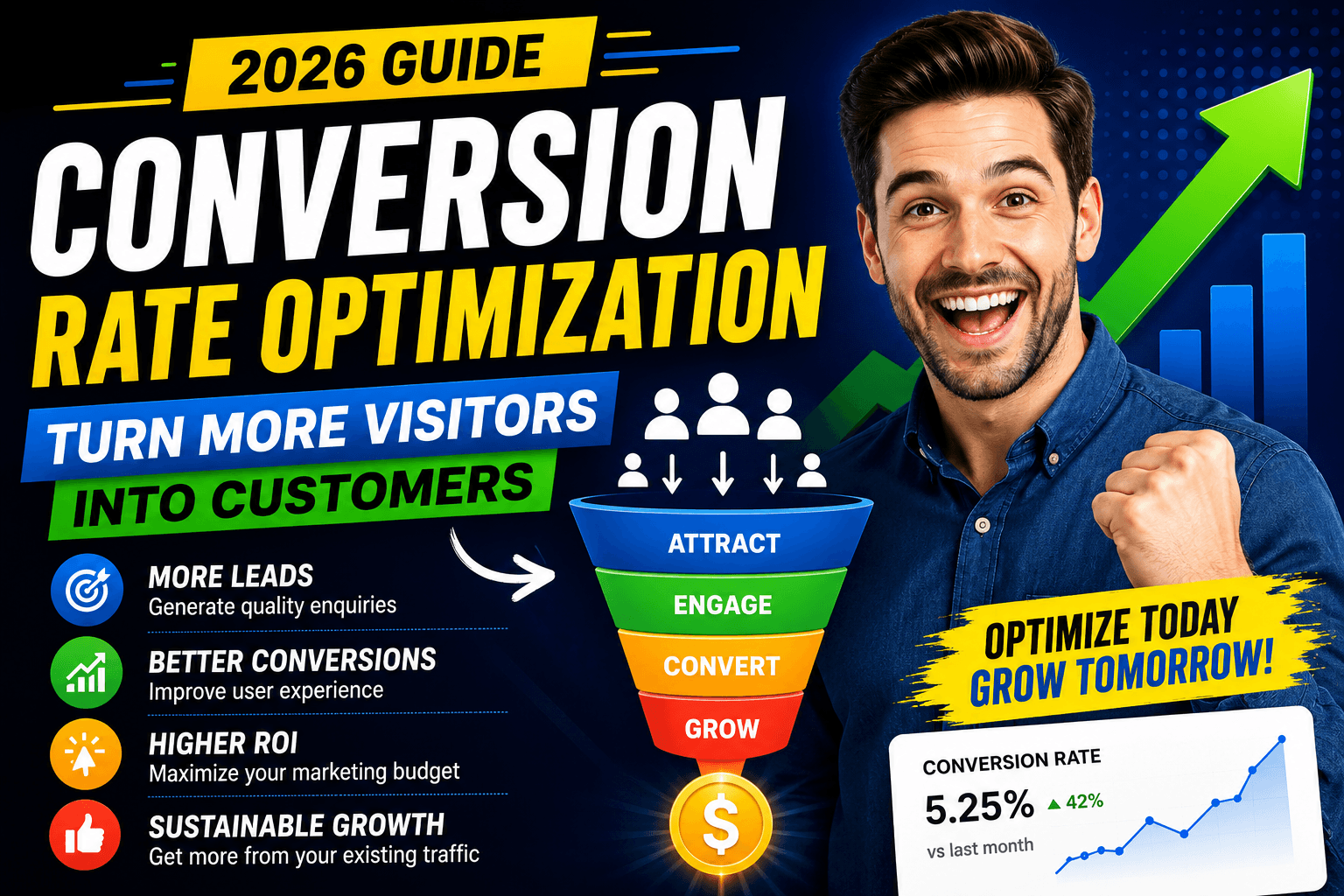
Conversion Rate Optimization in 2026: How to Turn More Website Visitors Into Customers
Getting more website traffic is only part of digital growth. Learn how conversion rate optimization can help businesses turn more visitors into leads, enquiries and customers without relying only on increasing traffic.

Getting people to visit your website is important.
But traffic alone does not grow a business.
If thousands of people visit your website but only a small percentage contact you, request a quote, book a service or make a purchase, there may be opportunities to improve the website experience.
This is where conversion rate optimization (CRO) becomes important.
Conversion rate optimization focuses on improving the website experience so that more visitors take meaningful actions.
Instead of simply asking:
“How can we get more visitors?”
Businesses should also ask:
“How can we get more value from the visitors we already have?”
In 2026, businesses are investing heavily in SEO, Google Ads, social media and other channels to bring traffic to their websites.
CRO helps make sure that traffic has a better opportunity to become real business.
What Is Conversion Rate Optimization?
Conversion rate optimization is the process of improving a website or landing page to increase the percentage of visitors who complete a desired action.
A conversion could be:
- Submitting a contact form
- Requesting a quote
- Booking an appointment
- Calling a business
- Purchasing a product
- Signing up for a service
- Downloading a resource
- Registering for an event
The exact conversion depends on the business.
For an e-commerce store, a purchase may be the primary conversion.
For a service company, a phone call or enquiry may be more valuable.
CRO is therefore not about one specific design technique.
It is about understanding what users need and removing unnecessary barriers between the visitor and the desired action.
Why CRO Matters for Businesses
Imagine two businesses receive the same amount of website traffic.
Business A: 10,000 visitors and 100 leads.
Business B: 10,000 visitors and 250 leads.
Business B is generating significantly more opportunities from the same amount of traffic.
This is why increasing traffic should not always be the first priority.
Improving the website's ability to convert existing visitors can also create substantial business value.
A strong CRO strategy can help businesses:
- Generate more leads
- Increase enquiries
- Improve sales
- Reduce wasted advertising spend
- Improve landing page performance
- Create better user experiences
- Get more value from existing traffic
CRO Is More Than Changing a Button
One common misunderstanding is that CRO simply means changing the color of a button.
In reality, conversion performance can be affected by many factors.
These include:
- Website speed
- Navigation
- Content
- Trust
- Pricing
- Page layout
- Forms
- Calls to action
- Mobile experience
- Images
- Customer reviews
- Value proposition
A successful CRO strategy looks at the complete customer journey rather than one isolated element.
Start With a Clear Conversion Goal
Before optimizing a website, businesses need to understand what they want visitors to do.
A page should have a clear purpose.
For example:
Service Page
Goal: Generate enquiries.
Product Page
Goal: Generate purchases.
Contact Page
Goal: Receive customer enquiries.
Landing Page
Goal: Generate leads from a specific marketing campaign.
Without a defined goal, it becomes difficult to determine whether a page is performing successfully.
Create a Strong Value Proposition
Visitors should quickly understand:
What do you offer?
Who is it for?
Why should they choose you?
A weak headline can force visitors to search through the page for basic information.
A strong value proposition communicates the core benefit quickly.
For example:
Instead of:
“Welcome to Our Digital Marketing Agency.”
A more focused message could be:
“Digital Marketing That Helps Businesses Generate More Qualified Leads.”
The second message communicates a clearer business outcome.
Improve Your Website's First Impression
Visitors often form an initial opinion about a website very quickly.
The first section of the page should therefore communicate the most important information.
A strong hero section can include:
- Clear headline
- Short supporting message
- Relevant visual
- Primary call to action
- Trust indicator
The goal is not to fill the screen with information.
The goal is to help visitors understand the business quickly.
Use Clear Calls to Action
A call to action tells visitors what they should do next.
Examples include:
- Request a Quote
- Book a Consultation
- Get Started
- Contact Us
- Schedule a Call
- Shop Now
- View Services
Calls to action should be easy to identify.
Visitors should not have to search the page to determine what action they can take.
Don't Give Visitors Too Many Choices
More options do not always create better experiences.
If a landing page contains:
- Five different buttons
- Multiple competing offers
- Several unrelated links
- Too many navigation options
- Long blocks of information
visitors may struggle to determine what they should do next.
A conversion-focused page should guide users toward a logical next step.
This does not mean removing all navigation.
It means prioritizing the actions that matter most.
Build Trust Before Asking for Action
Customers may hesitate to contact or purchase from a business they do not yet trust.
Trust signals can help reduce uncertainty.
Businesses can use:
- Customer reviews
- Testimonials
- Case studies
- Certifications
- Industry experience
- Client logos where appropriate
- Guarantees or clear policies
- Secure payment information
- Transparent contact details
Trust elements should support the decision rather than overwhelm the page.
Simplify Contact Forms
Long forms can create unnecessary friction.
If a business only needs a customer's:
- Name
- Phone
- Service requirement
there may be little reason to ask for many additional details at the first stage.
Shorter forms can make it easier for visitors to submit an enquiry.
However, the right form length depends on the business and the quality of information needed to qualify a lead.
The objective should be to collect useful information without creating unnecessary barriers.
Optimize Landing Pages
Landing pages are especially important for businesses running paid advertising campaigns.
A visitor who clicks a Google Ad should ideally reach a page that matches the advertisement.
For example:
Google Ad:
“Emergency Auto Body Repair in Atlanta”
Landing Page:
“Professional Auto Body Repair in Atlanta”
This creates consistency between the user's search, advertisement and website experience.
A strong landing page should focus on one primary objective.
Mobile Conversion Optimization
A website may look excellent on a desktop computer but still perform poorly on mobile devices.
Mobile users need:
- Easy-to-read text
- Clear buttons
- Simple navigation
- Fast loading
- Easy forms
- Convenient contact options
- Properly sized images
For local businesses, click-to-call functionality can also be particularly valuable.
Businesses should evaluate the complete mobile journey rather than simply checking whether the website technically fits the screen.
Website Speed Can Affect Conversions
Visitors expect websites to respond quickly.
If a page takes too long to load, users may leave before seeing the offer.
Performance optimization can include:
- Image optimization
- Efficient code
- Better hosting
- Caching
- Reduced unnecessary scripts
- Optimized fonts
- Efficient content delivery
Website performance is therefore both a technical and marketing consideration.
Write Content for Customer Questions
Visitors often have questions before taking action.
For example:
- How does the service work?
- How much does it cost?
- How long does it take?
- What is included?
- Do you serve my area?
- Why should I choose this business?
- What happens after I submit the form?
A good website should answer these questions before customers have to contact the business.
This can reduce uncertainty and help visitors make decisions.
Use Social Proof Strategically
Customer reviews can be powerful conversion elements.
But simply placing dozens of reviews on a page is not always the best approach.
Businesses should place relevant testimonials near important decision points.
For example:
Service → Customer Testimonial → Call to Action
This gives visitors supporting evidence at the moment they are considering taking action.
Use Analytics to Understand User Behaviour
CRO should be based on evidence whenever possible.
Businesses can analyze:
- Traffic sources
- Landing pages
- Conversion rates
- Form submissions
- Clicks
- Engagement
- Device usage
- Exit behaviour
- Customer journeys
Analytics can help identify pages where visitors are entering, leaving or failing to complete important actions.
Test Before Making Major Changes
Businesses should avoid making major website decisions based entirely on assumptions.
Testing can help determine which changes produce better results.
Businesses can experiment with:
- Headlines
- Images
- Calls to action
- Form layouts
- Page structures
- Offers
- Supporting content
A/B testing can be useful when enough traffic and conversions are available to produce meaningful comparisons.
Not every website will have enough traffic for statistically reliable testing, so qualitative research and analytics can also be valuable.
Don't Optimize Only for More Conversions
More conversions are not automatically better.
For example, a website could generate hundreds of low-quality leads that rarely become customers.
A better goal may be:
More qualified conversions.
Businesses should consider the quality of leads, not simply the number.
A successful CRO strategy should ultimately support business outcomes such as:
- Revenue
- Qualified leads
- Customer acquisition
- Bookings
- Sales
- Customer lifetime value
CRO and SEO Can Work Together
SEO brings organic visitors to a website.
CRO helps improve what happens after they arrive.
These two strategies can therefore complement each other.
For example:
SEO → More Relevant Traffic
CRO → More Visitors Taking Action
A business that invests in both can create a stronger digital growth strategy.
The same principle applies to Google Ads and social media advertising.
There is little value in generating large amounts of traffic if the website does not provide a clear path toward conversion.
CRO and Google Ads
Paid advertising makes every click valuable.
If a business pays to bring visitors to a landing page, improving conversion performance can potentially make the advertising investment more efficient.
For example:
1,000 visitors × 2% conversion rate = 20 conversions
Improving the conversion rate to:
1,000 visitors × 4% conversion rate = 40 conversions
The traffic remains the same.
The difference comes from improving the website experience.
Actual results vary significantly by industry, traffic quality and conversion definition, but the example illustrates why CRO matters.
Common CRO Mistakes
Changing Things Without Data
Random changes can make it difficult to know what actually improved performance.
Focusing Only on Design
A beautiful website can still have poor conversion performance.
Using Too Many CTAs
Multiple competing actions can confuse visitors.
Ignoring Mobile Users
A large percentage of visitors may interact with the website through mobile devices.
Making Forms Too Complicated
Unnecessary fields can create friction.
Hiding Important Information
Customers should not have to search for pricing, services, contact details or other important information.
Optimizing for Quantity Instead of Quality
More leads do not necessarily mean better business results.
A Practical CRO Strategy for 2026
Businesses can follow a simple process.
Step 1: Identify Your Goal
Define the primary conversion for each important page.
Step 2: Analyze Current Performance
Review analytics, traffic sources and existing conversion data.
Step 3: Identify Friction
Find areas where visitors may become confused, uncertain or frustrated.
Step 4: Prioritize Improvements
Focus on changes with the greatest potential business impact.
Step 5: Implement Changes
Improve messaging, UX, forms, CTAs, content and technical performance.
Step 6: Test
Use appropriate testing methods to evaluate changes.
Step 7: Measure Business Results
Look beyond clicks and track qualified leads, sales and revenue where possible.
Step 8: Keep Improving
CRO should be an ongoing process rather than a one-time project.
How Arrowhead DigiTech Can Help
At Arrowhead DigiTech, we help businesses improve the performance of their digital presence by combining design, development and digital marketing.
Our services include:
Website Development
We create modern websites designed around business objectives and customer needs.
UI/UX Optimization
We improve website structure, navigation and user journeys.
Landing Page Development
We create focused landing pages for services, products and marketing campaigns.
SEO
We help businesses attract relevant organic traffic through search optimization.
Google Ads
We develop paid search campaigns designed to reach relevant customers.
Conversion Optimization
We identify opportunities to improve website usability and encourage meaningful customer actions.
Analytics & Tracking
We help businesses understand how visitors interact with their websites and where improvements may be needed.
Our approach is simple:
Bring the right visitors. Give them the right experience. Make the next step clear.
A Simple CRO Framework
Businesses can think about conversion optimization through five stages:
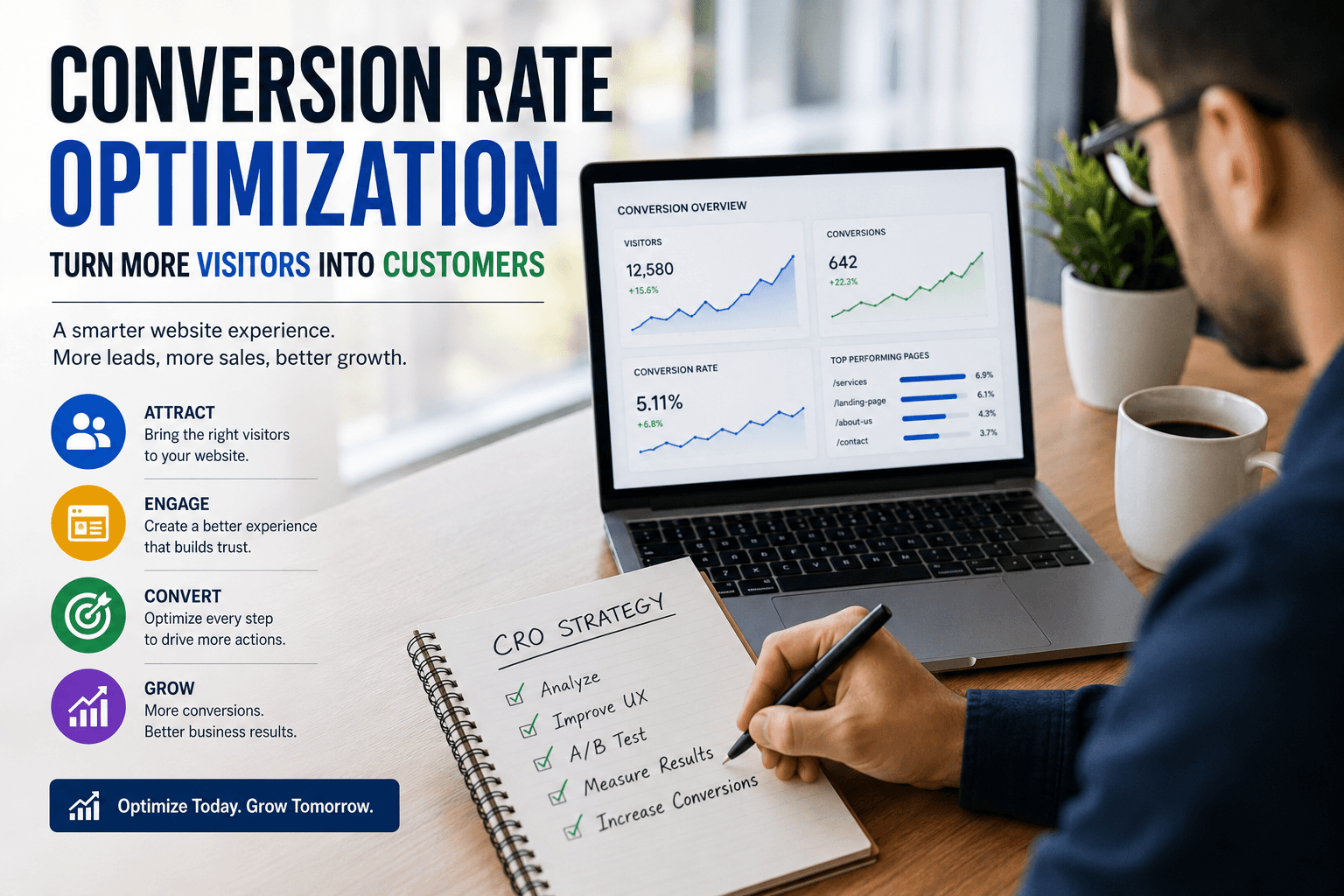
Attract → Understand → Trust → Act → Improve
Attract
Bring relevant visitors through SEO, Google Ads, social media and other channels.
Understand
Make it immediately clear what the business offers.
Trust
Provide evidence that the business is credible.
Act
Give visitors a clear and simple next step.
Improve
Use data and feedback to continuously optimize the experience.
Final Thoughts
Getting more website traffic is only one part of digital growth.
The bigger opportunity may be improving what happens after visitors arrive.
A clear value proposition, strong user experience, relevant content, effective calls to action, simple forms, trust signals and fast website performance can all contribute to better conversion experiences.
Businesses should also avoid treating CRO as a one-time redesign.
Customer expectations change.
Marketing campaigns change.
Products and services change.
Websites change.
That means conversion optimization should be an ongoing process of testing, learning and improving.
The goal is not simply to get more people onto your website.
The goal is to help more of the right visitors become customers.
Arrowhead DigiTech helps businesses build websites and digital marketing strategies focused on traffic, user experience, conversions and long-term growth.
Frequently Asked Questions
What is conversion rate optimization?
Conversion rate optimization is the process of improving a website or landing page to encourage a higher percentage of visitors to complete a desired action.
What counts as a website conversion?
A conversion can be a purchase, enquiry, phone call, booking, form submission, registration or another valuable customer action.
How can I increase my website conversion rate?
Businesses can improve conversions by strengthening messaging, simplifying navigation and forms, improving CTAs, building trust, optimizing mobile experiences and using analytics to identify friction.
Does CRO help SEO?
CRO and SEO have different objectives, but they can work together. SEO can bring relevant traffic while CRO helps improve the experience and actions that occur after visitors arrive.
Is CRO only useful for e-commerce websites?
No. CRO can benefit service businesses, agencies, local businesses, SaaS companies, professional services, travel companies and many other types of websites.
How long does CRO take?
There is no universal timeframe. Results depend on website traffic, conversion volume, the changes being tested and the business model.
Can Arrowhead DigiTech help with CRO?
Yes. Arrowhead DigiTech provides website development, UI/UX optimization, landing page development, SEO, Google Ads, analytics and conversion-focused digital marketing services.
This article provides general digital marketing information and does not guarantee specific conversion rates, leads, sales or revenue. Actual results depend on factors including traffic quality, industry, offer, competition, website experience and customer behaviour.