
Agentic Commerce in 2026: How AI Shopping Agents Are Changing E-Commerce
AI shopping agents can now research products, compare prices and assist with purchases. Learn what agentic commerce means for online businesses in 2026.
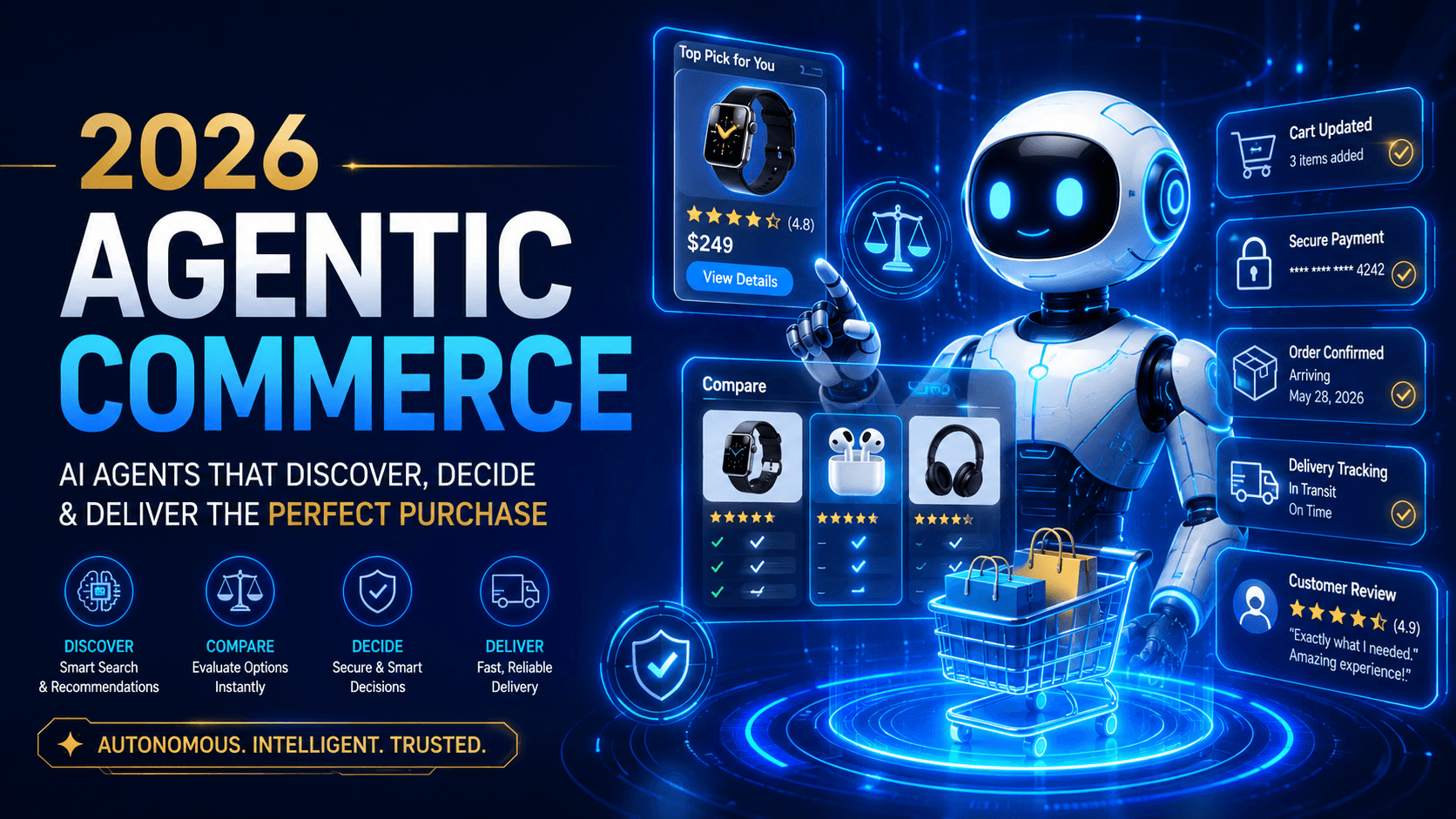

Online shopping is moving beyond search bars, product filters and traditional website navigation.
Customers are increasingly using artificial intelligence to explain what they need, compare products, identify suitable options and make purchasing decisions. Instead of opening several websites and manually reviewing dozens of items, a shopper can describe a goal and ask an AI assistant to handle much of the research.
This emerging model is known as agentic commerce.
Agentic commerce uses AI agents that can complete multiple stages of the shopping journey on behalf of customers. These systems may discover products, compare specifications, check prices, review delivery information and assist with an approved purchase.
In 2026, this model is developing from an experimental concept into a practical e-commerce channel.
Google launched the Universal Commerce Protocol in January 2026 as an open standard designed to connect AI agents, retailers and payment providers across product discovery, checkout and post-purchase support. Google developed the protocol with companies including Shopify, Etsy, Wayfair, Target and Walmart.
For online retailers, this shift creates an important question:
Will AI shopping agents be able to discover, understand and recommend their products?
At Arrowhead DigiTech, we are helping businesses prepare their websites, product catalogs and digital systems for this new stage of online commerce.
What Is Agentic Commerce?
Agentic commerce is an e-commerce model in which AI agents perform shopping-related tasks for customers with limited manual involvement.
A customer may give the AI a request such as:
“Find a lightweight business laptop under my budget with strong battery life and delivery before Friday.”
The AI agent may then:
- Search multiple available products
- Compare technical specifications
- Review prices and discounts
- Check inventory
- Evaluate customer ratings
- Review delivery times
- Recommend suitable choices
- Assist with checkout after approval
Shopify defines agentic commerce as a model where AI agents research, compare and select products for shoppers while supporting approved transactions with minimal human intervention.
The important difference is that the AI does more than answer a question. It can plan and complete several connected actions.
Conversational Commerce vs. Agentic Commerce
Conversational commerce already exists on many websites.
A conventional AI chatbot may answer questions, recommend a product or help a customer locate a particular page. However, the customer usually continues the shopping process manually.
Agentic commerce goes further.
A conversational chatbot might say:
“This jacket is available in medium and large.”
An AI shopping agent may:
- Ask about the customer’s preferred fit
- Compare similar jackets
- Check size availability
- review delivery options
- Recommend the best match
- Add the product to the cart
- Prepare the transaction for approval
Conversational commerce supports the shopper.
Agentic commerce can act for the shopper.
Why Agentic Commerce Matters in 2026
Consumer use of AI during online shopping is growing quickly.
Adobe reported that traffic from AI sources to US retail websites increased by 393% year over year during the first three months of 2026. In March 2026, AI-referred traffic converted into purchases 42% better than traffic from non-AI channels.
Shopify also reported strong growth during the first quarter of 2026. AI-driven traffic to Shopify stores grew eight times year over year, while orders originating from AI-powered searches increased nearly thirteen times.
These figures suggest that AI-assisted shoppers are not only conducting general research. Many are arriving with stronger purchasing intent.
A customer who has already asked an AI agent to compare products may be closer to making a decision than someone casually browsing a category page.
For e-commerce businesses, AI traffic can therefore become a valuable source of qualified customers.
How the Traditional Shopping Journey Is Changing
A traditional online shopping journey may include:
- Searching on Google
- Opening several websites
- Browsing product categories
- Applying filters
- Comparing specifications
- Reading reviews
- Selecting an item
- Completing checkout
An agentic shopping journey may be much shorter.
The customer explains the desired outcome, and the AI agent handles much of the discovery and comparison process.
For example, instead of searching through a furniture store manually, a customer may ask:
“Find a modern office chair for long working hours, suitable for a small room, with adjustable support and delivery this week.”
The AI system needs to understand more than the product name. It must evaluate:
- Product dimensions
- Intended use
- Material
- Features
- Availability
- Customer preferences
- Price
- Delivery time
- Return policy
This means businesses need richer and more accurate product information.
A basic title and short description may no longer be enough.
Product Discovery Is Becoming Machine-Led
For years, online stores were designed mainly for human visitors.
Images, menus, visual layouts and promotional banners helped customers browse the store. These elements remain important, but AI agents may interpret the store differently.
An AI system needs structured, accessible and consistent information.
It must be able to determine:
- What the product is
- Who it is suitable for
- What features it includes
- Which variations are available
- How much it costs
- Whether it is in stock
- Where it can be delivered
- What the return policy includes
Adobe’s analysis of US retail websites found that individual product pages had an average AI-readability score of only 66%. This indicated that a significant portion of product-page content was difficult for AI systems to interpret.
Businesses with incomplete, inconsistent or poorly structured product data may therefore become less visible in AI-assisted shopping experiences.
What Is the Universal Commerce Protocol?
The Universal Commerce Protocol, commonly known as UCP, is an open standard introduced to help commerce systems and AI agents communicate.
Instead of building a completely separate integration for every AI platform, UCP aims to provide a common language covering:
- Product discovery
- Buying
- Payments
- Order management
- Post-purchase support
Google states that UCP is compatible with other industry protocols and is designed to allow agents, businesses and payment providers to work together more easily.
Google also announced that UCP would support checkout for eligible US retailers through product listings appearing in AI Mode and the Gemini app.
This development represents an important change.
The purchase journey may increasingly take place within an AI conversation rather than entirely on the retailer’s traditional website.
Will E-Commerce Websites Become Unnecessary?
No.
The role of the website may change, but the website remains an essential source of product information, brand credibility, customer service and transaction support.
Even when an AI agent introduces a product, customers may still visit the website to:
- Confirm business legitimacy
- View detailed photographs
- Read reviews
- Understand the brand
- Check policies
- Explore related products
- Contact customer support
- Complete a purchase
The website also supplies much of the information that search engines and AI platforms use to understand the business.
Agentic commerce does not eliminate the online store. It increases the need for stores to become technically organized, trustworthy and machine-readable.
How E-Commerce Businesses Should Prepare
Improve Product Titles
Product titles should clearly describe the item without unnecessary promotional language.
A useful title may include:
- Brand
- Product type
- Model
- Important variation
- Size or capacity
- Primary feature
Titles should remain readable for customers while providing enough information for search systems and shopping agents.
Create Detailed Product Descriptions
Product descriptions should answer real purchasing questions.
They should explain:
- Main features
- Customer benefits
- Materials
- Dimensions
- Compatibility
- Usage instructions
- Included accessories
- Care requirements
- Limitations
Businesses should avoid using the manufacturer’s exact generic description across every retailer.
Original and useful product information can help differentiate the store.
Add Accurate Product Attributes
AI agents may compare items using specific attributes.
Depending on the product, these may include:
- Color
- Size
- Weight
- Material
- Compatibility
- Warranty
- Energy rating
- Technical specifications
- Age suitability
- Delivery availability
Google announced new Merchant Center attributes intended to improve product discovery in conversational shopping experiences. These include information addressing common product questions, compatible accessories and suitable substitutes.
The more clearly a store provides relevant information, the easier it becomes for an AI system to match the product with a specific request.
Maintain Real-Time Pricing and Inventory
An AI recommendation becomes frustrating when the product is unavailable or the displayed price is incorrect.
Inventory, product variations and pricing should remain synchronized across:
- Online store
- Inventory software
- Google Merchant Center
- Marketplaces
- Mobile applications
- Physical locations
- Advertising platforms
Automated synchronization can reduce overselling, cancelled orders and poor customer experiences.
Implement Product Structured Data
Structured data provides machine-readable information about products.
Product schema may include:
- Product name
- Description
- Image
- Brand
- SKU
- Price
- Currency
- Availability
- Rating
- Review information
Structured data should match the visible information on the page.
It should not contain misleading prices, ratings or availability information that customers cannot verify on the website.
Improve Product Images
AI shopping is not only text-based.
Multimodal AI systems can analyze photographs and use visual information during product discovery.
Online stores should use:
- Clear product photographs
- Multiple viewing angles
- Consistent backgrounds
- High-resolution images
- Close-up detail photographs
- Accurate color representation
- Descriptive image alternative text
Lifestyle images can also help customers understand how the product may be used.
Make Policies Easy to Understand
AI agents may consider delivery, returns and warranties before recommending a product.
Stores should clearly publish:
- Shipping charges
- Delivery locations
- Estimated delivery times
- Return period
- Refund process
- Exchange rules
- Warranty information
- Customer-support options
Important policies should not be hidden inside lengthy or confusing pages.
Simplify Checkout
An AI agent may help a customer select a product, but a complicated checkout can still prevent the purchase.
Businesses should reduce unnecessary friction by providing:
- Guest checkout
- Secure payment methods
- Clear delivery options
- Transparent costs
- Mobile-friendly forms
- Address validation
- Simple order confirmation
Unexpected fees and complicated account-creation requirements can increase cart abandonment.
Customer Trust Remains Essential
Customers may appreciate AI assistance, but they still want transparency and control.
Adobe’s 2026 research found that 43% of customers were willing to interact with a brand’s AI concierge or agent. However, 37% said they would disengage if they discovered they were interacting with AI while expecting a person.
Businesses should clearly explain when customers are communicating with AI.
A trustworthy AI shopping experience should provide:
- Clear AI disclosure
- Accurate recommendations
- Secure handling of customer information
- Easy access to human assistance
- Customer approval before payment
- Transparent product comparisons
- Simple correction of mistakes
AI should support the customer rather than pressure them.
Human Support Will Still Matter
AI agents can answer many routine questions, but some situations require human judgment.
A customer may need personal assistance with:
- Complex product compatibility
- Custom orders
- Damaged deliveries
- Refund disputes
- High-value purchases
- Sensitive account issues
- Unusual delivery requirements
Adobe found that clear AI disclosure and easy escalation to human support were among the most important steps organizations identified for building trust in agentic AI.
Businesses should therefore design AI systems with a visible and reliable human-support option.
Agentic Commerce for Small Businesses
Agentic commerce is not limited to major international retailers.
Small and medium-sized businesses can benefit when they provide specialized products, strong product information and reliable service.
An AI agent may recommend a smaller retailer when that store offers:
- A better product match
- More detailed information
- Competitive pricing
- Faster delivery
- Stronger reviews
- A specialized item
- Clearer policies
- Better availability
This may create opportunities for niche brands that previously struggled to compete for expensive advertising positions.
However, visibility will depend on the quality and accessibility of the retailer’s product data.
Small businesses should begin by improving their existing store rather than attempting to implement every new AI technology immediately.
Challenges Businesses Must Consider
Inaccurate Recommendations
An AI system may misunderstand a product or recommend an unsuitable option when the available data is incomplete.
Outdated Information
Incorrect prices, stock levels or delivery times can create customer dissatisfaction.
Customer Privacy
Personalization must be handled responsibly. Businesses should collect only necessary information and protect customer data.
Platform Dependence
Retailers should avoid relying entirely on one AI platform or marketplace for product discovery.
Measurement
Attribution may become more complicated when customers interact with several AI tools before making a purchase.
Brand Visibility
When an AI agent summarizes several options, businesses may have less control over how their brand is presented.
A strong website, clear product information and consistent brand identity can reduce these risks.
How Performance Should Be Measured
Traditional e-commerce metrics remain important, but businesses should also monitor AI-assisted customer journeys.
Useful measurements include:
- AI-referred website traffic
- Product-page engagement
- AI-channel conversion rate
- Product-feed errors
- Shopping-agent referrals
- Cart completion rate
- Average order value
- Repeat purchases
- Product visibility across AI platforms
- Customer-support requests
- Return and cancellation rates
Adobe reported that AI-referred retail visitors in March 2026 spent 48% more time on websites, viewed 13% more pages and demonstrated a 12% higher engagement rate than visitors from non-AI sources.
Businesses should evaluate whether AI traffic produces meaningful sales rather than monitoring traffic volume alone.
What Arrowhead DigiTech Is Doing
At Arrowhead DigiTech, we help businesses prepare their e-commerce operations for both human shoppers and emerging AI shopping channels.
Our approach includes:
AI-Ready E-Commerce Development
We build and improve online stores using platforms such as Shopify, WordPress and custom e-commerce systems.
Product Catalog Optimization
We organize product titles, descriptions, categories, attributes and variations so customers and automated systems can understand them more easily.
Product Structured Data
We implement and review relevant structured data to improve product clarity for search engines and AI discovery platforms.
Merchant Feed Management
We help businesses maintain cleaner product feeds containing accurate prices, availability and product details.
Inventory and System Integration
We connect e-commerce stores with inventory, customer-management, payment and business systems to reduce manual updates.
AI Shopping Assistants
We develop conversational systems that can answer product questions, recommend suitable options and guide customers through the buying journey.
Checkout and Conversion Optimization
We improve mobile usability, product navigation, calls to action and checkout flows to reduce unnecessary friction.
Analytics and Performance Monitoring
We help businesses measure customer behavior, AI referrals, product engagement and conversions.
Customer Trust and Security
We support secure websites, responsible automation, clear customer communication and reliable access to human assistance.
Our goal is not to add AI simply because it is popular.
We focus on practical systems that improve product discovery, customer experience and business performance.
Building an Agent-Ready Online Store
An agent-ready store begins with strong e-commerce fundamentals.
Businesses should prioritize:
- Accurate product data
- Detailed descriptions
- Reliable inventory
- Transparent pricing
- Clear policies
- Fast mobile performance
- Secure checkout
- Helpful customer support
- Consistent product feeds
- Structured information
Advanced AI tools cannot compensate for poor data or an unreliable purchasing experience.
Adobe’s 2026 report found that only 44% of surveyed organizations considered their data quality and accessibility adequate for AI. It also found that 75% identified data integration and quality as the leading challenge to implementing agentic AI.
For many businesses, improving data quality is therefore the most important first step.
Final Thoughts
Agentic commerce is changing the relationship between customers, online stores and digital platforms.
Customers can increasingly ask AI agents to research products, compare options and assist with purchasing decisions.
For e-commerce businesses, future visibility may depend on whether automated systems can understand and trust their product information.
The businesses that prepare now will be better positioned to benefit from this change.
They should focus on accurate product catalogs, machine-readable information, reliable inventory, secure checkout and transparent customer experiences.
Arrowhead DigiTech helps online businesses prepare for this transition through e-commerce development, product-data optimization, AI automation, system integration and conversion-focused digital strategies.
The future of online shopping will not belong only to the businesses with the largest advertising budgets.
It will also belong to businesses whose products are easiest for customers—and their AI agents—to discover, evaluate and purchase.
Frequently Asked Questions
What is agentic commerce?
Agentic commerce is an online shopping model where AI agents can research, compare and select products while helping customers complete approved purchases.
How is agentic commerce different from a chatbot?
A chatbot normally answers questions or recommends products. An agentic system can complete several connected actions, such as comparing items, checking availability and preparing checkout.
Will AI shopping agents replace e-commerce websites?
No. Websites will remain important for product information, customer trust, brand presentation, support and transaction processing.
Can small businesses benefit from agentic commerce?
Yes. Small businesses with specialized products, accurate data, clear policies and strong customer experiences may be recommended by AI shopping agents.
How can an online store become AI-ready?
The store should improve product descriptions, structured data, inventory accuracy, product feeds, mobile performance, policies and checkout usability.
What is the Universal Commerce Protocol?
The Universal Commerce Protocol is an open standard designed to help AI agents, retailers and payment systems communicate throughout the shopping journey.
How can Arrowhead DigiTech help?
Arrowhead DigiTech provides e-commerce development, product-data optimization, AI shopping assistants, structured data, inventory integration, analytics and conversion optimization.