
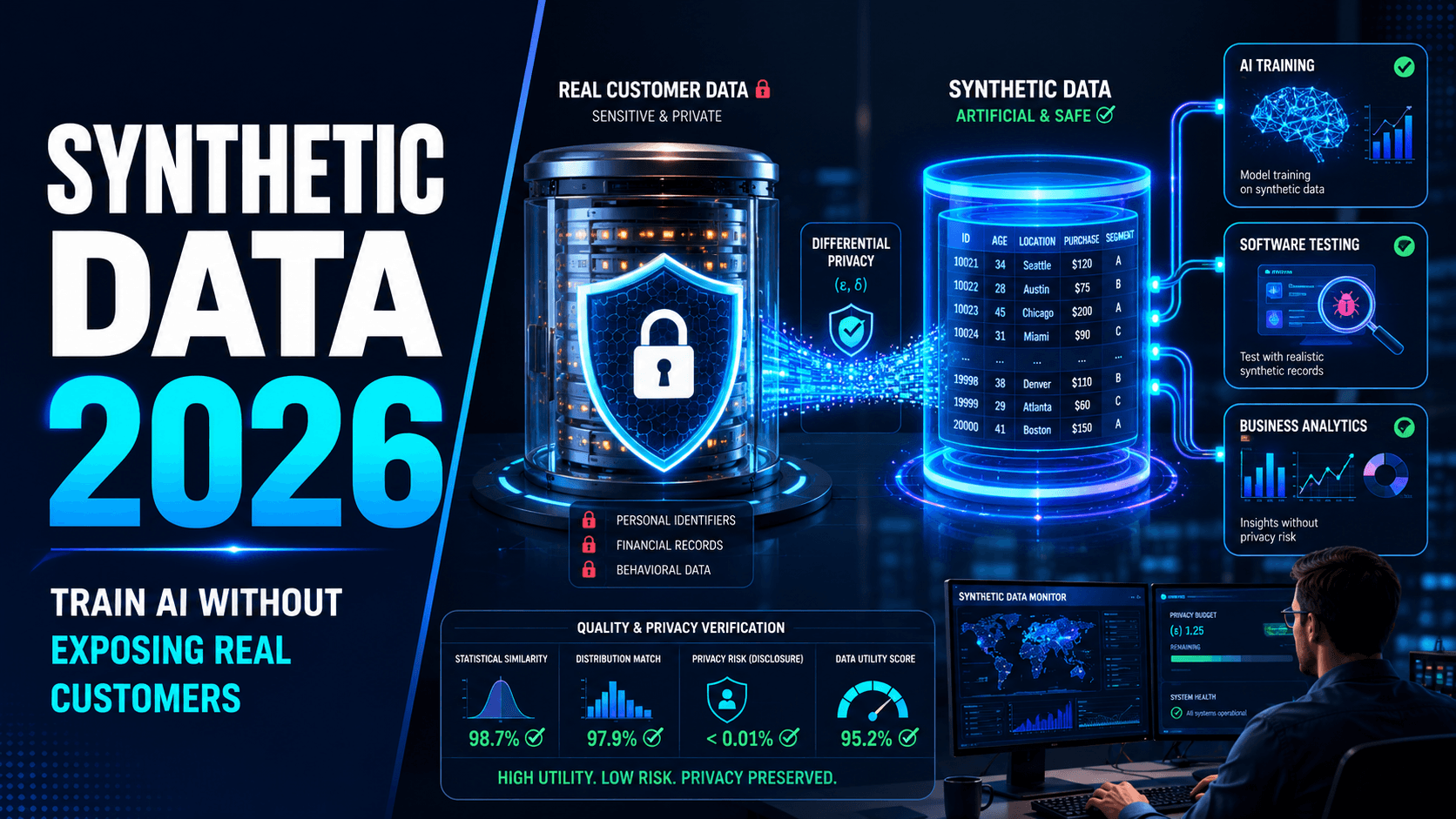
Synthetic Data in 2026: How Businesses Can Train AI Without Exposing Real Customer Data
Businesses need high-quality information to build AI, but using real customer records creates privacy and security risks. Learn how synthetic data can support safer development and testing.
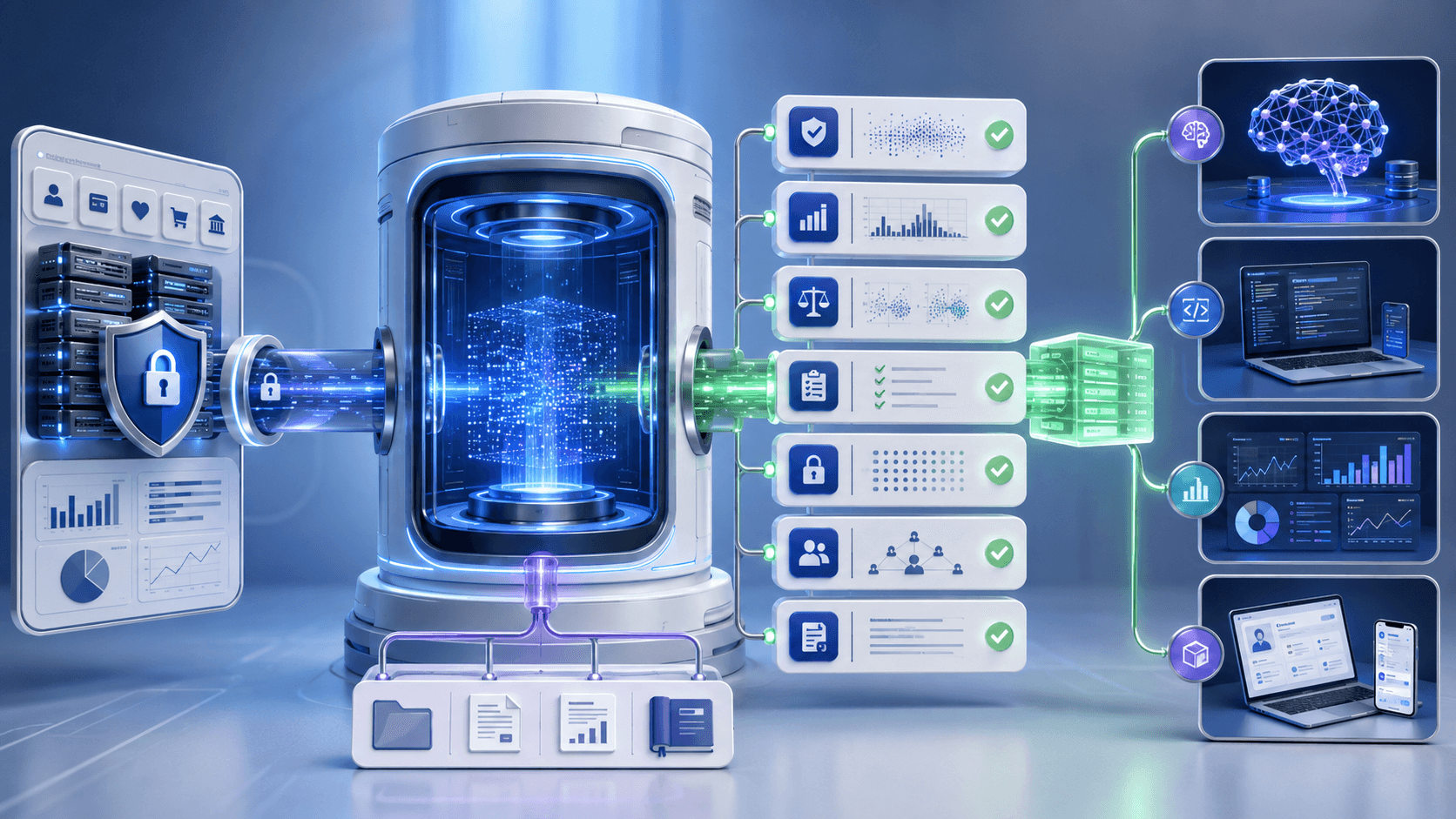

Artificial intelligence depends on data.
A customer-service assistant needs examples of customer questions. A fraud-detection model needs transaction patterns. A healthcare application needs realistic clinical information, while a software-development team needs customer-like records to test whether a new platform works correctly.
However, real business data can be difficult and risky to use.
Customer records may contain names, addresses, financial information, medical details, account activity and confidential business information. Providing this data to developers, vendors or AI systems can increase privacy, security and compliance risks.
Businesses may also lack enough examples of rare but important situations.
A fraud dataset may contain thousands of normal transactions but relatively few confirmed fraud cases. An industrial safety system may have limited examples of unusual equipment failures. A healthcare dataset may not represent every important patient group equally.
Synthetic data offers another approach.
Synthetic data is artificially generated information designed to reproduce selected patterns, structures and statistical relationships found in real-world data without simply copying every original record.
The UK government’s March 2026 AI guidance explains that synthetic data can mimic real-world properties and relationships while helping address data-quality, scaling, bias and privacy challenges.
At Arrowhead DigiTech, we help businesses evaluate their data, generate controlled testing environments and build AI applications without unnecessarily exposing sensitive customer records.
What Is Synthetic Data?
Synthetic data is computer-generated information created to resemble a real dataset or business environment.
It may include artificial:
- Customer profiles
- Financial transactions
- Medical records
- Website activity
- Product orders
- Sensor measurements
- Images
- Voice samples
- Business documents
- Software events
A synthetic customer record may look realistic and follow the same general structure as an actual customer profile, but it should not directly represent a real person.
For example, a synthetic retail dataset might preserve relationships between age groups, product categories, purchase frequency and average order value while generating new artificial records.
The European Data Protection Supervisor describes synthetic data as information generated from a model trained to reproduce the characteristics and structure of original data. Its privacy level depends on how easily information about individuals in the source dataset can be inferred or reconstructed.
Why Synthetic Data Is Becoming Important in 2026
Businesses are building more AI systems while facing stronger restrictions around customer information.
Development teams need realistic datasets for:
- Training AI models
- Testing software
- Validating analytics
- Demonstrating products
- Sharing information with partners
- Reproducing system errors
- Testing rare scenarios
Using complete production databases for these activities can create unnecessary exposure.
Recent UK government guidance highlights that synthetic data is particularly valuable when real information is sensitive, difficult to access or does not contain enough examples of unusual but important events.
The Office for National Statistics also permits synthetic data as a substitute for testing and research where real data is inaccessible, while warning that synthetic datasets may not accurately preserve every property of the original information.
This balance is important.
Synthetic data can improve access and reduce exposure, but it must still be evaluated for privacy, quality, fairness and suitability.
How Synthetic Data Is Created
Different methods are suitable for different business applications.
Rule-Based Generation
Developers create rules describing how records should be generated.
For example:
- Customer age must fall within a defined range
- Order value must be positive
- Delivery date must follow the purchase date
- A product must belong to an approved category
Rule-based generation is useful for software testing because developers can create predictable scenarios.
However, manually written rules may fail to reproduce complex relationships found in real customer behaviour.
Statistical Modelling
A statistical model studies the distributions and relationships inside a real dataset and generates new artificial records with similar characteristics.
This can preserve important patterns without copying complete records directly.
Generative AI Models
Machine-learning models can learn complex relationships from tabular data, images, text, audio or sensor information and produce new synthetic examples.
These systems may be useful when the data contains many variables or complex patterns.
They also require careful testing because a poorly controlled model may reproduce sensitive training examples or introduce unrealistic information.
Simulation
A simulated environment creates artificial data by modelling a real physical or operational process.
Examples include:
- Vehicle movement
- Warehouse activity
- Factory equipment
- Customer queues
- Weather conditions
- Robotic operations
Simulation can create events that are difficult, expensive or unsafe to reproduce in the real world.
Differentially Private Generation
Differential privacy introduces carefully controlled statistical noise during analysis or data generation.
NIST explains that differentially private synthetic data can preserve useful statistical characteristics while providing a mathematically defined privacy guarantee about individuals in the source dataset.
Not every synthetic-data generator provides differential privacy.
Businesses should request specific evidence instead of assuming that the word “synthetic” automatically means private.
Fully Synthetic vs. Partially Synthetic Data
Fully Synthetic Data
Every record or selected field in the released dataset is artificially generated.
The resulting information should not directly describe real individuals.
Fully synthetic data may provide greater separation from production records, but maintaining realistic relationships can be more difficult.
Partially Synthetic Data
Only selected sensitive fields are replaced.
For example, a hospital-testing dataset may retain non-sensitive equipment information while replacing patient identity, location and admission details.
ICO guidance recognises both fully and partially synthetic approaches and explains that the appropriate method depends on the intended purpose and required level of realism.
Partially synthetic data may retain more analytical value, but it can also preserve greater disclosure risk because some original values remain.
Important Business Use Cases
Software Development and Testing
Developers regularly need realistic information to test:
- Customer portals
- Payment systems
- Mobile applications
- CRM platforms
- Reporting dashboards
- Search functions
- Data imports
- Account permissions
Using production customer records in development environments can expose sensitive information to employees, contractors and testing tools.
Synthetic data allows the team to create realistic test accounts and transactions without copying the complete customer database.
Developers can also generate unusual scenarios such as:
- Extremely large orders
- Failed payments
- Duplicate accounts
- Missing fields
- Expired subscriptions
- Incorrect addresses
- Unusual characters
These cases help identify software failures before customers encounter them.
AI Model Training
A business may use synthetic information to supplement limited real-world training data.
For example, a fraud-detection model may need more examples of rare transaction patterns.
Synthetic examples can increase representation of these events, although they should be validated against real-world outcomes.
Synthetic data should normally complement carefully governed real data rather than being treated as automatically superior.
Healthcare Research
Healthcare organisations may want to analyse patient journeys, claims, treatments and outcomes without giving every researcher access to identifiable records.
A May 2026 Society of Actuaries study demonstrated AI-based generation of synthetic medical-claims data for actuarial modelling and analysis.
Healthcare synthetic data still requires strong quality, clinical and privacy review. An artificial dataset may reproduce bias, omit rare conditions or generate medically unrealistic combinations.
Financial Services
Financial institutions can use synthetic transactions to test:
- Fraud detection
- Credit models
- Payment systems
- Anti-money-laundering workflows
- Customer onboarding
- Cybersecurity monitoring
A bank can generate artificial transaction behaviour without distributing complete account histories across development environments.
Cybersecurity
Security teams can generate artificial:
- Login activity
- Network traffic
- Phishing attempts
- Account behaviour
- Malware alerts
- Access anomalies
This allows teams to test detection tools and incident-response procedures without waiting for a real security incident.
Product Demonstrations
Software companies need realistic information when demonstrating a platform to potential clients.
A CRM demonstration containing genuine customer names or sales information can create unnecessary exposure.
Synthetic demonstration data can show how the system works while protecting confidential records.
Data Sharing and Collaboration
Companies may want to share information with researchers, agencies, software vendors or business partners.
Synthetic data can reduce the need to distribute raw customer records.
However, organisations should still evaluate privacy risk before wider release. The Office for National Statistics requires synthetic datasets intended for broader sharing to be checked for disclosure concerns.
Rare-Event Testing
Real datasets often contain few examples of rare but important events.
Synthetic generation can create controlled examples of:
- Equipment failures
- Fraud patterns
- Medical complications
- Supply-chain disruptions
- Extreme customer demand
- Software overload
- Safety incidents
The 2026 UK AI guidance specifically identifies underrepresented and extreme events as areas where synthetic information can strengthen development datasets.
Synthetic Data Is Not Automatically Anonymous
This is the most important limitation.
A synthetic dataset may appear artificial while still revealing information about people in the original dataset.
For example, if the source data contains one highly unusual customer and the synthetic model reproduces a very similar record, an attacker may infer that the person appeared in the original information.
ICO guidance warns that synthetic data can retain privacy risk when unusual individuals or strong source-data patterns are reproduced.
Businesses should therefore evaluate:
- Record similarity
- Membership-inference risk
- Attribute-inference risk
- Rare combinations
- Outlier reproduction
- Model memorisation
- Reidentification possibilities
A synthetic dataset should not be publicly released simply because direct names were removed.
Privacy and Utility Must Be Balanced
A highly realistic synthetic dataset may retain more useful statistical relationships.
However, very high similarity to the original data may also increase privacy risk.
A strongly protected dataset may provide greater privacy but lose important details required for analysis.
This creates a trade-off between:
- Privacy
- Accuracy
- Statistical fidelity
- Fairness
- Business usefulness
UK Statistics Authority guidance explains that higher-fidelity synthetic information may support more analytical applications but can also create greater disclosure risk.
There is no universal quality setting suitable for every project.
The correct balance depends on the intended use.
Synthetic data created for a visual software demonstration may not need the same fidelity as information used to validate a healthcare model.
Synthetic Data Can Reproduce Bias
Synthetic information learns from source data, rules or simulations.
When the original information contains bias, the generated data may reproduce or amplify it.
For example:
- Historical hiring data may underrepresent certain candidates
- Healthcare data may contain unequal access patterns
- Fraud records may reflect past investigation priorities
- Customer data may exclude people with limited digital access
Synthetic generation does not automatically correct these problems.
The UK government’s 2026 guidance notes that synthetic data can be used to adjust representation, but responsible development requires teams to understand and evaluate the original dataset, generation process and intended use.
Businesses should compare performance across important groups rather than relying only on one overall accuracy score.
Synthetic Data vs. Anonymised Data
Anonymised data normally begins with real records and removes or transforms identifying information.
Synthetic data generates new artificial records based on patterns learned from source information or defined rules.
Both approaches may reduce exposure, but neither should be considered risk-free without assessment.
Synthetic data may offer greater flexibility because developers can create new scenarios rather than modifying existing records.
Anonymised data may preserve real-world detail more accurately, but unusual combinations can still make individuals identifiable.
Synthetic Data vs. Masked Test Data
Data masking replaces sensitive values inside real records.
Examples include:
- Replacing names
- Hiding payment numbers
- Changing email addresses
- Obscuring account identifiers
The record structure and many original relationships remain.
Synthetic data instead creates artificial records.
Masking may be easier for certain software tests, while synthetic data may provide stronger separation from production information.
Businesses may use both techniques depending on the workflow.
How to Evaluate Synthetic Data Quality
Statistical Similarity
Compare distributions, averages, correlations and category frequencies with the original dataset.
Business Rules
Check whether the records follow real operational logic.
For example:
- Refunds should correspond with orders
- Discharge dates should follow admission dates
- Subscription cancellation should follow account creation
Downstream Model Performance
Train or test the intended model using synthetic information and compare performance with an appropriately controlled real-data benchmark.
Privacy Testing
Attempt to determine whether original records or sensitive attributes can be inferred.
NIST’s privacy research includes adversarial testing of synthetic datasets to evaluate reconstruction and reidentification risks.
Fairness Evaluation
Measure whether the synthetic dataset represents important user and customer groups appropriately.
Rare-Event Accuracy
Confirm that generated unusual cases remain realistic rather than impossible or misleading.
Expert Review
Healthcare, finance, manufacturing and other specialised datasets should be reviewed by people who understand the real business domain.
A statistically realistic record can still be operationally impossible.
What Businesses Should Do Now
1. Define the Purpose
Document exactly why synthetic data is required.
Possible purposes include:
- Software testing
- AI training
- Product demonstrations
- Partner collaboration
- Rare-event simulation
- Research
A dataset created for one purpose should not automatically be reused for another.
2. Classify the Source Data
Identify whether the original information contains:
- Personal data
- Medical information
- Financial records
- Employee data
- Confidential business information
- Intellectual property
The sensitivity of the source data should influence security, privacy testing and approval.
3. Minimise the Source Information
Use only the information required to generate the intended synthetic dataset.
Unnecessary variables increase complexity and privacy risk.
4. Select the Generation Method
Choose rule-based, statistical, simulation, generative or differentially private techniques according to the business requirement.
5. Establish Quality Requirements
Define acceptable:
- Accuracy
- Statistical similarity
- Privacy risk
- Bias levels
- Rare-event representation
- Model performance
6. Test for Disclosure Risk
Evaluate whether artificial records reveal or closely reproduce real individuals.
Do not depend only on visual inspection.
7. Document the Dataset
ICO guidance recommends documenting when and how synthetic data was created and explaining why it is suitable for the intended AI use.
Documentation should include:
- Source-data description
- Generation method
- Software version
- Privacy controls
- Quality tests
- Known limitations
- Approved use cases
- Creation date
- Responsible owner
8. Control Access
The source data and generation environment may remain highly sensitive even when the final output is artificial.
Apply appropriate access restrictions, encryption and logging.
9. Validate With Real Outcomes
Synthetic data can support development, but production performance should be evaluated using legitimate real-world evidence where appropriate.
10. Monitor Reuse
Track which teams, vendors and models use each dataset.
Prevent teams from using low-fidelity demonstration data for high-impact business decisions.
Common Synthetic Data Mistakes
Assuming Synthetic Means Anonymous
Artificial generation does not automatically remove inference or reidentification risk.
Measuring Only Visual Similarity
A dataset can look realistic while failing important statistical or business relationships.
Ignoring Outliers
Rare source records may be easier to identify or may be reproduced too closely.
Training Entirely on Synthetic Data Without Validation
The generated information may contain unrealistic assumptions or model-generated artefacts.
Reproducing Historical Bias
Synthetic generation can repeat unequal patterns found in the source dataset.
Using One Dataset for Every Purpose
Software testing, model training and public demonstrations require different levels of quality and privacy.
Sharing Without Disclosure Testing
Wider release should receive stronger privacy assessment.
Failing to Document Generation
Teams need to understand how the information was created and where it should not be used.
What Arrowhead DigiTech Is Doing
At Arrowhead DigiTech, we help businesses use data for AI and software development without creating unnecessary customer exposure.
Data Readiness Assessments
We review data quality, sensitivity, structure and availability before recommending AI development.
Synthetic Test Data
We generate controlled customer, order, transaction and application records for software development and quality testing.
AI Training Data Preparation
We clean, structure and supplement datasets for machine-learning and generative-AI projects.
Privacy Risk Assessments
We evaluate whether generated information may expose source records or sensitive attributes.
Data Quality Validation
We compare synthetic and real information across statistical, operational and business requirements.
Rare-Scenario Generation
We create controlled examples of unusual transactions, system failures and customer journeys.
Secure Development Environments
We separate production information from testing, staging and demonstration platforms.
AI Governance
We document dataset ownership, approved use, generation methods and known limitations.
Cloud and Data Integration
We connect synthetic-data workflows with analytics platforms, databases, AI systems and development pipelines.
Ongoing Model Monitoring
We help businesses compare AI performance with real-world results after deployment.
Our objective is not simply to create more data.
We help businesses create the right data for a clearly defined purpose while protecting customers and maintaining measurable quality.
A Practical Synthetic Data Roadmap
Stage One: Discovery
Identify the business problem, source data, users and privacy risks.
Stage Two: Design
Select the generation method, required fields and quality standards.
Stage Three: Generate
Create the synthetic dataset inside a controlled environment.
Stage Four: Validate
Test privacy, quality, fairness, business rules and model performance.
Stage Five: Govern and Monitor
Control distribution, document usage and review performance regularly.
Final Thoughts
Businesses need high-quality information to build reliable AI and software systems.
However, copying real customer databases into development, analytics and vendor environments creates significant privacy and security risks.
Synthetic data can provide a safer and more flexible alternative.
It can help development teams test software, support AI training, generate rare scenarios and collaborate without distributing unrestricted production records.
Recent government guidance published in 2026 shows that synthetic data is becoming an increasingly important part of responsible AI and data-development strategies.
But synthetic data is not automatically anonymous, accurate or unbiased.
Businesses must evaluate the source data, generation method, disclosure risk, statistical fidelity and intended purpose.
Arrowhead DigiTech helps organisations build this foundation through data assessments, synthetic test-data generation, secure development, AI preparation and ongoing quality monitoring.
The goal is not to replace every real dataset.
It is to reduce the amount of sensitive information businesses must expose while still giving their teams the data needed to build, test and innovate.
Frequently Asked Questions
What is synthetic data?
Synthetic data is artificially generated information designed to reproduce selected patterns and characteristics of real-world data.
Is synthetic data anonymous?
Not automatically. A synthetic dataset may still reveal information about individuals in the original dataset and should receive privacy testing.
Can synthetic data be used to train AI?
Yes. It can supplement or replace selected training information, but model performance should be validated against appropriate real-world evidence.
What is differentially private synthetic data?
It is synthetic information generated using differential-privacy methods that provide a mathematically defined privacy guarantee.
Can synthetic data replace production data in software testing?
In many cases, yes. It can create realistic test records without copying complete customer information into development environments.
Does synthetic data remove bias?
No. It may reproduce or amplify bias contained in the original information or generation rules.
Can small businesses use synthetic data?
Yes. Small businesses can use it for website testing, CRM demonstrations, AI pilots and software-development environments.
How can Arrowhead DigiTech help?
Arrowhead DigiTech provides data assessments, synthetic test-data generation, AI data preparation, privacy testing, software development and ongoing model monitoring.