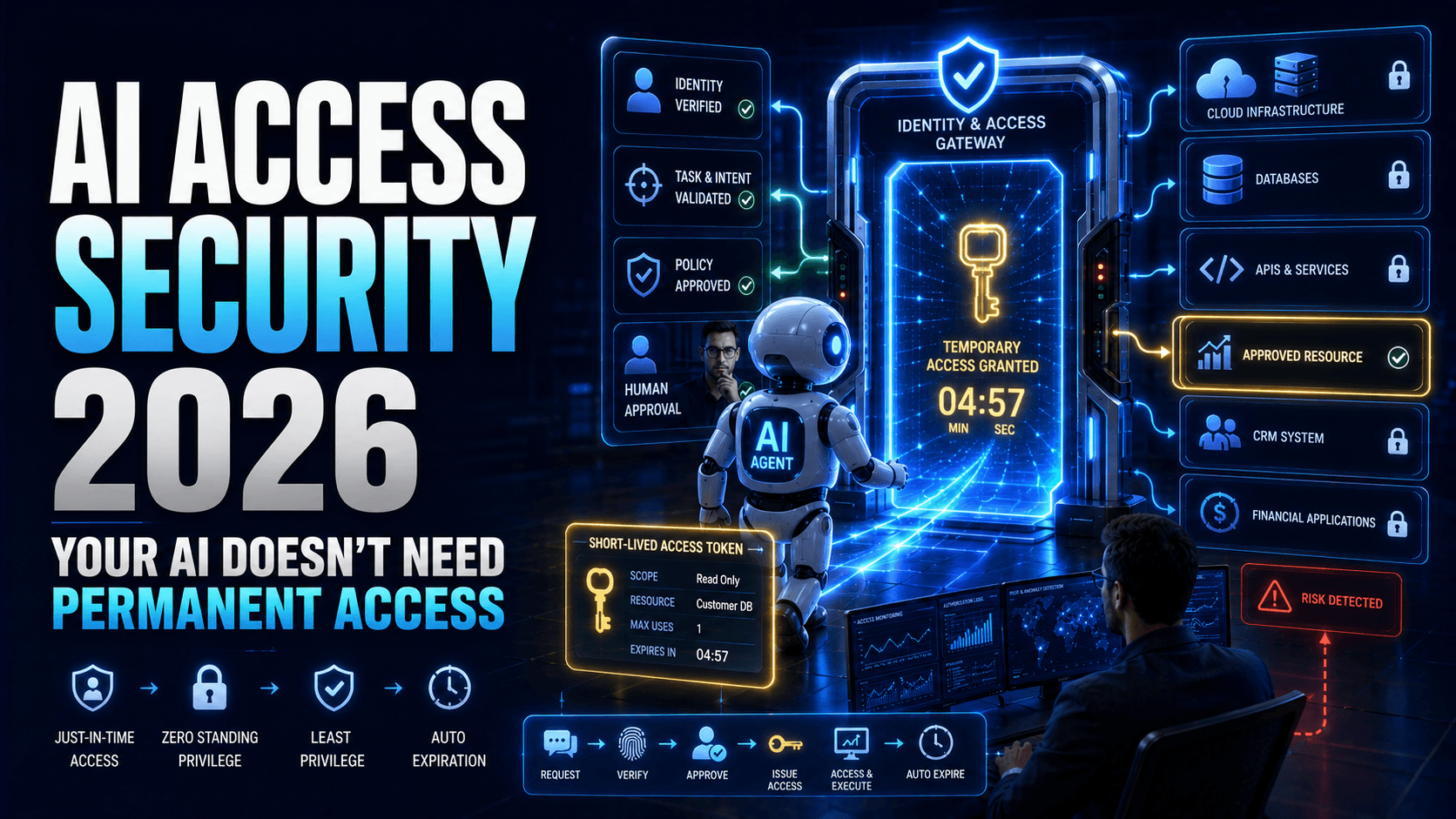
Just-in-Time Access for AI Agents in 2026: Why Permanent Permissions Are Becoming a Security Risk
AI agents need access to enterprise systems—but they do not need permanent permissions. Discover how Just-in-Time access, short-lived credentials, runtime authorization and Zero Standing Privilege can help businesses safely control autonomous AI in 2026.
AI agents are becoming active participants in enterprise systems.
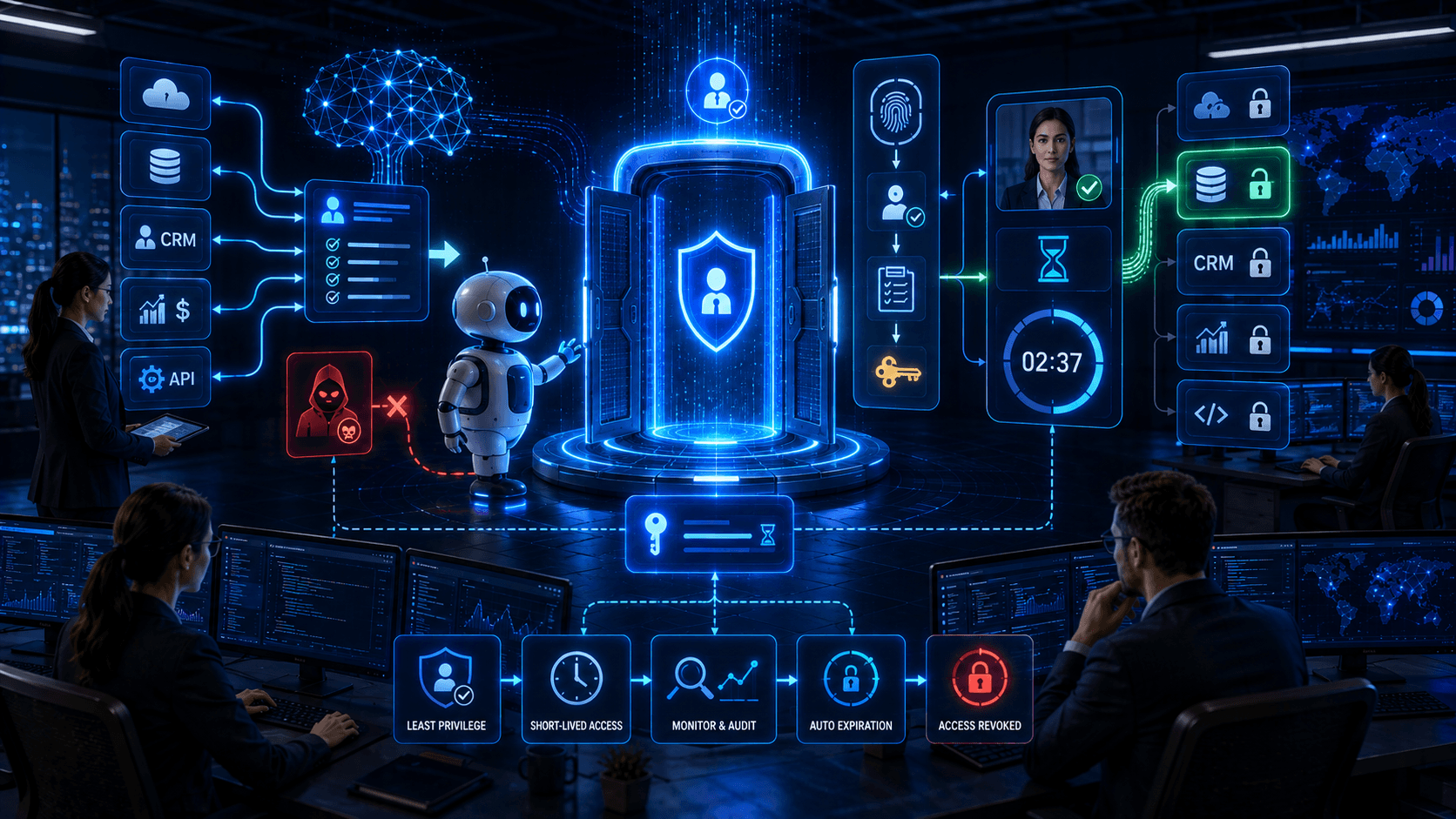
They can query databases, access cloud environments, interact with CRM platforms, execute workflows, analyse financial information, call APIs and communicate with other software agents.
But there is a growing security problem:
Many AI agents have access even when they are not actively performing a task.
Traditional enterprise systems frequently rely on persistent permissions. An application receives credentials and keeps those privileges until an administrator changes them.
That approach becomes significantly more dangerous when the identity holding those permissions is an autonomous AI agent.
A better model is emerging:
Just-in-Time Access for AI Agents.
Instead of giving an agent permanent authority, businesses can grant narrowly scoped permissions only when a verified task requires them—and automatically remove those permissions when the task ends.
The Permanent-Permission Problem
Imagine an AI finance agent that occasionally needs to retrieve invoices from a financial system.
A traditional implementation might give the agent permanent read access.
The agent therefore has that permission:
Monday.
Tuesday.
Wednesday.
At night.
On weekends.
Even when nobody is asking it to retrieve an invoice.
If the agent, its credentials or its surrounding workflow is compromised, those standing permissions increase the attacker's opportunity.
The agent does not need continuous access.
It needs access when performing an authorised task.
That distinction is the foundation of Just-in-Time access.
What Is Just-in-Time Access?
Just-in-Time (JIT) access grants temporary permissions when they are required and removes them automatically afterward.
Instead of:
Agent → Permanent Credential → Enterprise System
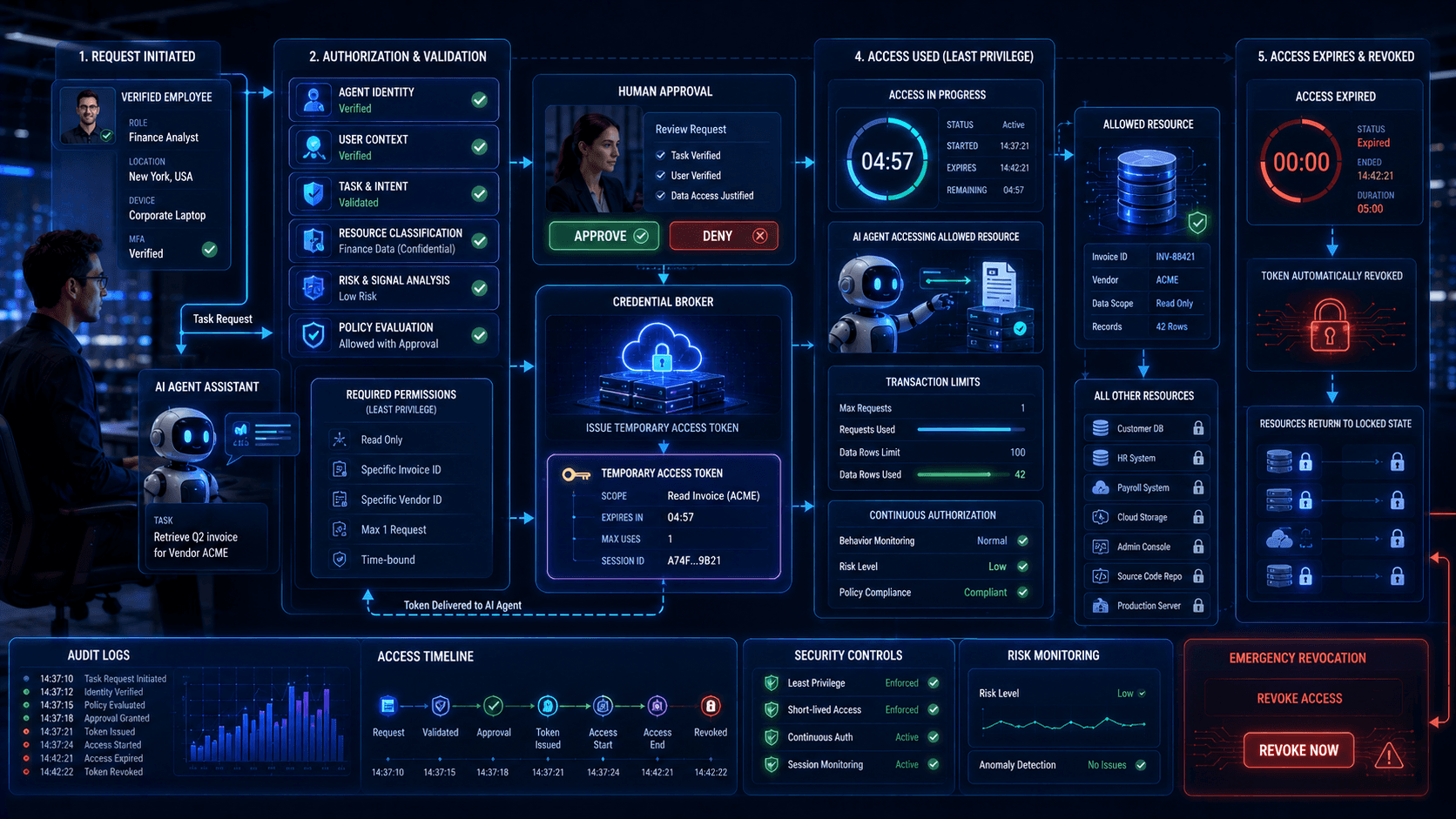
the architecture becomes:
Agent Request
↓
Identity Verification
↓
Task Validation
↓
Policy Check
↓
Temporary Credential
↓
Approved Action
↓
Credential Expires
The agent receives authority for a specific purpose rather than unlimited standing access.
Why AI Agents Make JIT More Important
Traditional service accounts usually execute predictable software processes.
AI agents are different.
They can:
- Interpret instructions
- Create plans
- Select tools
- Change execution paths
- Interact with external information
- Call multiple systems
- Generate new actions dynamically
This flexibility is useful.
But it means security teams cannot always predict every sequence of operations beforehand.
Therefore the safest question is not simply:
“Does this agent have permission?”
It is:
“Should this agent have this permission for this task, right now?”
AI Agents Are Non-Human Identities
An AI agent should have its own identifiable security identity.
Businesses need to distinguish between:
Human User
Application
Service Account
AI Agent
Sub-Agent
Using one shared service account for multiple autonomous agents makes governance difficult.
Security teams should be able to identify exactly which agent requested access and why.
The Delegation Chain
AI agents often act on behalf of people.
For example:
Employee
↓
AI Assistant
↓
Finance Agent
↓
Accounting API
↓
Customer Record
Security systems should preserve this delegation chain.
The accounting system should not merely know:
“Finance Agent requested this.”
It should ideally understand:
Which employee initiated the task?
Which agent is acting?
What business purpose was approved?
Which resource is being accessed?
This improves accountability.
Just Enough Authority
JIT access becomes even stronger when combined with Just Enough Authority.
Imagine an agent needs to retrieve one customer's invoice.
It should not receive:
Read access to the entire finance database for eight hours.
A safer permission could be:
Read invoice #58431 for customer #9281 for five minutes.
The difference is substantial.
AI permissions can potentially be scoped by:
- Resource
- Tool
- Operation
- Customer
- Project
- Environment
- Time
- Transaction value
- Data sensitivity
The smaller the permission boundary, the smaller the potential blast radius.
Short-Lived Credentials
Long-lived API keys are particularly problematic for autonomous systems.
If an API key remains valid for months, stealing it can provide persistent access.
JIT systems can issue credentials lasting:
- Minutes
- One workflow
- One transaction
- One tool call
After expiration, the credential becomes useless.
This reduces the value of stolen credentials.
Use Case: AI Finance Agent
Consider an employee asking:
“Check whether Acme's latest invoice has been paid.”
The system could process this as:
1. Authenticate employee
↓
2. Verify finance agent
↓
3. Confirm employee may view Acme account
↓
4. Grant temporary read permission
↓
5. Retrieve invoice
↓
6. Return result
↓
7. Revoke permission
The agent never receives permanent financial-system access.
Use Case: DevOps Agent
A DevOps AI agent may diagnose production problems.
Most of the time it only needs read access.
But occasionally it may need to restart a service.
Instead of giving permanent administrative access:
Diagnosis Mode
Read logs
Read metrics
Read configuration
Then, when necessary:
Temporary Elevated Permission
Restart service
↓
Human approval
↓
Permission valid for 60 seconds
↓
Action completed
↓
Privilege removed
This dramatically reduces standing privilege.
Use Case: Customer Support
A support agent may need to retrieve one customer's information.
It should not automatically have unrestricted access to every customer record.
The permission could be scoped according to the customer associated with the current support case.
When the ticket closes, access ends.
Use Case: AI Coding Agents
Coding agents increasingly interact with:
- Git repositories
- CI/CD
- Cloud infrastructure
- Package registries
- Development environments
A coding agent may need permission to create a branch.
It does not necessarily need permanent permission to deploy production infrastructure.
High-impact capabilities can remain unavailable until a verified workflow explicitly requires them.
Dynamic Authorization
Traditional authorization often asks:
Identity + Role = Allowed?
Agentic systems require more context.
A modern authorization decision might consider:
Identity
User
Task
Requested Tool
Data Sensitivity
Current Risk
Environment
Time
=
Authorization Decision
This turns authorization into a runtime decision rather than a static configuration.
Intent-Based Access Control
AI agents introduce an unusual challenge.
Two technically identical API calls may have completely different business intentions.
For example:
Transfer customer data to approved analytics system
may be legitimate.
But:
Transfer customer data to unknown external endpoint
is not.
Traditional permission systems may see both as technically permitted network operations.
Agent-aware authorization should evaluate whether the action aligns with the approved task.
Transaction Limits
Temporary access does not necessarily mean unlimited authority during that period.
Businesses can also enforce transaction limits.
A procurement agent might have authority to:
Prepare any purchase request
but automatically approve only:
Purchases below $500
Larger transactions require human approval.
Similar limits can apply to:
- Refunds
- Payments
- File deletion
- Cloud resources
- Customer credits
- Infrastructure changes
Human Approval
JIT access works naturally with human approval.
For example:
Agent requests privileged action
↓
Policy engine identifies high risk
↓
Employee receives approval request
↓
Employee reviews action
↓
Temporary permission issued
↓
Agent executes
↓
Permission expires
The employee approves the specific action, not unlimited future access.
Continuous Authorization
A permission should not necessarily remain valid simply because it was valid when the task began.
Conditions may change.
For example:
- Employee session becomes suspicious
- Agent behaviour changes
- Customer classification changes
- Security incident begins
- Business approval is withdrawn
- Agent attempts an unexpected tool
A mature system can continuously re-evaluate authorization.
If risk changes, access can be revoked immediately.
AI Agent Kill Switch
Businesses also need a reliable way to stop autonomous systems.
A kill switch should be able to:
- Revoke credentials
- Stop workflows
- Disable tool access
- Terminate sessions
- Block network access
- Prevent new tasks
This is especially important for agents capable of operating continuously.
Credential Brokers
Instead of storing credentials directly inside AI agents, businesses can use a credential broker.
The agent requests access from the broker.
The broker evaluates policy.
If approved, it issues a temporary credential.
AI Agent
↓
Credential Broker
↓
Policy Engine
↓
Temporary Credential
↓
Enterprise Resource
The agent never needs to permanently store powerful secrets.
JIT Access + MCP
Model Context Protocol allows agents to connect with enterprise tools.
But exposing a tool through MCP should not automatically mean the agent can use every operation at any time.
A secure MCP environment can combine:
MCP Tool Discovery
with:
Runtime Authorization
and:
Temporary Credentials
The agent may know a tool exists without having permanent authority to execute sensitive operations.
JIT Access + AI Gateways
AI gateways can act as another enforcement layer.
The gateway can inspect:
- Agent identity
- Model request
- Task
- Data classification
- Destination
Before allowing sensitive operations.
JIT identity infrastructure and AI gateways can therefore work together.
JIT Access + Browser Agents
Browser agents create another interesting challenge.
Instead of permanently storing employee passwords inside automation systems, businesses can create temporary authenticated sessions.
The browser agent receives access only to the approved application for the duration of the workflow.
When the task finishes:
Session terminated.
This reduces credential exposure.
Auditability
Every temporary authorization should create an audit trail.
Security teams should know:
- Which agent requested access
- Which human initiated the workflow
- Which resource was accessed
- Which permission was granted
- Why it was granted
- When it was issued
- When it expired
- Which actions were performed
This creates far stronger accountability than shared service accounts.
Behavioural Monitoring
Authorization should also consider behaviour.
Imagine an accounting agent normally makes five database requests per task.
Suddenly it makes 5,000.
Even if each individual request is technically authorised, the behaviour is abnormal.
Security systems should detect deviations and automatically:
- Reduce permissions
- Require approval
- Pause the agent
- Revoke credentials
Zero Standing Privilege
The long-term objective is Zero Standing Privilege.
Instead of maintaining powerful accounts that always have access:
Default state = No privileged access
When required:
Verified request → Temporary privilege
After completion:
Return to zero privilege
This is particularly valuable for AI agents because autonomous systems can operate at machine speed.
What Businesses Should Do Now
1. Inventory AI Agent Identities
Identify every autonomous agent operating across the organisation.
2. Map Agent Permissions
Document which applications, APIs, databases and cloud resources each agent can access.
3. Find Standing Privileges
Identify permissions that remain active even when the agent is idle.
4. Replace Long-Lived Credentials
Move toward temporary identity-based credentials wherever possible.
5. Scope Permissions
Limit access according to task, resource and operation.
6. Preserve Human Delegation
Record which employee or business process initiated each agent workflow.
7. Require Approval for High-Risk Actions
Do not give agents permanent authority over critical operations.
8. Add Runtime Monitoring
Observe how agents actually use their permissions.
9. Automate Revocation
Credentials should disappear automatically when tasks finish.
10. Test Emergency Shutdown
Confirm that agent access can be revoked immediately during an incident.
What Arrowhead DigiTech Is Doing
At Arrowhead DigiTech, we help organisations design AI-agent environments where autonomy does not require unlimited authority.
Agent Identity Architecture
We create identifiable security boundaries for autonomous AI systems.
Just-in-Time Access
We design temporary permission workflows for sensitive enterprise resources.
Least-Privilege Architecture
Agents receive only the capabilities required for their specific roles.
MCP Security
We apply authorization controls around AI tools and MCP servers.
AI Gateway Security
We centralise policy enforcement around enterprise AI traffic.
Credential Management
We reduce dependence on long-lived API keys and shared secrets.
Human Approval Workflows
We add verification checkpoints before high-impact actions.
AI Observability
We monitor agent identity, tool usage, permissions and abnormal behaviour.
Zero Trust Architecture
We continuously verify AI-agent requests rather than assuming trusted access.
AI Security Testing
We evaluate whether compromised or manipulated agents can abuse enterprise permissions.
Final Thoughts
AI agents need authority to be useful.
But authority does not need to be permanent.
The old model was:
Create identity → Grant permission → Leave permission active.
The emerging agentic model is:
Verify task → Grant minimum authority → Execute → Revoke.
This changes enterprise security from permanent trust to temporary, contextual trust.
As autonomous AI gains access to financial systems, cloud infrastructure, customer records and business applications, one of the most important questions will become:
Not “Can this AI agent access the system?”
but:
“Why does it need access right now—and exactly when should that access disappear?”
That is the foundation of Just-in-Time security for enterprise AI.