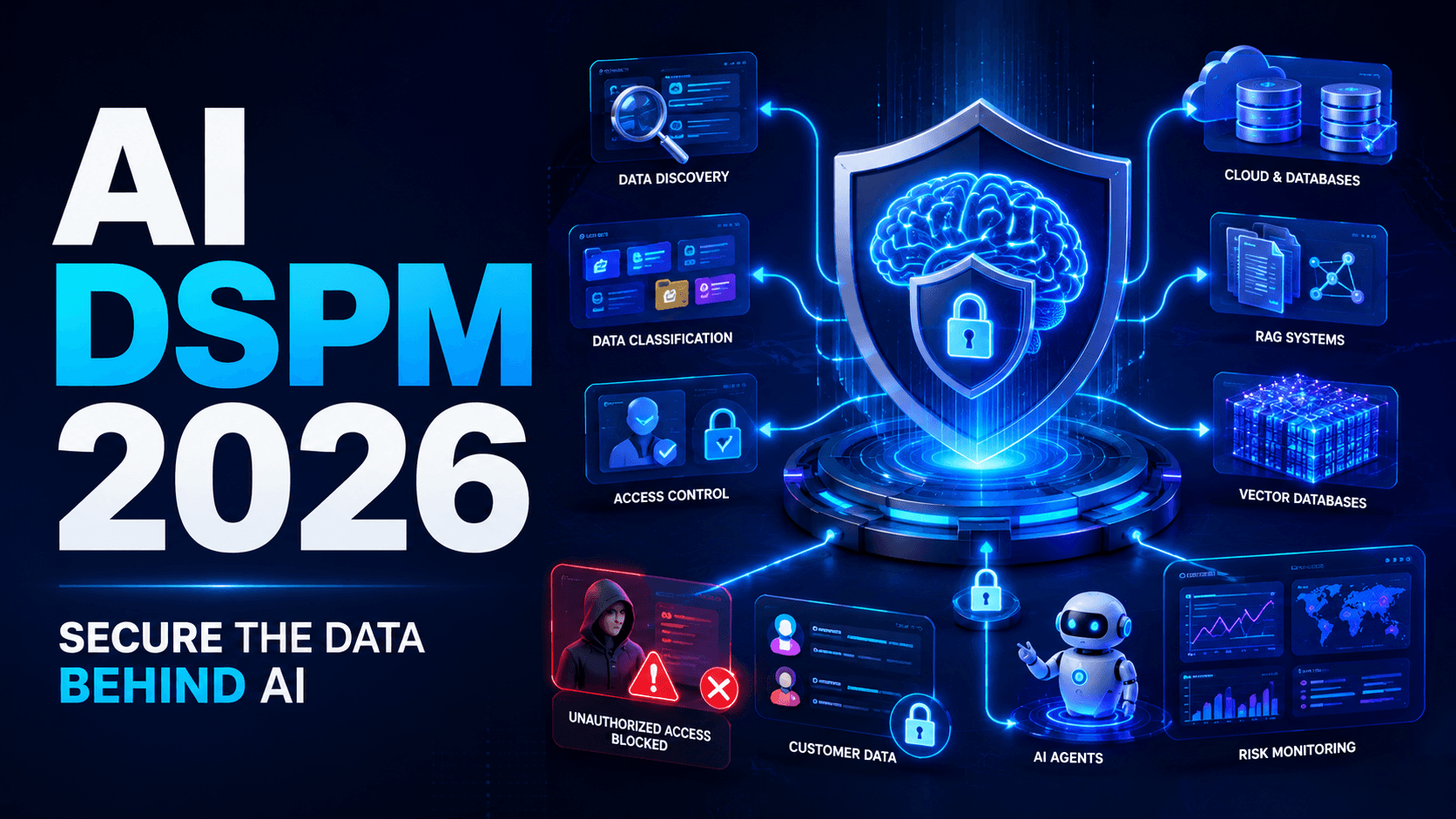
AI Data Security Posture Management (DSPM) in 2026: Protecting the Data Behind Modern AI
AI DSPM helps businesses discover, classify and protect sensitive data used by AI, RAG systems and AI agents—reducing data exposure while enabling secure enterprise AI adoption.
Artificial intelligence is changing how businesses work with data.
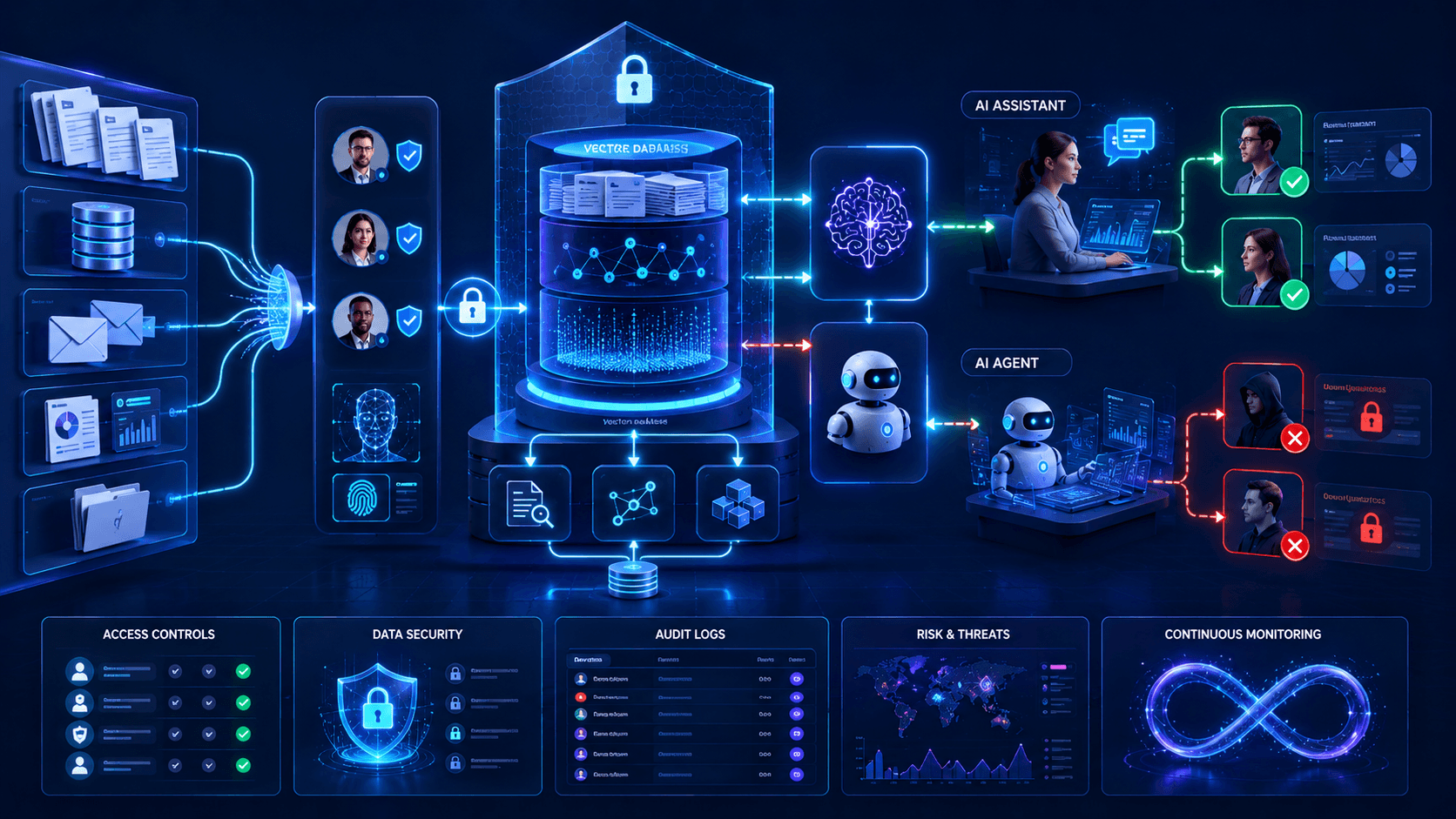
Modern AI applications can access customer records, internal documents, cloud databases, CRM platforms, business analytics, APIs and knowledge bases. Retrieval-augmented generation (RAG) systems can search large collections of company information before generating an answer, while AI agents can increasingly interact with business systems and perform actions.
This creates a new security challenge:
Do businesses actually know what sensitive information their AI systems can access?
Traditional data-security tools were designed primarily around databases, files, cloud storage and applications.
AI introduces another layer.
Sensitive information can now flow through:
AI models
RAG pipelines
Vector databases
Embedding systems
AI agents
Prompt histories
AI development platforms
Cloud AI services
Third-party AI APIs
Knowledge repositories
This is where AI Data Security Posture Management (AI DSPM) becomes increasingly important.
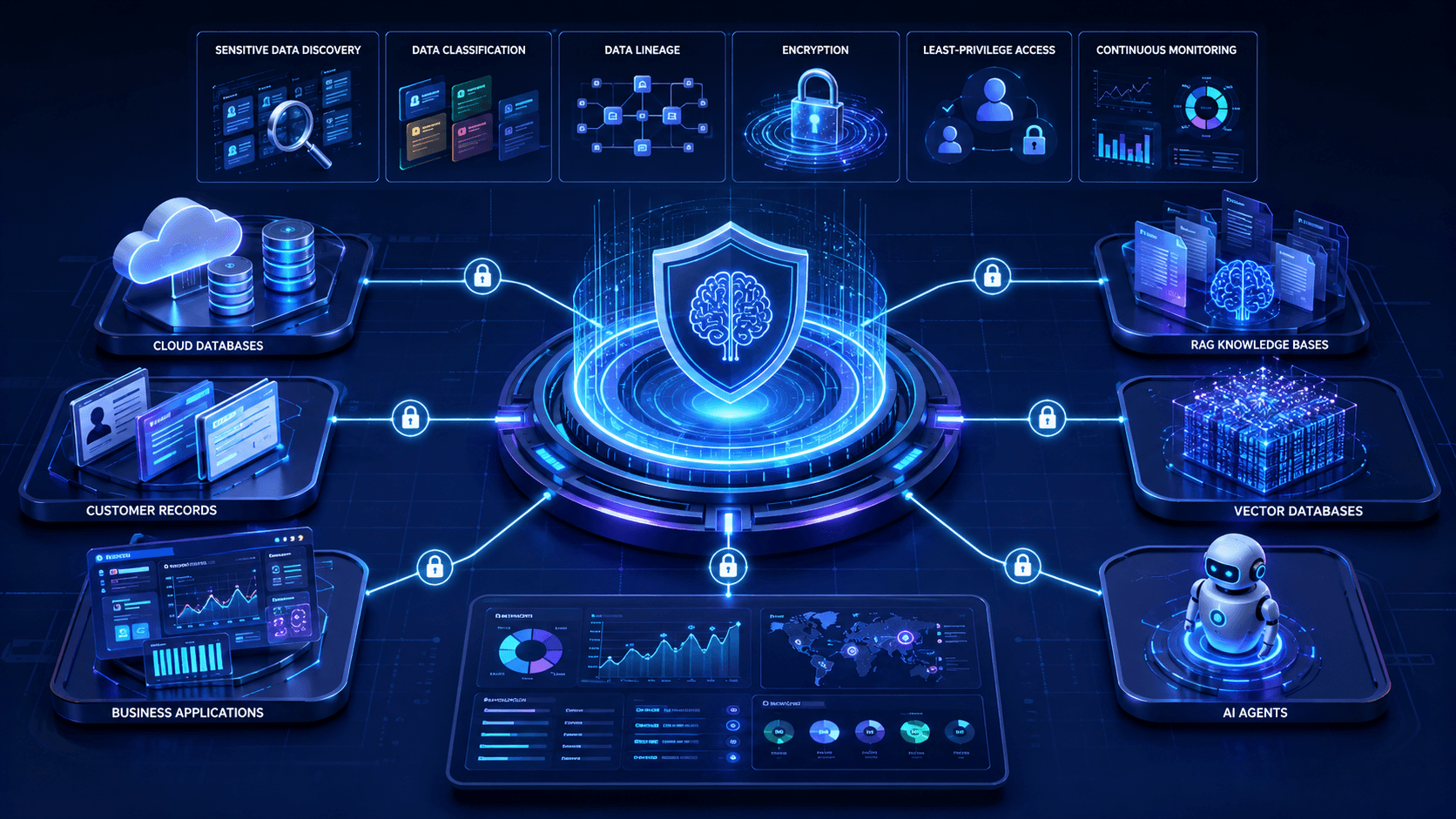
AI DSPM focuses on discovering where sensitive information exists, understanding how AI systems access it, identifying excessive exposure and continuously monitoring the security of data used by AI.
What Is AI Data Security Posture Management?
AI Data Security Posture Management is an approach for discovering, classifying, monitoring and protecting sensitive information across the data environments connected to artificial-intelligence systems.
Traditional DSPM focuses heavily on finding sensitive information across cloud storage, databases and other data repositories.
AI DSPM expands this visibility into AI-specific environments.
A typical AI data-security program may examine:
AI applications
RAG knowledge bases
Vector databases
Embeddings
Cloud storage
Enterprise databases
AI agents
API connections
Prompts and responses
Model-access permissions
Data pipelines
Third-party AI platforms
The objective is simple:
Know what data AI can access, why it can access it, who or what can access it, and whether that access is appropriate.
Why AI Creates a New Data-Security Problem
Businesses already have sensitive data.
The difference is that AI can connect many previously separate systems.
Imagine an enterprise AI assistant connected to:
CRM records
HR documents
financial reports
customer-support tickets
cloud storage
internal emails
product documentation
project-management systems
The assistant may become extremely useful.
But if permissions are poorly configured, an employee could potentially receive information that they were never supposed to see.
The problem may not be the AI model itself.
The real issue could be:
AI + excessive permissions + sensitive data + poor visibility.
This makes data security a foundational requirement for enterprise AI.
The AI Data Security Attack Surface
AI introduces several new places where sensitive information can become exposed.
1. RAG Knowledge Bases
RAG systems retrieve information from business repositories before generating responses.
If the underlying knowledge base contains confidential documents, the AI application must enforce the same access boundaries that exist in the original systems.
A document that should only be visible to the finance department should not suddenly become available to every employee through an AI assistant.
2. Vector Databases
RAG systems frequently convert documents and other information into embeddings that can be stored in vector databases.
These databases can become an important part of the AI data-security architecture.
Security teams should understand:
What information is represented
Where vectors are stored
Who can query them
Which applications can access them
How long they are retained
Whether deleted source information is also removed appropriately
3. AI Agents
AI agents can create an even larger security challenge.
Unlike a simple chatbot, an agent may have permission to interact with:
CRM systems
Databases
Cloud storage
Email platforms
APIs
Ticketing systems
Financial applications
Internal tools
If an agent receives excessive permissions, the potential impact of a compromised or incorrectly behaving system increases.
AI DSPM should therefore consider not only what data exists, but also which AI identities and agents can reach it.
4. AI Development Environments
Developers often need realistic data to test AI applications.
The problem occurs when production information is copied directly into development environments.
Sensitive customer information may then appear in:
Development databases
Testing environments
Notebooks
Debugging systems
Logs
AI evaluation datasets
Organizations should minimize unnecessary movement of production data and consider synthetic or properly protected test data where appropriate.
5. Third-Party AI Services
Businesses increasingly use external AI platforms and APIs.
Before sensitive information is sent to an external service, organizations should understand:
What information is being transmitted
Why it is required
Where it is processed
How access is controlled
How long information is retained
What contractual protections exist
Whether the data can be used for other purposes
AI data security extends beyond the organization's own cloud environment.
AI DSPM vs Traditional DSPM
Traditional DSPM generally answers questions such as:
Where is our sensitive data?
AI DSPM needs to answer additional questions:
Where is our sensitive data being used by AI?
Which AI applications can access it?
Which agents can retrieve it?
Which users can ask AI systems to access it?
Which data is being indexed into RAG systems?
Which sensitive information is entering AI workflows?
This difference is significant.
An organization may have excellent visibility into its databases while having limited visibility into how those databases are being connected to AI applications.
The Most Important AI DSPM Capabilities
Sensitive Data Discovery
The first step is identifying sensitive information.
Organizations may need to discover:
Personally identifiable information
Financial information
Healthcare information
Authentication data
Intellectual property
Confidential contracts
Customer records
Employee information
Business strategies
Discovery should cover both traditional repositories and AI-specific systems.
Data Classification
Not every piece of information has the same security requirements.
Organizations can classify information into categories such as:
Public
Information approved for general access.
Internal
Information intended for employees.
Confidential
Business information requiring controlled access.
Restricted
Highly sensitive information requiring strict controls.
This classification can then influence AI-access policies.
AI Data Lineage
Data lineage helps organizations understand how information moves.
For example:
CRM → Data Pipeline → Vector Database → RAG Application → AI Agent → Employee
This creates a clear picture of where sensitive information travels.
Without lineage, security teams may struggle to understand how a particular AI application is accessing company information.
Access Analysis
AI applications should not automatically receive broad access to every available dataset.
AI DSPM can help identify:
Excessive permissions
Unused access
Overexposed repositories
Unnecessary API connections
Shared credentials
Weak identity controls
The principle should be:
Give AI systems the minimum access required to perform their approved task.
Continuous Monitoring
AI environments change quickly.
New models are deployed.
New agents are created.
New data sources are connected.
New APIs are added.
New employees receive access.
Security therefore cannot depend on a one-time assessment.
Continuous monitoring can help detect changes that increase risk.
RAG Security: The Data Layer Behind Enterprise AI
Retrieval-augmented generation is one of the most practical enterprise AI architectures.
Instead of relying exclusively on information learned during model training, the application retrieves relevant business information before generating a response.
This makes the AI more useful.
But it also means the underlying data becomes part of the AI security boundary.
Consider an internal legal assistant.
It may have access to:
Contracts
Litigation documents
Regulatory material
Internal policies
Customer agreements
If access controls are incorrect, the AI could retrieve documents that the requesting employee should not see.
The solution is not simply to block RAG.
The solution is to build identity-aware, permission-aware and data-aware retrieval.
AI Agents Make Data Security Even More Important
AI agents can perform multi-step workflows.
For example:
Customer request → AI agent → CRM → Order database → Shipping API → Customer notification
Every connection introduces another security decision.
Security teams should ask:
What identity does the agent use?
Which tools can it access?
What information can it retrieve?
What actions can it perform?
Can it create or modify records?
Are permissions temporary?
Are actions logged?
Is human approval required for sensitive operations?
AI DSPM should work alongside identity and access management rather than replacing it.
Protecting Sensitive Data From AI Overexposure
Organizations can use several strategies.
Data Minimization
Only provide AI systems with the information necessary for the task.
If an assistant only needs an order number and delivery status, it may not need complete customer financial information.
Role-Based Access
AI applications should respect the permissions of the user making the request.
A sales employee should not automatically gain access to confidential HR information simply because an AI assistant can technically retrieve it.
Attribute-Based Access
More advanced environments can make decisions based on:
User
Department
Location
Data classification
Application
Purpose
Time
Risk level
This creates more granular control.
Encryption
Sensitive information should be protected during storage and transmission.
Encryption should cover appropriate:
Databases
Cloud storage
APIs
Data pipelines
Backups
AI infrastructure
Short-Lived Credentials
AI agents and automated services should avoid unnecessarily long-lived credentials.
Temporary credentials can reduce the potential impact of credential exposure.
Human Approval
Certain actions should require human confirmation.
Examples may include:
Financial transactions
Customer-account changes
Privileged access
Data deletion
External communications
High-risk administrative operations
Shadow AI and the Data Security Problem
Employees are increasingly experimenting with AI tools.
This can create Shadow AI.
An employee may copy:
Customer information
Internal documents
Code
Contracts
Financial information
into an AI service without security teams knowing.
The challenge is visibility.
Organizations need to understand which AI services are being used and what categories of information may be entering them.
Security policies should not simply say:
“Do not use AI.”
A better strategy is to establish approved AI services, acceptable-use rules, data classifications and monitoring mechanisms.
AI Data Security and Compliance
AI data security can also support broader privacy and compliance programs.
Organizations may need to understand:
What data they collect
Where it is stored
Who can access it
How it is processed
How long it is retained
Where it is transferred
Which third parties receive it
When AI systems are added, these questions become more complex.
Data mapping should therefore include AI applications and AI-enabled workflows.
AI DSPM and Data Loss Prevention
AI DSPM and DLP have overlapping objectives but are not identical.
DLP focuses heavily on preventing unauthorized data movement.
DSPM focuses on understanding the security posture of data.
AI DSPM extends this visibility into AI-related data environments.
Together they can help organizations identify sensitive data and prevent inappropriate movement into AI systems.
A Practical AI DSPM Strategy for Businesses
Step 1: Discover AI Applications
Create an inventory of:
AI models
AI applications
AI agents
RAG systems
AI APIs
Vector databases
AI development platforms
Step 2: Map Sensitive Data
Identify where confidential information exists.
Connect data classification with AI-access information.
Step 3: Map Data Flows
Document how information moves between:
Users → Applications → AI → Data Sources → External Services
Step 4: Review Permissions
Identify AI systems with excessive access.
Remove unnecessary permissions.
Step 5: Secure RAG Systems
Apply document-level and user-level access controls to retrieval systems.
Step 6: Protect AI Agents
Give agents narrowly defined permissions and monitor their actions.
Step 7: Monitor AI Data Usage
Look for:
Sensitive prompts
Unusual retrieval activity
Unexpected data access
New AI connections
Excessive permissions
Unknown AI services
Step 8: Test the System
Security teams should test whether users or AI applications can retrieve information outside their authorized scope.
Step 9: Establish Governance
Create clear rules for:
Approved AI systems
Sensitive data
AI access
Agent permissions
Third-party services
Data retention
Incident response
Common AI Data Security Mistakes
Giving AI Broad Database Access
An AI application rarely needs unrestricted access to an entire production database.
Ignoring Vector Databases
Security teams may protect the original documents while overlooking the AI retrieval layer.
Forgetting AI Agents
Agents can have permissions that traditional application inventories do not capture.
Copying Production Data Into Development
This increases exposure unnecessarily.
Assuming Internal AI Is Automatically Safe
An internally hosted model can still have poorly configured access to sensitive information.
Ignoring Shadow AI
Employees may introduce unmanaged AI services into business workflows.
Treating AI Security as Only a Model Problem
Many AI risks originate in data, identity, permissions and integrations rather than the model itself.
The Future of AI Data Security
As businesses deploy more AI agents, RAG applications and autonomous workflows, data security will increasingly become part of AI architecture rather than a separate security function.
The future enterprise AI environment may look like:
Identity → Data Discovery → Classification → AI Access → Retrieval → Model → Agent → Tool → Monitoring
Every stage creates a security decision.
Organizations that build strong data visibility early will be better positioned to scale AI without losing control over sensitive information.
The key question will no longer be:
“Which AI model are we using?”
It will increasingly become:
“What information can that AI access, and can we prove that access is appropriate?”
Final Thoughts
AI can create enormous business value, but AI is only as secure as the data and permissions surrounding it.
AI Data Security Posture Management provides a framework for understanding the relationship between sensitive business information and modern AI systems.
By discovering sensitive data, mapping AI data flows, enforcing least-privilege access, securing RAG environments, monitoring AI agents and controlling third-party AI services, businesses can build a much stronger foundation for enterprise AI.
The goal is not to prevent AI from accessing data.
The goal is to make sure AI accesses the right data, for the right purpose, with the right permissions, under continuous security monitoring.
That is the foundation of responsible enterprise AI in 2026.
Frequently Asked Questions
What is AI DSPM?
AI Data Security Posture Management is an approach for discovering, classifying, monitoring and protecting sensitive information used by AI systems.
Why is AI DSPM important?
AI applications can connect models, agents, databases, cloud systems and business applications. AI DSPM helps organizations understand and control these data relationships.
What is the difference between DSPM and AI DSPM?
Traditional DSPM focuses primarily on the security posture of data repositories. AI DSPM extends this visibility into AI applications, RAG systems, vector databases, agents and AI data workflows.
Does AI DSPM replace DLP?
No. AI DSPM and DLP address different but complementary security requirements.
How does AI DSPM help RAG security?
It helps organizations discover sensitive data used by RAG systems, understand retrieval paths and identify excessive access to protected information.
Why do AI agents need data-security controls?
AI agents may connect to multiple business systems and perform actions. Limiting their permissions reduces unnecessary exposure and potential impact.
What should businesses secure first?
Start with sensitive-data discovery, AI application inventory, identity controls, RAG permissions, agent access and continuous monitoring.
Can AI DSPM prevent Shadow AI?
It can improve visibility into AI usage and help organizations identify unmanaged AI services, but it should be combined with governance, employee education and appropriate security controls.
Recommended CTA:
Building AI systems but concerned about data exposure? Talk to Arrowhead DigiTech about AI data security, secure AI architecture, data governance and enterprise cybersecurity solutions.