AI Governance in 2026: How Businesses Can Use AI Without Losing Control
Businesses are adopting AI faster than their policies can keep up. Learn how a practical AI governance framework can reduce risk without slowing innovation.


Artificial intelligence is becoming part of everyday business operations.
Employees use AI to write emails, prepare reports, analyse documents, create marketing content and answer customer questions. Companies are also deploying AI chatbots, automated hiring tools, recommendation systems, fraud detection platforms and intelligent workflow agents.
The technology can improve productivity and create new services. However, rapid adoption can also introduce risks that are difficult to identify when no one clearly understands which AI systems are being used, what information they receive or who is responsible for their decisions.
An employee may paste confidential customer information into a public AI application. A chatbot may provide an inaccurate answer. An automated hiring system may create unfair outcomes. AI-generated content may be published without appropriate disclosure or human review.
These are not only technology problems.
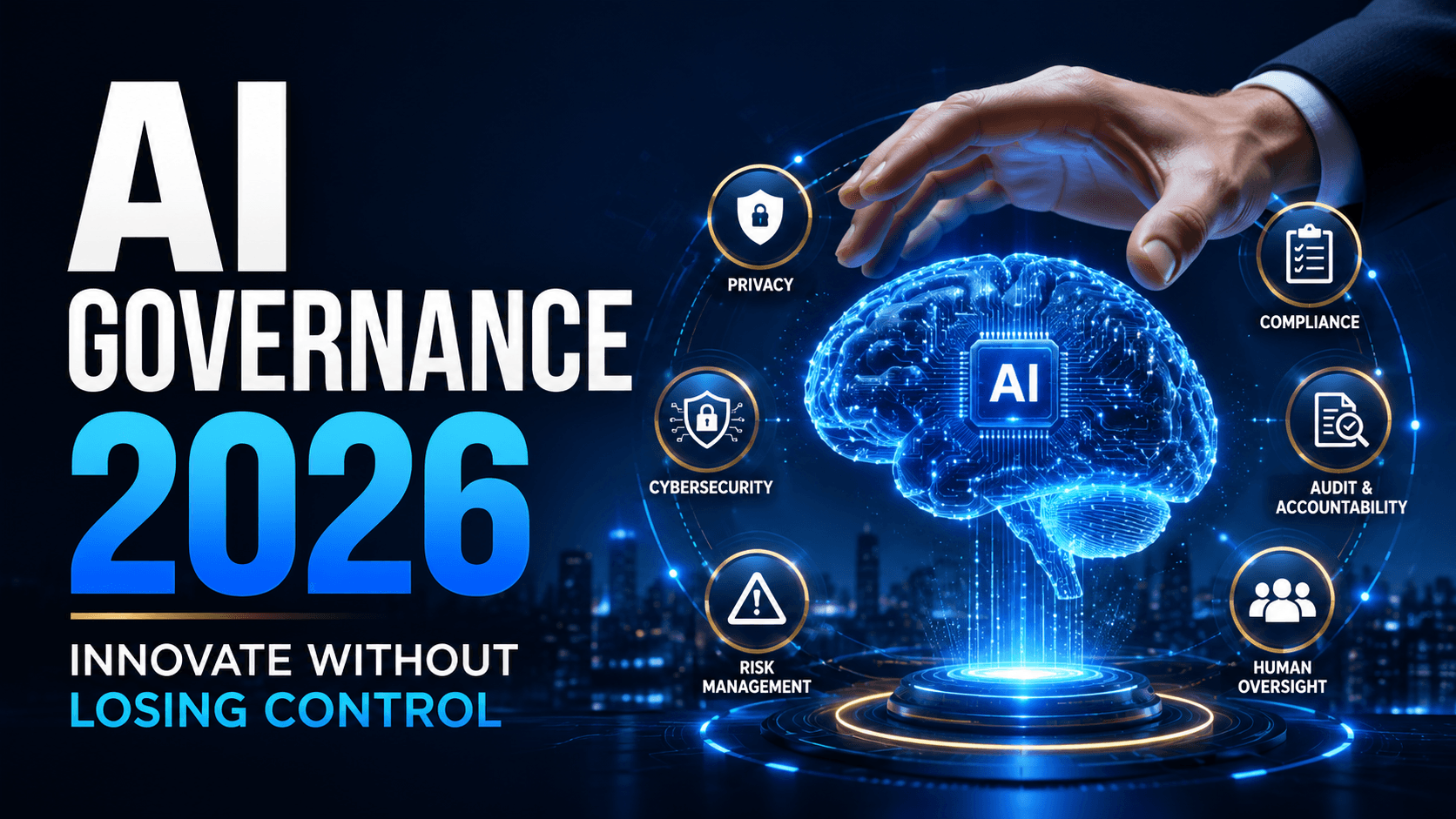
They involve privacy, cybersecurity, legal responsibility, customer trust, employee training and business reputation.
This is why AI governance has become an important business priority in 2026.
The European Union’s AI Act entered into force on 1 August 2024 and becomes broadly applicable on 2 August 2026, although different requirements and exceptions follow their own implementation schedules. AI literacy requirements and certain prohibited-use rules have already applied since 2 February 2025.
At Arrowhead DigiTech, we help businesses create practical AI policies, secure technology environments and responsible automation workflows that support innovation without sacrificing control.
What Is AI Governance?
AI governance is the collection of policies, responsibilities, technical controls and review processes used to manage artificial-intelligence systems throughout their lifecycle.
It helps a business answer questions such as:
- Which AI systems are employees allowed to use?
- What information can be entered into those systems?
- Who approved the AI application?
- How was the system tested?
- Can a human review or reverse its decisions?
- How are errors reported?
- Are customers informed when they interact with AI?
- What happens when an AI provider changes its model?
- Who is responsible if the system creates harm?
AI governance does not mean preventing employees from using AI.
Its purpose is to ensure that AI is selected, deployed and monitored according to the organisation’s business goals, risk tolerance and responsibilities.
A useful governance framework should cover both internally developed systems and third-party tools purchased from external providers.
Why Businesses Need AI Governance Now
Many organisations have adopted AI through individual departments rather than through a coordinated company strategy.
Marketing teams may use one writing tool. Human resources may use an automated screening platform. Customer service may introduce a chatbot, while employees independently experiment with several free AI applications.
This creates shadow AI: the use of artificial-intelligence tools without formal approval, visibility or security review.
Without governance, a business may not know:
- Which tools are processing company information
- Where customer data is being sent
- Whether prompts are stored
- Whether outputs are reviewed
- Whether the provider uses submitted information for training
- Which employees have access
- Whether the system is producing biased or inaccurate results
AI governance creates a structured process for discovering and managing these systems.
NIST’s voluntary AI Risk Management Framework helps organisations address AI risk through four connected functions: Govern, Map, Measure and Manage. The framework is designed for organisations that develop, deploy or use AI systems.
AI Governance Is Not Only for Large Technology Companies
A small business may not train its own foundation model, but it can still face significant AI risk.
Examples include:
- A healthcare company using AI to summarise patient communications
- A recruitment agency using automated candidate ranking
- A retailer using AI-based product recommendations
- A financial company using fraud-detection software
- A home-care provider using an AI scheduling assistant
- A marketing agency generating customer content
- A law firm reviewing confidential documents with AI
- A customer-service team using an automated chatbot
The organisation may be considered a user or deployer rather than the original provider of the AI model. However, it remains responsible for how the technology is used within its own business processes.
The level of governance should reflect the potential consequences of the system.
An AI tool creating draft social-media captions generally requires different controls from a system influencing hiring, healthcare, lending or access to important services.
Understanding AI Risk Levels
Businesses should classify AI systems according to their purpose and potential impact.
Low-Risk AI
Low-risk systems may include tools that:
- Brainstorm internal ideas
- Correct grammar
- Format non-sensitive documents
- Generate draft social content
- Organise public information
These systems may require basic data rules, employee training and human review.
Moderate-Risk AI
Moderate-risk systems may include:
- Customer-service chatbots
- Product recommendations
- Sales lead scoring
- Business forecasting
- Employee productivity monitoring
- Automated marketing personalisation
These applications may require more extensive testing, monitoring, disclosure and approval processes.
High-Impact AI
High-impact systems may influence:
- Recruitment
- Employment decisions
- Healthcare
- Credit
- Insurance
- Education
- Legal services
- Biometric identification
- Essential public or private services
These systems deserve stronger documentation, testing, human oversight and specialist review.
The European Commission published draft guidelines in 2026 to help providers and deployers determine whether an AI system falls within the AI Act’s high-risk classification. A further targeted consultation remains open until 23 July 2026, meaning businesses should continue monitoring the final guidance rather than relying on assumptions.
The Main Risks Businesses Should Govern
Privacy and Confidentiality
Employees may unintentionally enter customer records, financial details, source code, contracts or internal strategy documents into public AI applications.
Businesses should clearly define which information can and cannot be processed by each AI platform.
Approved enterprise tools may offer stronger contractual and privacy protections than free consumer applications, but their settings and agreements must still be reviewed.
Inaccurate Outputs
Generative AI can produce confident answers that are incomplete, outdated or incorrect.
AI output should not automatically become a final customer response, medical recommendation, financial decision or legal conclusion.
Human reviewers should verify important information against reliable sources.
Bias and Unfair Outcomes
AI systems may reflect limitations or patterns within their training data, design or deployment environment.
A system used for recruitment, customer eligibility or employee assessment should be evaluated for unfair outcomes across different groups.
Testing should continue after deployment because real-world users and data may differ from the original testing environment.
Cybersecurity
AI applications can introduce new attack surfaces.
Risks may include:
- Prompt injection
- Data leakage
- Malicious files
- Stolen API keys
- Excessive agent permissions
- Unsafe external integrations
- Model manipulation
- Insecure plugins
- Compromised third-party providers
AI security should be integrated with identity management, network protection, monitoring and incident response.
Intellectual Property
Employees may use copyrighted, confidential or third-party material when generating content.
Businesses should establish rules for source verification, licensing, originality and approval before publishing AI-assisted work.
Lack of Transparency
Customers may believe they are communicating with a person when they are actually interacting with an AI system.
The EU AI Act includes transparency requirements for certain AI interactions and AI-generated or manipulated content. Relevant Article 50 obligations become applicable from 2 August 2026, including specific requirements around AI-generated content and deepfakes.
Over-Automation
Not every process should be completely automated.
AI may be able to recommend, prioritise or prepare an action without having authority to execute it independently.
Businesses should define where human approval is required, particularly for:
- Financial transactions
- Employee decisions
- Customer account changes
- Legal communications
- Healthcare decisions
- Deleting information
- Publishing public content
- Accessing sensitive systems
AI Literacy Is Now a Business Responsibility
Employees cannot follow an AI policy that they do not understand.
AI literacy includes the knowledge and practical awareness required to use AI systems responsibly and recognise their opportunities, limitations and risks.
The EU AI Act’s AI literacy requirement has applied since 2 February 2025. It requires providers and deployers to take measures to ensure a sufficient level of AI literacy among staff and others using AI systems on their behalf.
Training should reflect the employee’s role.
A marketing employee may need guidance on copyright, accuracy and content disclosure.
A developer may need training on model security, API access and technical testing.
A human-resources team may need stronger education about bias, candidate rights and human review.
Useful AI literacy training should address:
- Approved AI platforms
- Confidential-data restrictions
- Verification of outputs
- Prompt security
- Bias awareness
- Customer disclosure
- Escalation procedures
- Human oversight
- Reporting incidents
A single general presentation is unlikely to be sufficient for every employee and every system.
What an AI Governance Policy Should Include
A practical policy should be understandable to employees rather than written only for lawyers or technical specialists.
Approved and Prohibited Tools
Create a list of approved AI platforms and explain how employees can request approval for a new tool.
Do not rely only on blocking websites. Employees need to understand why certain tools are restricted.
Data-Handling Rules
Define which information may be entered into AI systems.
Common prohibited categories may include:
- Passwords
- Private customer information
- Medical information
- Payment-card data
- Confidential contracts
- Unreleased financial results
- Proprietary source code
- Employee records
- Authentication credentials
Different rules may apply to different approved platforms.
Human Review Requirements
Explain which outputs require review before being used.
High-impact content should normally be checked for accuracy, privacy, fairness, tone and regulatory concerns.
Transparency Rules
Specify when customers, employees or the public should be informed that AI was used.
From 2 August 2026, relevant providers and deployers falling within Article 50 must comply with applicable EU transparency obligations for certain AI-generated or manipulated content. The European Commission has also published a voluntary Code of Practice to support implementation.
Incident Reporting
Employees should know how to report:
- Incorrect AI decisions
- Data exposure
- Offensive outputs
- Security concerns
- Unexpected system behaviour
- Customer complaints
- Policy violations
Reporting should be simple and should not discourage employees from raising concerns.
Ownership and Responsibility
Every important AI system should have a named business owner.
This person does not need to build the model, but should be responsible for coordinating approval, documentation, monitoring and review.
Create an AI System Inventory
A business cannot govern systems it does not know exist.
An AI inventory should document:
- System name
- Business purpose
- Provider
- Responsible department
- Business owner
- Data processed
- User groups
- Risk classification
- External integrations
- Human-review process
- Contract status
- Security review
- Deployment date
- Monitoring schedule
The inventory should cover AI embedded within other software.
A company may use AI through a CRM, recruitment platform, security system or productivity suite without employees considering it a separate AI product.
The inventory should therefore review the functionality of existing software as well as newly purchased tools.
Assess AI Vendors Before Purchase
A professional website and strong sales presentation do not automatically make an AI provider trustworthy.
Before purchasing a system, businesses should ask:
- What information does the system collect?
- Where is the information stored?
- Is submitted data used for model training?
- Can training use be disabled?
- Which subcontractors process the data?
- How long are prompts and outputs retained?
- What security certifications are available?
- Can the system explain important decisions?
- Does the platform maintain audit logs?
- Can business data be deleted?
- How are model changes communicated?
- What happens when the contract ends?
The answers should be documented rather than accepted only through informal sales discussions.
Build Human Oversight Into the Workflow
Human oversight should be designed before deployment.
It should not depend on an employee occasionally noticing that something looks wrong.
A meaningful oversight process should define:
- Who reviews the output
- What the reviewer must verify
- Which decisions require approval
- How a decision can be challenged
- How the system can be paused
- Who receives an escalation
- How errors are documented
- How affected customers are informed
The reviewer must also have enough knowledge, authority and time to challenge the AI system.
A human approval button provides limited protection when employees are expected to accept every recommendation without meaningful examination.
Test AI Before and After Deployment
AI testing should evaluate more than technical accuracy.
Businesses may need to examine:
- Correctness
- Reliability
- Bias
- Security
- Privacy
- User experience
- Explainability
- Accessibility
- Failure behaviour
- Human override
- Performance changes
Testing should use scenarios that reflect the real business environment.
A customer chatbot should be tested with unclear, hostile, unusual and sensitive questions rather than only with ideal examples.
A document-analysis system should be tested with incomplete, conflicting and incorrectly formatted files.
AI risk does not end when the application is launched. Models, data, users and providers can change over time.
Monitor AI Systems Continuously
Monitoring can help identify:
- Inaccurate answers
- Increased customer complaints
- Unusual access
- Biased outcomes
- Model-performance decline
- Policy violations
- Provider changes
- Security incidents
- Excessive automation
- Higher operating costs
Businesses should define measurable performance and risk indicators before deployment.
A chatbot may be measured through resolution rate and customer satisfaction, but governance monitoring should also examine escalation failures, unsafe answers and disclosure compliance.
NIST’s AI RMF emphasises that identified AI risks should be measured, prioritised and managed throughout the AI lifecycle rather than evaluated only once.
Manage Third-Party and Embedded AI
A business may depend on several external providers within one AI workflow.
For example:
- A website collects customer information
- An AI model analyses the request
- A CRM stores the output
- An automation platform triggers an email
- A cloud provider hosts the application
- An analytics platform records behaviour
Each component introduces data, security and availability dependencies.
Governance should examine the complete workflow rather than reviewing only the central AI model.
The business should understand what happens when:
- One provider experiences an outage
- An API changes
- A model becomes unavailable
- Pricing increases
- A vendor changes its privacy terms
- Data must be migrated
- The system produces a harmful result
AI Governance for Marketing Content
Marketing teams are among the most active users of generative AI.
AI can help with:
- Blog outlines
- Social-media drafts
- Advertising concepts
- Email campaigns
- Image generation
- Market research
- Content repurposing
However, marketing content can also create copyright, accuracy and transparency risks.
A governance process should require teams to:
- Verify factual claims
- Review images and visual details
- Check brand consistency
- Avoid fake testimonials
- Confirm permissions
- Protect customer information
- Disclose AI-generated content where required
- Maintain human editorial responsibility
AI should accelerate the creative process without removing accountability from the business publishing the content.
What Businesses Should Do Now
1. Discover Existing AI Use
Survey departments and employees to identify official and unofficial AI tools.
The objective should initially be visibility rather than punishment.
2. Create an AI Inventory
Document each system, its purpose, data, provider, owner and risk level.
3. Publish an Interim AI Policy
Do not wait for a perfect governance programme.
Begin with clear rules covering approved tools, confidential data, human review and incident reporting.
4. Provide Role-Based Training
Train employees according to how they use AI and the risks associated with their work.
5. Review High-Impact Systems First
Prioritise systems affecting people, sensitive information, financial decisions or important business operations.
6. Assess Providers and Contracts
Review data processing, retention, security, model training, subcontractors and exit options.
7. Establish Human Approval Points
Identify actions that AI may recommend but should not execute independently.
8. Create Monitoring and Audit Processes
Track system performance, errors, complaints, access and important changes.
9. Monitor Legal Developments
AI requirements are evolving across jurisdictions.
For EU-related activities, businesses should particularly monitor the AI Act’s transparency requirements, GPAI enforcement developments and final high-risk classification guidance.
Common AI Governance Mistakes
Banning Every AI Tool
A complete ban may encourage employees to hide their usage.
A controlled approval process is usually more practical.
Approving AI Without Understanding the Data
The business should know what information the system receives and where it goes.
Depending Entirely on the Vendor
The provider may build the technology, but the customer organisation controls its business use.
Treating Every AI System the Same
Governance should reflect the potential consequences of each system.
Writing a Policy Without Training
A document stored in a company folder will not change behaviour by itself.
Assuming Human Review Automatically Solves Risk
Human reviewers need clear responsibilities, knowledge and authority.
Forgetting to Monitor Model Changes
Cloud-based AI systems may change after deployment. Businesses should review provider updates and test important workflows regularly.
What Arrowhead DigiTech Is Doing
At Arrowhead DigiTech, we help businesses adopt AI through practical governance, security and implementation processes.
Our services include:
AI Readiness Assessments
We review business goals, current tools, sensitive data and operational risks before recommending automation.
AI System Inventories
We help organisations document approved and unapproved AI applications across departments.
Responsible AI Policies
We develop practical internal guidance covering tool approval, data handling, human review and employee responsibilities.
AI Workflow Design
We build structured automation processes with appropriate approval points, access limitations and escalation paths.
Secure AI Integration
We connect AI systems with websites, CRM platforms, cloud services and business applications using controlled permissions.
AI Vendor Reviews
We help businesses evaluate provider security, privacy, data use, integration and operational dependencies.
Employee AI Training
We provide role-relevant guidance for responsible use, privacy, verification and security.
Monitoring and Analytics
We help organisations track system performance, errors, customer outcomes and business value.
Custom AI Development
We build AI assistants, workflow agents and automation solutions designed around the organisation’s requirements and governance controls.
Our objective is not to slow AI adoption.
We help businesses use AI in a way that is secure, measurable, maintainable and aligned with their responsibilities.
A Practical AI Governance Roadmap
Businesses can divide implementation into five stages.
Stage One: Discovery
Identify existing AI systems, users, data and business purposes.
Stage Two: Classification
Evaluate the potential impact and assign a risk level.
Stage Three: Governance Design
Create policies, ownership, approval requirements and vendor controls.
Stage Four: Implementation
Train employees, secure integrations and establish human oversight.
Stage Five: Monitoring
Review system performance, legal changes, incidents and business outcomes.
This phased approach allows organisations to improve governance while continuing to benefit from responsible innovation.
Final Thoughts
Artificial intelligence is becoming too important to manage through informal decisions and individual employee preferences.
Businesses need visibility into which AI systems they use, what information those systems process and how automated decisions affect customers, employees and operations.
AI governance provides this structure.
It combines policies, training, documentation, testing, human oversight, cybersecurity and continuous monitoring.
The regulatory environment is also becoming more active. The EU AI Act becomes broadly applicable on 2 August 2026, while transparency rules for certain AI-generated content take effect and final guidance for high-risk systems continues to develop.
Businesses should not wait until an AI incident, customer complaint or regulatory inquiry exposes weaknesses in their processes.
Arrowhead DigiTech helps organisations establish responsible AI foundations through readiness assessments, governance policies, secure automation, custom development and ongoing monitoring.
The companies that succeed with AI will not necessarily be those that deploy the largest number of tools.
They will be the companies that understand what their AI systems are doing, where the risks exist and when human judgment must remain in control.
Frequently Asked Questions
What is AI governance?
AI governance is the system of policies, responsibilities, technical controls and monitoring processes used to manage artificial-intelligence systems responsibly.
Does a small business need AI governance?
Yes. Even small businesses may process confidential information, generate customer content or make automated recommendations through AI tools.
What is shadow AI?
Shadow AI is the use of AI applications without formal approval, security review or organisational visibility.
What is AI literacy?
AI literacy is the knowledge and understanding needed to use AI systems appropriately while recognising their benefits, limitations and potential risks.
When does the EU AI Act apply?
The Act entered into force on 1 August 2024 and becomes broadly applicable on 2 August 2026, although certain requirements became applicable earlier and some follow separate schedules.
Should every AI output be reviewed by a person?
The level of review should reflect the risk. Important customer, employment, financial, healthcare or public content should receive meaningful human oversight.
How can Arrowhead DigiTech help?
Arrowhead DigiTech provides AI readiness assessments, internal policies, secure integrations, workflow automation, employee training, vendor reviews and custom AI development.
This article provides general business and technology information and should not be treated as legal or regulatory advice. Organisations should consult qualified legal, privacy and compliance professionals regarding requirements applicable to their activities.