
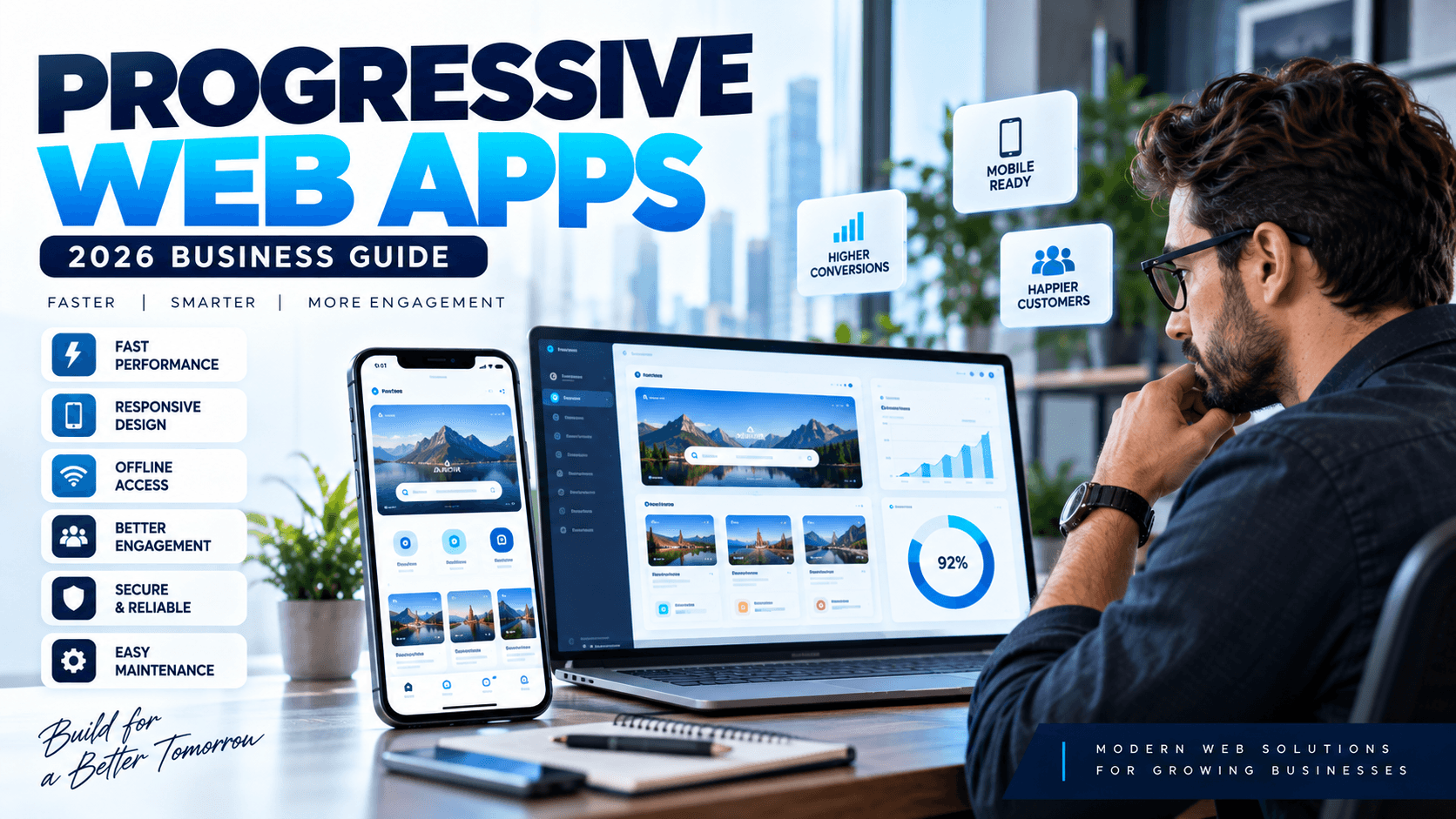
Progressive Web App Development in 2026: How Businesses Can Improve Mobile Experiences
Customers expect fast and convenient digital experiences on their mobile devices. Progressive Web Apps help businesses deliver app-like experiences through the web while improving accessibility, performance and customer engagement.


Customers increasingly use smartphones to search for services, explore products and interact with businesses. If a website is slow, difficult to navigate or inconvenient on mobile devices, users may leave before completing an action.
This is where Progressive Web App development can provide a valuable solution.
Progressive Web Apps, commonly known as PWAs, combine important features of websites and mobile applications. They can offer a fast, responsive and app-like experience while allowing users to access the platform through a web browser.
What Is a Progressive Web App?
A Progressive Web App is a web application designed to provide an enhanced mobile and desktop experience.
Unlike a traditional website, a PWA can support features such as:
Responsive app-like interfaces
Installation on supported devices
Offline or limited-connectivity experiences
Push notifications where supported
Faster repeat visits
Reliable navigation
Improved mobile usability
The available features depend on the browser, device and technical implementation.
The main objective is to make a digital experience more convenient without requiring every user to download a traditional mobile application.
Why PWA Development Matters in 2026
Mobile users expect websites to load quickly and function smoothly.
Traditional websites can be effective, but some businesses need more interactive experiences, especially when customers frequently return to the platform.
A well-designed PWA can help businesses create a more engaging experience by combining web accessibility with selected application-style features.
This can be useful for businesses that want to improve customer interaction without immediately developing separate native applications for every platform.
Improve the Mobile User Experience
A poor mobile experience can make it difficult for customers to complete important actions.
For example, users may struggle with:
Complicated navigation
Slow page loading
Difficult forms
Poorly designed buttons
Unresponsive layouts
Repeated login processes
PWA development focuses on creating a responsive and user-friendly interface that works across supported devices.
A smoother experience can help users browse, interact and complete tasks more comfortably.
Faster Access for Returning Users
Some Progressive Web Apps can be installed on a supported device and accessed through an app-like icon.
This can make it easier for returning users to access a business platform without repeatedly searching for the website.
For businesses with frequently returning customers, this convenience may support stronger engagement.
However, installation behavior and available features depend on the user's device and browser.
Can PWAs Work Offline?
Certain Progressive Web Apps can provide offline or limited-connectivity functionality through caching and service workers.
For example, a business may allow users to view previously loaded information or access selected features when their internet connection is unstable.
Offline capabilities should be planned carefully. Not every feature can work without a network connection, especially when real-time data or secure transactions are required.
Progressive Web Apps for Business Growth
A PWA can support different types of business activities, including:
E-commerce
Businesses can create mobile-friendly shopping experiences with product browsing, cart functionality and supported checkout workflows.
Booking Platforms
Service providers can develop convenient interfaces for appointments, reservations and customer enquiries.
Customer Portals
Businesses can offer customers access to account information, updates and selected services through a web-based platform.
Internal Business Tools
Companies can use web applications for workflows, dashboards and employee-facing processes.
The best use case depends on the business model and customer requirements.
PWA vs. Traditional Mobile App
A Progressive Web App and a native mobile application have different strengths.
PWAs can be accessed through the web and may reduce the need for separate application development across platforms.
Native apps can provide deeper access to certain device features and platform-specific capabilities.
The right choice depends on factors such as:
Required functionality
Target audience
Development budget
Device features
Performance requirements
Maintenance needs
Business goals
Businesses should choose technology based on actual requirements rather than following a trend.
Important Features of a Successful PWA
A professional Progressive Web App should focus on more than appearance.
Responsive Design
The interface should work across different screen sizes.
Fast Performance
Pages and features should be optimized for efficient loading and interaction.
Clear Navigation
Users should be able to find important information without confusion.
Secure Connections
Appropriate security measures, including HTTPS, are essential for modern web applications.
Accessible Experience
The interface should consider readable content, keyboard access, contrast and other accessibility requirements.
Reliable Functionality
The application should be tested across relevant browsers, devices and network conditions.
How Businesses Can Start PWA Development
A successful PWA project begins with planning.
Step 1: Define the Business Objective
Determine whether the application is intended for e-commerce, bookings, customer services or another purpose.
Step 2: Understand the Users
Identify the audience, devices and tasks users need to complete.
Step 3: Plan the Features
Select the features that provide real business value.
Step 4: Design the Experience
Create a clean, responsive and accessible interface.
Step 5: Develop and Test
Build the application and test performance, security and usability.
Step 6: Monitor and Improve
Review user feedback and improve the application as business requirements evolve.
Final Thoughts
Progressive Web App development gives businesses another way to create modern digital experiences.
By combining web accessibility with selected app-like capabilities, PWAs can help businesses improve mobile usability, simplify access and support customer engagement.
In 2026, the goal should not be to develop an application simply because the technology is popular.
The goal is to build a fast, useful and reliable digital experience that solves real customer problems.
FAQs
What is Progressive Web App development? Progressive Web App development involves creating web applications that offer enhanced functionality and an app-like experience through supported web browsers.
Can a PWA work on mobile devices? Yes. PWAs are designed to work across supported mobile and desktop browsers, with certain installation and functionality features depending on the device.
Are Progressive Web Apps better than native apps? They serve different purposes. The right option depends on the required features, target audience, budget and technical requirements.
Can a PWA work without an internet connection? Some PWA features can work offline or with limited connectivity when properly implemented, but offline functionality depends on the application's design.
Are PWAs useful for small businesses? They can be useful for businesses that need a responsive, interactive and convenient web experience without necessarily developing separate native apps for every platform.