
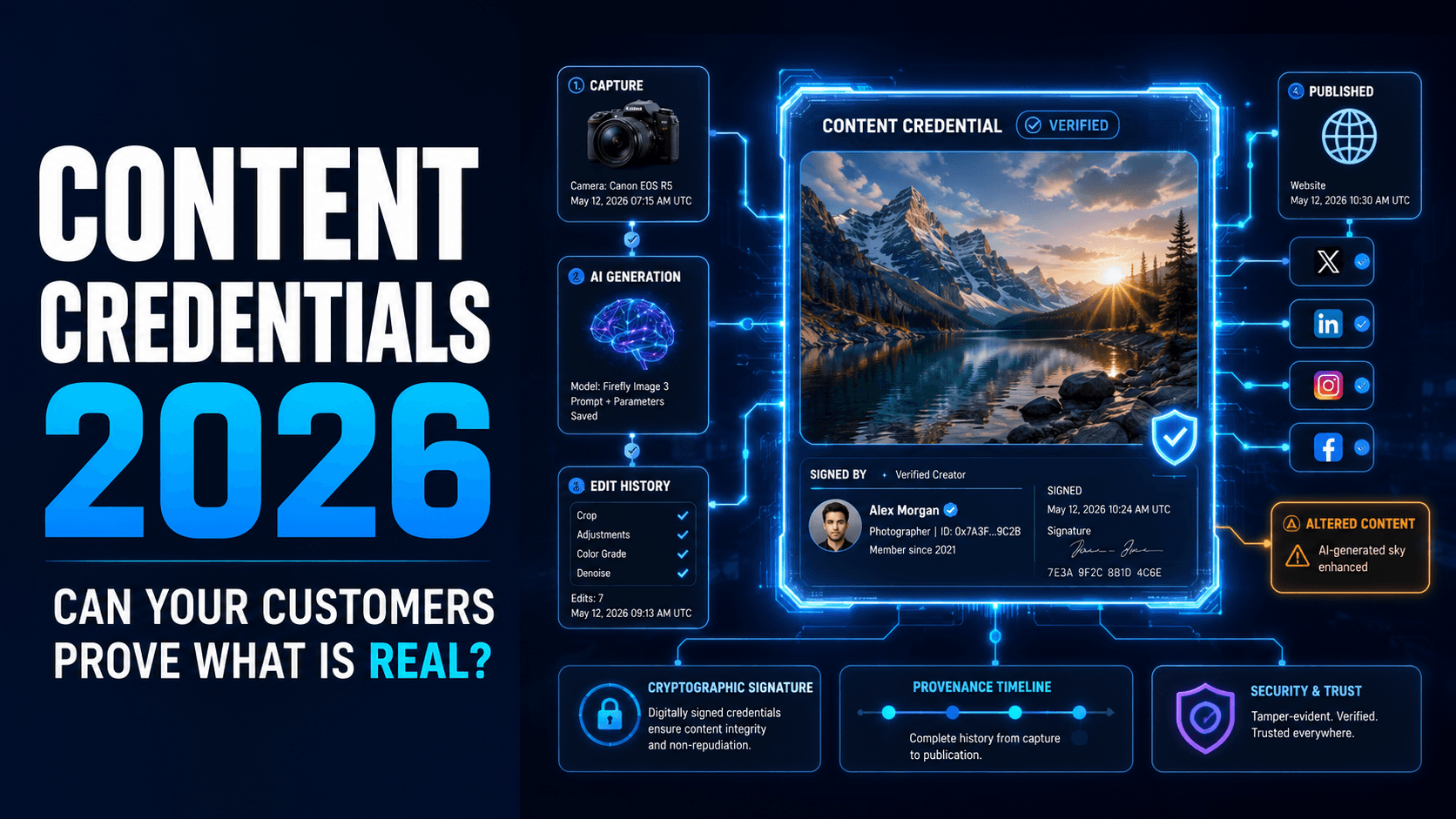
Content Credentials in 2026: How Businesses Can Prove What Is Real Online
AI can now produce realistic images, audio and video within seconds. Learn how Content Credentials help businesses document where digital content came from, how it was edited and whether AI was involved.

Artificial intelligence has dramatically changed how businesses create digital content.
Marketing teams can generate campaign images, product visuals, voiceovers, videos and social-media content within minutes. Designers can modify backgrounds, replace objects and create realistic scenes without organising a traditional photoshoot.
These capabilities can improve productivity and reduce production time.
However, they also create an important trust problem.
Customers may struggle to determine whether an image shows a real event, whether a product photograph was significantly altered or whether a video genuinely came from the company publishing it.
Businesses face a similar challenge internally.
A marketing team may receive a photograph from an agency, freelancer, employee or AI platform without having a reliable record of:
- Who created it
- Which tools were used
- Whether AI was involved
- What edits were made
- Whether the file was altered after approval
- Whether the organisation is authorised to publish it
Traditional metadata can contain some of this information, but it may be incomplete, editable or removed when content is uploaded to another platform.
Content Credentials are designed to provide a more reliable record of digital-content provenance.
The Coalition for Content Provenance and Authenticity, commonly known as C2PA, has developed an open technical standard for documenting the source and history of digital media through cryptographically signed, tamper-evident information.
At Arrowhead DigiTech, we help businesses build content workflows that combine AI productivity with stronger transparency, approval, security and brand control.
What Are Content Credentials?
Content Credentials are digitally signed records attached or connected to digital content.
They can provide information about:
- Who or which organisation created the content
- Which application or device produced it
- Whether generative AI was used
- Which editing actions were performed
- When the credential was added
- Which organisation signed the record
- Whether the content has changed since signing
Adobe describes Content Credentials as an industry-standard form of durable metadata that acts like a digital nutrition label for content. It can show whether content was captured with a camera, edited through creative software or produced using AI.
A user viewing supported content may see a recognised Content Credentials icon and inspect the available provenance information.
The exact information shown depends on the creator, application, platform and privacy settings.
What Is C2PA?
C2PA stands for the Coalition for Content Provenance and Authenticity.
It develops the technical standard behind the wider Content Credentials ecosystem.
The standard provides a structured way for compatible:
- Cameras
- Smartphones
- Editing applications
- AI-generation platforms
- Content-management systems
- News platforms
- Social networks
- Verification tools
to create and inspect signed provenance records.
The current C2PA specification is version 2.4, released in April 2026. It introduced additional asset-format support, new assertions and a JSON-based representation designed to support interoperability and validation reporting.
C2PA reported in February 2026 that its wider ecosystem had grown to more than 6,000 members and affiliates, demonstrating that content provenance is moving from research into practical implementation.
Content Credentials Are Not an AI Detector
Content Credentials and AI-detection software solve different problems.
An AI detector examines a piece of content and estimates whether it may have been generated or altered using artificial intelligence.
A Content Credential records declared and cryptographically signed information about how content was created or edited.
This distinction is important.
AI detectors may produce false positives or fail to recognise content generated by a new model. Content Credentials instead provide provenance evidence from participating tools and organisations.
However, Content Credentials do not automatically prove that every statement shown in an image or video is factually true.
They help answer questions such as:
- Where did this file come from?
- Who signed it?
- Was AI used?
- Which edits were recorded?
- Has the signed information been modified?
Businesses should therefore treat provenance as one layer of verification rather than a complete truth-detection system. This follows from C2PA’s design as a provenance and authenticity standard rather than a factual verification service.
Content Credentials vs. Watermarks
A visible watermark places a name or logo directly on an image or video.
It may discourage unauthorised reuse but can also interfere with the appearance of the content.
A digital watermark may be hidden inside the media and detected through specialised software.
Content Credentials can include signed metadata and may also work with additional durability methods such as digital watermarks and content fingerprinting.
This matters because some websites and social platforms remove metadata during upload or compression.
The Content Authenticity Initiative describes a durable approach using embedded metadata, invisible watermarking and digital fingerprinting so that provenance information may still be recovered after content is modified or stripped of its original metadata.
Why 2026 Is a Turning Point
The ability to identify and label AI-generated content is becoming more than a voluntary brand decision.
Article 50 of the European Union AI Act applies from 2 August 2026.
It includes transparency obligations for certain AI systems and content.
Providers of relevant generative AI systems must support machine-readable marking of AI-generated or manipulated content. Deployers may also need to disclose certain deepfakes and AI-generated or manipulated text published to inform the public about matters of public interest.
The European Commission published a Code of Practice on the transparency of AI-generated content in June 2026. In July, the Commission concluded that the Code adequately addressed the relevant Article 50 obligations.
These developments make content provenance important for organisations that:
- Produce AI-generated media
- Publish content for EU audiences
- Operate marketing platforms
- Manage customer-generated content
- Distribute news or public information
- Create realistic synthetic audio or video
The exact obligations depend on the organisation’s role, content and jurisdiction. Businesses should obtain qualified legal advice for compliance decisions.
Why Businesses Need Media Provenance
Protecting Brand Reputation
A fake advertisement or manipulated executive video can damage customer trust.
Content Credentials can help a company publish signed official media that customers, partners and platforms may verify.
They do not prevent every impersonation attempt, but they provide another way to distinguish approved brand content from unauthorised copies.
Managing AI-Generated Marketing
Marketing teams may use several AI platforms during one campaign.
Without a structured process, the business may lose track of:
- Which assets were AI-generated
- Which assets were only lightly edited
- Which model or application was used
- Who approved the final version
- Whether disclosure is required
Content Credentials can support a more traceable workflow.
Confirming Asset History
A creative asset may pass through a photographer, designer, agency, marketing manager and publishing platform.
A provenance record can preserve information about important stages of that journey.
Supporting Creator Attribution
Creators can use Content Credentials to attach identity or attribution information to their work.
This can help photographers, designers, video producers and agencies demonstrate who produced the original asset.
C2PA’s current guidance also includes recommendations for expressing human and organisational identity through compatible creator-identity specifications.
Reducing Internal Content Risk
Employees may download or reuse digital assets without understanding their origin or licensing status.
A content-verification process can help teams identify whether an asset has approved creator information and a documented production history before publication.
Strengthening Customer Trust
Customers may be more comfortable engaging with media when they can inspect how it was created.
For example, a real-estate company could explain that a room image was digitally staged. An e-commerce brand could disclose that a background was generated while the product itself remained unchanged.
Transparency does not necessarily reduce marketing impact.
When implemented carefully, it can show that the company is using AI responsibly.
Important Business Use Cases
Digital Advertising
Advertising teams can apply credentials to campaign images and videos before distribution.
The credential may record the organisation, production application and AI involvement.
E-Commerce Product Images
An online retailer may use AI to:
- Remove backgrounds
- Create lifestyle scenes
- Adjust lighting
- Generate product variations
- Build promotional videos
Content Credentials can help distinguish authentic product photography from heavily generated or altered presentation.
Businesses should still avoid using AI images that misrepresent a product’s actual size, features, condition or performance.
Corporate Communications
Companies can sign official:
- Executive announcements
- Press images
- Investor videos
- Public statements
- Event recordings
- Product-launch media
This can provide stakeholders with additional evidence that the content came through an approved company workflow.
News and Public Information
Publishers can preserve information from camera capture through editing and publication.
Content provenance does not replace editorial verification, but it can provide useful evidence about the production history of an image or video.
Recruitment
A business may use AI-generated people or voices in a recruitment campaign.
Clear provenance and disclosure can prevent candidates from incorrectly assuming that synthetic individuals are real employees.
Insurance and Documentation
Insurers, property companies and service businesses regularly receive images from customers and contractors.
Provenance information may help establish how an image was captured and whether it was altered.
It should be combined with fraud detection, identity verification and human investigation.
Creative and Marketing Agencies
Agencies can provide clients with signed final assets and a more organised production history.
This can improve approval, accountability and handover between the agency and client.
What Information Can Be Included?
Depending on the implementation, a Content Credential may contain information such as:
- Creator or organisation
- Signing entity
- Date of creation
- Editing application
- AI-generation method
- Content source
- Actions performed
- Related source assets
- Copyright or attribution details
- Credential issue date
Businesses should not automatically include sensitive employee, customer or location information.
Content transparency should be balanced with privacy and operational security.
What Businesses Should Do Now
1. Create a Digital Asset Inventory
Identify where the business creates, stores and publishes:
- Images
- Videos
- Audio
- Advertisements
- Product media
- Social content
- Corporate communications
Document which departments, agencies and platforms are involved.
2. Identify AI-Generated Content
Create a simple classification system such as:
- Camera-captured
- Traditionally edited
- AI-assisted
- Partially AI-generated
- Fully AI-generated
The classification should be based on a consistent internal policy.
3. Establish an AI Disclosure Policy
Define when the company will disclose AI use.
The policy should cover:
- Social-media graphics
- Advertising
- Product images
- Customer testimonials
- AI voices
- Synthetic people
- Public-information content
The organisation should also review whether applicable regulations require a specific disclosure.
4. Review Creative Tools
Ask whether the company’s:
- Cameras
- Editing software
- AI-generation tools
- Digital asset manager
- Content-management system
- Publishing platforms
can create, preserve or display C2PA-compatible Content Credentials.
5. Apply Credentials at the Correct Stage
Where possible, provenance should begin when the content is created or captured.
Additional credentials can then document editing and final approval.
Applying one credential only after the complete history has been lost provides less useful information.
6. Protect Signing Credentials
Digital signatures depend on trusted keys and certificates.
Businesses should control:
- Who may sign company content
- Where signing keys are stored
- Which applications may use them
- How access is logged
- How compromised credentials are revoked
- How keys are rotated
A poorly protected signing identity could allow unauthorised content to appear official.
7. Preserve Credentials Through Publishing
Test whether the website, content-delivery network, social platform and image-optimisation process preserve credential information.
Image compression, resizing and format conversion may affect metadata.
Durable provenance methods may be required for content distributed through platforms that remove embedded information.
8. Verify Incoming Assets
Businesses should inspect media received from:
- Freelancers
- Influencers
- Agencies
- Suppliers
- Customers
- Employees
Content Credentials can provide useful production context, but missing credentials should not automatically mean that the content is fake.
The technology remains opt-in and is not yet present on every platform or device.
9. Connect Credentials With Approval Workflows
The credential process should be integrated with:
- Creative review
- Brand approval
- Legal review
- Copyright checks
- AI disclosure
- Final publishing
This prevents credentials from becoming a disconnected technical feature.
10. Train Employees
Marketing, design and content teams should understand:
- What Content Credentials show
- What they do not prove
- When AI disclosure is required
- How to preserve credentials
- How to verify incoming content
- How to report suspicious media
A Practical Content Provenance Workflow
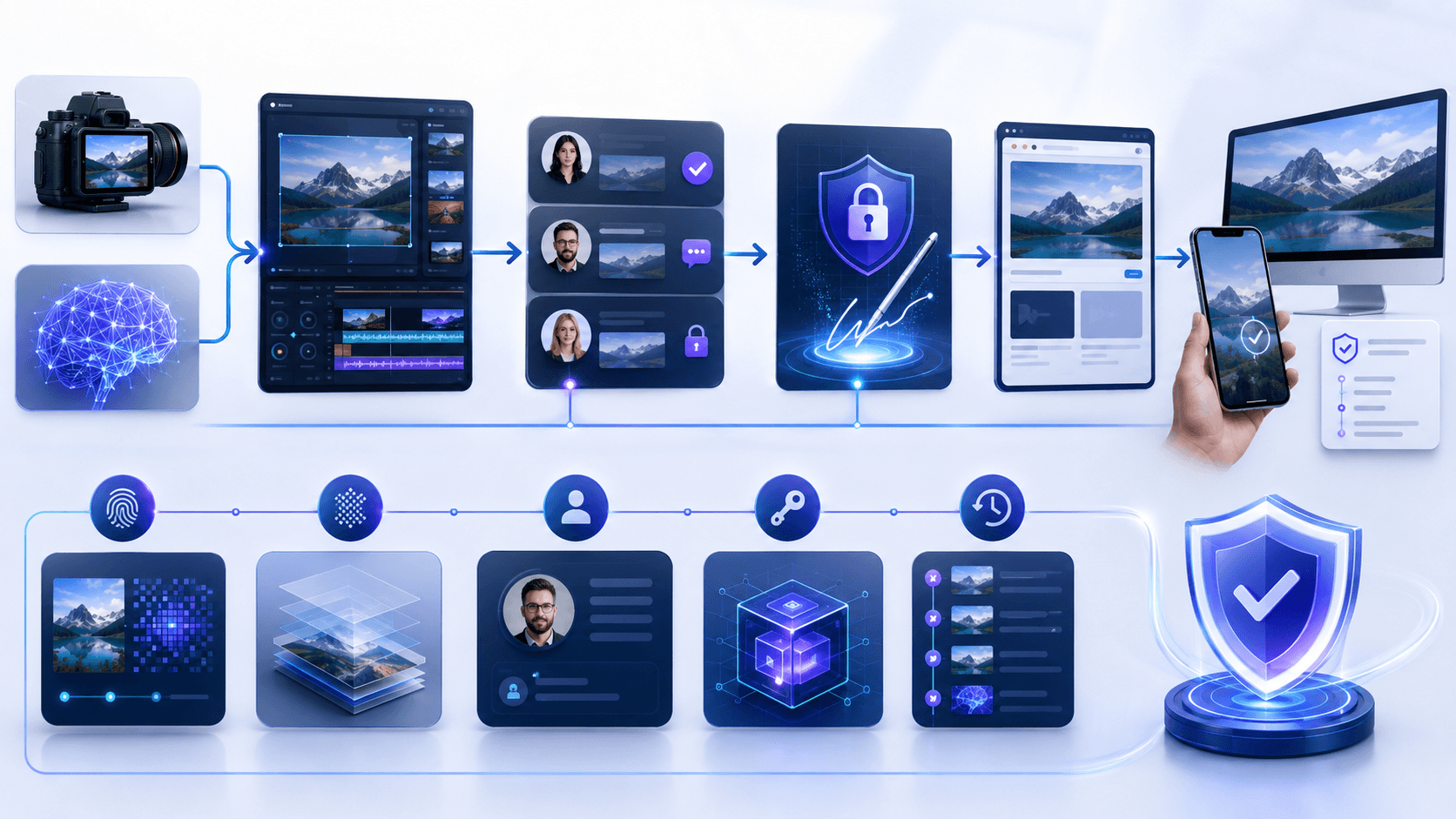
A useful workflow may follow five stages.
Stage One: Creation
The camera, creative platform or AI system records initial provenance.
Stage Two: Editing
Approved modifications are added to the asset history.
Stage Three: Review
Marketing, legal and brand teams confirm the content and disclosure requirements.
Stage Four: Signing and Publishing
The organisation signs the approved asset and publishes it through compatible channels.
Stage Five: Monitoring
The business monitors impersonation, altered copies and unauthorised reuse.
This workflow helps connect technical provenance with real business responsibility.
Content Credentials and Copyright
Content Credentials may help document attribution, creation history and timestamps.
They do not automatically register copyright or guarantee ownership.
A person may sign content that contains material they were not authorised to use.
Businesses should still maintain:
- Creator agreements
- Model releases
- Stock licences
- Music licences
- Customer permissions
- Agency contracts
- Copyright records
Provenance evidence can support copyright management, but it does not replace legal rights or contractual documentation.
Content Credentials and Customer Privacy
A credential should not expose unnecessary personal information.
Businesses should evaluate whether to include:
- Employee names
- Creator profiles
- Social-media accounts
- Device information
- Capture locations
- Production timestamps
Some information may improve attribution, while other details may create privacy or safety concerns.
The company should define which information is public, internal or excluded.
Common Content Credential Mistakes
Treating Credentials as Proof That Content Is True
The credentials record provenance. They do not independently verify every claim within the content.
Adding Credentials Only at Publication
Important creation and editing history may already have been lost.
Ignoring Metadata Removal
Publishing platforms may remove embedded information during processing.
Using AI Disclosure Inconsistently
Different departments may label similar content differently without a shared policy.
Exposing Sensitive Information
Creator identity, location and device details should be reviewed before public disclosure.
Signing Without Protecting Keys
An insecure signing process can damage confidence in every company credential.
Assuming Missing Credentials Mean Fake Content
Participation is voluntary and adoption is still expanding.
Forgetting Agencies and Contractors
External creative partners should follow the same provenance and disclosure standards as internal teams.
What Arrowhead DigiTech Is Doing
At Arrowhead DigiTech, we help businesses build more transparent and secure digital-content operations.
AI Content Workflow Assessments
We review how AI-generated and traditionally created media moves between employees, agencies, tools and publishing platforms.
Content Credential Readiness
We assess whether existing creative tools, websites and asset systems can support C2PA-compatible provenance.
Website and CMS Integration
We help websites preserve and display authenticity information where supported.
Digital Asset Management
We organise approved assets, versions, ownership information and publishing permissions.
AI Disclosure Policies
We help businesses create practical internal rules for AI-generated images, videos, audio and marketing content.
Brand Asset Protection
We establish controlled approval, signing and distribution workflows for official company media.
Content Verification Tools
We integrate verification steps for assets received from employees, agencies, suppliers and customers.
Secure Key Management
We help protect organisational signing credentials through controlled access, storage and monitoring.
Employee Training
We provide clear guidance for marketing, design, communications and management teams.
Ongoing Monitoring
We help businesses identify unauthorised brand content, impersonation attempts and inconsistencies in their publishing processes.
Our objective is not to stop companies from using generative AI.
We help them use AI while maintaining clearer evidence of origin, approval and accountability.
Final Thoughts
Artificial intelligence is making digital content faster and easier to produce.
At the same time, customers are finding it more difficult to determine where online media came from and whether it was significantly altered.
Content Credentials provide one of the strongest emerging technical foundations for addressing this challenge.
They create a signed provenance record that can explain who created content, which tools were involved and whether AI played a role.
The technology is also becoming increasingly relevant to regulation.
From 2 August 2026, the EU AI Act introduces applicable transparency requirements for certain AI-generated and manipulated content, including machine-readable marking obligations for relevant providers.
Businesses should begin by inventorying digital assets, defining an AI-disclosure policy, evaluating compatible tools and protecting the credentials used to sign official content.
Arrowhead DigiTech helps organisations implement this foundation through AI governance, content workflows, website integration, cybersecurity and digital asset management.
In an AI-driven media environment, customers may increasingly ask:
“Is this content real?”
The most prepared businesses will be able to respond with something stronger than a promise.
They will be able to provide a verifiable history.
Frequently Asked Questions
What are Content Credentials?
Content Credentials are cryptographically signed records that provide information about the source, creator and editing history of digital content.
What does C2PA mean?
C2PA stands for the Coalition for Content Provenance and Authenticity, the organisation that develops the open technical standard behind Content Credentials.
Can Content Credentials detect every AI-generated image?
No. They depend on participating tools and platforms recording and preserving provenance information.
Do Content Credentials prove that an image is true?
They provide evidence about origin and editing history, but they do not independently prove every claim shown in the image.
Can credentials be removed?
Embedded metadata may be stripped during publishing. Durable provenance methods can use additional techniques such as watermarking and fingerprinting to help recover credential information.
Are businesses required to label AI-generated content?
Requirements depend on the content, business role and jurisdiction. Relevant EU AI Act transparency obligations apply from 2 August 2026.
Can small businesses use Content Credentials?
Yes. Small businesses can begin by using compatible creative tools, defining an AI-disclosure policy and preserving credentials on important brand assets.
How can Arrowhead DigiTech help?
Arrowhead DigiTech provides AI-content assessments, CMS integration, asset-management workflows, disclosure policies, brand protection, verification tools and cybersecurity support.