
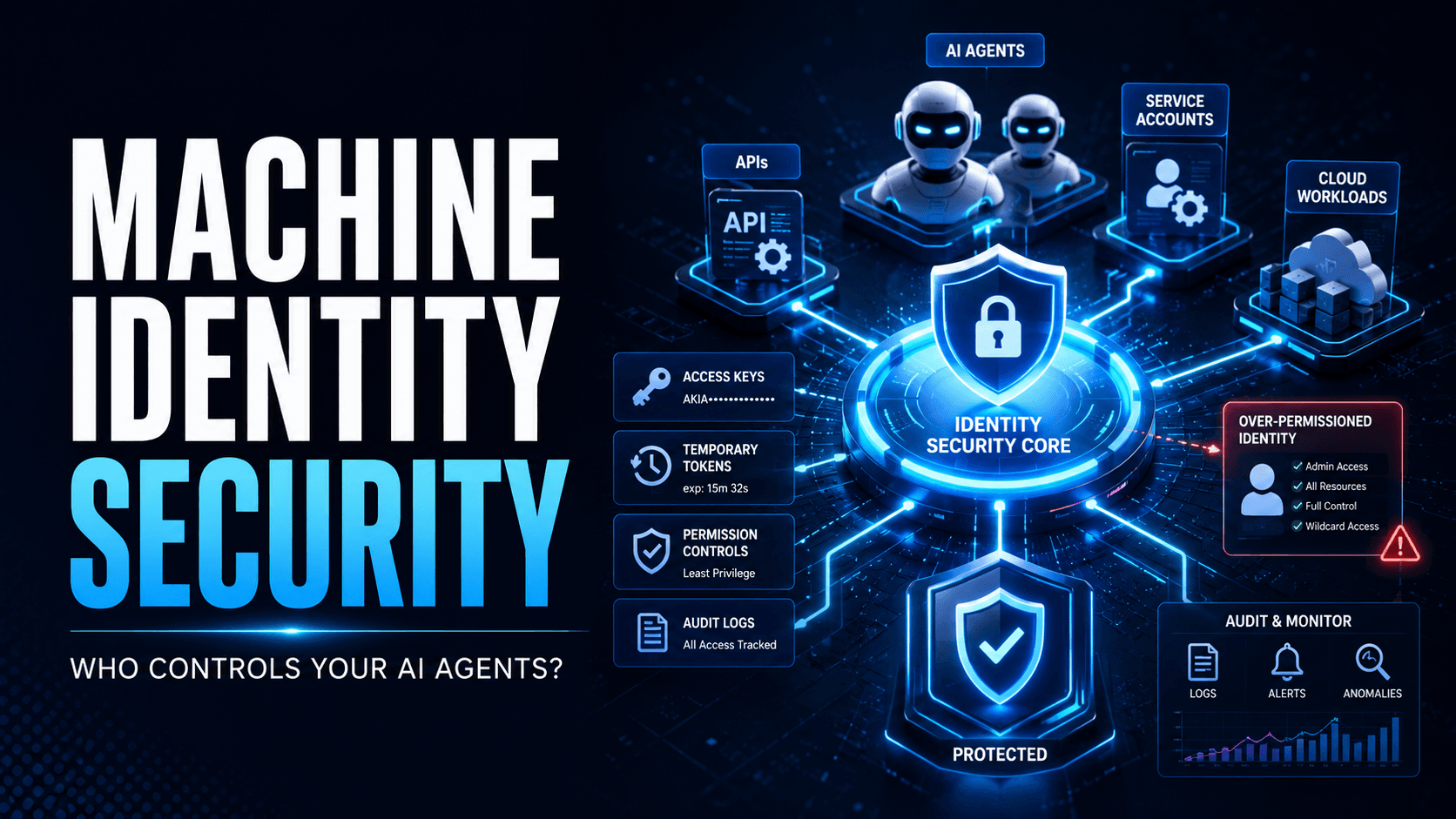
Machine Identity Security in 2026: Protecting AI Agents, APIs and Cloud Workloads
AI agents, APIs and cloud workloads can access sensitive business systems without a human signing in. Learn how to discover, control and secure these machine identities.


Most businesses carefully manage the accounts used by employees.
New employees receive usernames and permissions. Password policies are applied. Multifactor authentication may be required, and access is removed when someone leaves the company.
However, employees are no longer the only identities operating inside business systems.
Applications communicate with databases. Websites connect with payment gateways. Cloud services access storage platforms. Automated deployment systems publish software, while AI agents read documents, update customer records and interact with external tools.
Each of these digital actors needs a way to prove its identity and receive permission.
These are commonly described as machine identities, workload identities or non-human identities.
Machine identities may include service accounts, API keys, access tokens, certificates, automation bots, application identities, containers, scripts and autonomous AI agents.
They can perform essential business tasks without requiring a person to sign in for every action. However, poorly managed machine identities may also hold long-lived credentials, excessive permissions and access to highly sensitive systems.
In 2026, this has become an important cybersecurity concern.
The Cloud Security Alliance’s 2026 research found that rapid AI adoption is increasing existing non-human identity problems involving visibility, ownership, permissions and credential lifecycle management.
At Arrowhead DigiTech, we help businesses identify automated access, secure cloud integrations and build controlled AI and software workflows with stronger identity management.
What Is a Machine Identity?
A machine identity is a digital identity assigned to software, a device, an application or an automated workload rather than a human employee.
It allows the system to authenticate itself and request access to another resource.
Examples include:
- A website connecting to a database
- An application calling a payment API
- A backup system accessing cloud storage
- A deployment pipeline publishing new code
- A chatbot reading customer information
- An AI agent updating a CRM
- A container communicating with another microservice
- A monitoring platform accessing server information
A machine identity may use different credentials depending on the environment.
These may include:
- API keys
- OAuth tokens
- Digital certificates
- Service-account credentials
- Cryptographic keys
- Cloud IAM roles
- JSON key files
- Signed workload tokens
- Managed identities
The identity explains what the workload is, while its permissions determine what the workload is allowed to do.
Why Machine Identities Are Increasing
Modern business systems are becoming more connected and automated.
A single customer transaction may involve a website, payment platform, inventory system, email service, CRM, analytics platform and cloud database.
Each connection may require one system to authenticate with another.
The growth of the following technologies is increasing the number of machine identities:
- Cloud computing
- Microservices
- APIs
- Containers
- SaaS integrations
- DevOps pipelines
- Robotic process automation
- Internet of Things devices
- AI assistants
- Autonomous AI agents
SPIFFE, an open workload-identity framework, explains that cloud computing, container orchestration and microservice environments have made infrastructure increasingly dynamic. Traditional controls based mainly on network location struggle to manage this complexity, creating the need for first-class workload identity.
The problem is not that machine identities exist.
The problem occurs when businesses do not know how many exist, who owns them, what they can access or whether they are still required.
Human Identities vs. Machine Identities
Human accounts usually follow recognisable lifecycle events.
A person is hired, changes roles and eventually leaves the organisation. Human access can be connected to HR records and reviewed by a manager.
Machine identities behave differently.
They may be:
- Created automatically
- Used continuously
- Shared across applications
- Active for years
- Embedded inside code
- Duplicated across environments
- Controlled by several teams
- Forgotten after a project ends
A service account may continue accessing sensitive data long after the original application has been replaced.
An API key created for a temporary integration may remain active because no one was assigned responsibility for removing it.
An AI agent may generate additional tasks or delegate work to other agents, creating a more complex chain of permissions.
This makes machine identity governance a lifecycle and ownership problem—not simply a password problem.
Why AI Agents Create a New Identity Challenge
Traditional service accounts normally perform predictable tasks.
For example, a backup service may copy files to a specific storage location at a scheduled time.
AI agents can behave differently.
An agent may interpret a goal, choose a tool, retrieve information, make a decision and take several connected actions. It may operate continuously and adapt its workflow according to changing data.
This creates new questions:
- How should the agent prove its identity?
- Which human authorised the agent?
- What tools may it access?
- Can it delegate authority to another agent?
- How long should its credentials remain valid?
- Who is responsible for its actions?
- How can the business stop it immediately?
- How are its decisions and actions audited?
The OpenID Foundation identified identity infrastructure as an important and underexamined part of AI agent security in its March 2026 response to NIST. The Foundation has also described authorisation as one of the defining challenges of the agent era.
An AI agent should therefore not be treated as an unrestricted employee account or a traditional chatbot with no operational authority.
It requires its own identity, limited permissions, monitoring and clear ownership.
The Machine Identity Governance Gap
Businesses often invest heavily in employee identity protection while applying weaker controls to applications and automated workloads.
Common problems include:
- No complete machine-identity inventory
- Permanent API keys
- Credentials stored in source code
- Shared service accounts
- Unclear ownership
- Excessive permissions
- Infrequent credential rotation
- Limited activity monitoring
- No automatic expiration
- Poor removal processes
A 2026 Cloud Security Alliance analysis reported that 78% of surveyed organisations lacked a documented policy for creating or removing AI identities. Only 8% expressed high confidence that their legacy identity-management systems could handle AI and non-human identity risks.
This gap can increase as teams rapidly deploy new integrations and AI tools without involving security or IT administrators.
The Main Machine Identity Risks
Long-Lived Credentials
An API key or certificate that remains valid for several years gives an attacker a large opportunity to misuse it.
The risk becomes greater when the credential is copied across development laptops, cloud systems and internal documents.
Temporary credentials reduce the time available for misuse after a credential is exposed.
Google Cloud, AWS and Microsoft all provide workload or managed-identity options intended to reduce reliance on manually stored long-term credentials. Google Workload Identity Federation and AWS IAM roles can issue temporary credentials, while Azure managed identities allow applications to authenticate without storing credentials directly in code.
Excessive Permissions
A machine identity may receive broad administrative access because it is easier than identifying the exact permissions required.
For example, an application that only needs to read one storage folder may receive access to read, modify and delete every file in the account.
If that identity is compromised, the attacker inherits the same permissions.
Credentials Stored in Code
Developers may place API keys, database passwords or cloud credentials inside:
- Source-code files
- Configuration files
- Mobile applications
- Deployment scripts
- Public repositories
- Container images
- Shared documents
Even when the code repository is private, copied credentials may remain inside backups, development branches and employee devices.
Orphaned Identities
An orphaned identity remains active even though the original application, employee, vendor or project no longer needs it.
These identities are particularly dangerous because normal activity may no longer be monitored by an active owner.
Shared Service Accounts
When several applications use the same service account, it becomes difficult to determine which workload performed a particular action.
Shared accounts weaken accountability and make credential rotation more disruptive.
Poor Certificate Management
Certificates help systems verify digital identities and secure communication.
Expired certificates can interrupt business operations, while stolen or improperly issued certificates can allow impersonation.
Businesses need visibility into certificate ownership, expiration dates, usage and renewal.
Unmonitored Agent Actions
An AI agent may perform actions through legitimate tools and accounts.
Traditional security monitoring may identify the credential as authorised without recognising that the agent’s behaviour is unusual or inappropriate.
Monitoring must therefore examine both identity and behaviour.
Machine Identity Security and Zero Trust
Zero Trust security follows the principle that access should not be trusted automatically based on network location or previous approval.
Every request should be evaluated according to identity, permissions, context and policy.
NIST’s Zero Trust guidance applies authorised access controls to users as well as machines, applications and services across on-premises and cloud environments.
For machine identities, Zero Trust can include:
- Verifying every workload
- Limiting permissions
- Using short-lived credentials
- Checking device or workload condition
- Logging access
- Continuously reviewing behaviour
- Denying access when expected conditions change
Being inside the company network should not automatically give an application unlimited trust.
Workload Identity and Attestation
In dynamic cloud environments, identifying a workload only by its server address can be unreliable.
Containers may be created and removed quickly. Applications may move between cloud platforms, and IP addresses may change.
Workload-identity frameworks can issue verifiable identities based on the actual workload and the environment in which it is running.
SPIFFE provides a standardised identity called a SPIFFE ID. A workload can use a verifiable identity document, or SVID, to communicate its identity to another service.
SPIRE, the implementation associated with SPIFFE, can verify workload attributes before issuing an identity. This process is known as workload attestation.
The purpose is to ensure that credentials are issued to the expected workload instead of being copied manually between systems.
Short-Lived Credentials vs. Permanent Secrets
A permanent API key may remain usable until someone actively revokes it.
A short-lived credential expires automatically.
This creates an important security advantage.
When temporary credentials are stolen, the opportunity for misuse may be limited to minutes or hours rather than months or years.
Google Cloud’s Workload Identity Federation allows eligible external workloads to exchange trusted identity information for short-lived cloud credentials instead of using stored service-account keys. AWS similarly recommends temporary role credentials for workloads rather than long-term access keys.
Short-lived credentials do not remove every risk.
An attacker may still misuse them during the valid period. However, expiration reduces persistent access and makes automatic rotation easier.
What Businesses Should Do Now
1. Create a Machine Identity Inventory
Begin by identifying non-human access across the organisation.
The inventory should include:
- Service accounts
- API keys
- OAuth applications
- Certificates
- Cloud roles
- Managed identities
- Automation bots
- CI/CD identities
- Containers
- AI agents
- Vendor integrations
- Database credentials
For each identity, document:
- Business purpose
- Technical owner
- Business owner
- Systems accessed
- Permissions
- Credential type
- Expiration date
- Last activity
- Creation date
- Review schedule
A machine identity without an owner should be treated as a security issue.
2. Identify Credentials Stored in Code
Scan source repositories, configuration files and deployment pipelines for exposed secrets.
Credentials discovered in code should be:
- Removed
- Revoked
- Replaced
- Stored in a protected secrets-management system
- Investigated for possible misuse
Deleting a key from the latest version of a file may not remove it from repository history.
The credential itself should normally be rotated or revoked.
3. Replace Permanent Keys Where Possible
Evaluate whether cloud roles, workload federation, managed identities or short-lived tokens can replace static keys.
The ideal approach depends on the platform and application, but the objective remains the same: reduce the number of credentials that must be manually stored and protected.
4. Apply Least-Privilege Access
Each machine identity should receive only the permissions required for its defined task.
A reporting agent may need read access but not permission to modify or delete records.
A deployment system may need access to one application environment rather than the complete cloud account.
Permissions should be reviewed after implementation because temporary troubleshooting access often becomes permanent.
5. Assign Clear Ownership
Every service account, AI agent and integration should have a named owner.
The owner should be responsible for:
- Reviewing permissions
- Approving changes
- Monitoring activity
- Rotating credentials
- Responding to incidents
- Removing the identity when it is no longer needed
Ownership should remain current when employees or vendors change.
6. Separate Development and Production Identities
Development tools should not normally use the same credentials as production systems.
Separate identities reduce the chance that a credential exposed in a testing environment provides access to live customer information.
7. Monitor Machine Behaviour
Monitoring should establish expected activity for important machine identities.
The business should investigate unusual behaviour such as:
- Access from a new location
- Large data downloads
- Activity outside expected hours
- Attempts to access new systems
- Repeated authentication failures
- Sudden permission changes
- Unusual agent tool usage
- Unexpected deletion activity
Machine traffic can be fast and continuous, making automated monitoring important.
8. Create Automatic Expiration
Temporary projects, vendor integrations and test agents should have planned expiration dates.
A temporary identity should not become permanent because no one remembered to remove it.
9. Protect Secrets Centrally
Credentials that cannot yet be eliminated should be stored in an appropriate secrets-management system.
A central vault can support:
- Encryption
- Access policies
- Rotation
- Audit logs
- Version management
- Expiration
- Controlled retrieval
Secrets should not be shared through email, chat messages or unprotected spreadsheets.
10. Build Emergency Controls for AI Agents
AI agents with operational access should have clear containment controls.
These may include:
- A kill switch
- Credential revocation
- Session termination
- Tool-access suspension
- Transaction limits
- Human approval requirements
- Network isolation
- Safe-mode operation
The business should test how quickly an agent can be stopped before providing access to critical systems.
Human Approval for High-Impact Actions
Some machine actions should require human confirmation.
Examples include:
- Sending payments
- Deleting production data
- Changing customer accounts
- Publishing public statements
- Modifying employee records
- Approving refunds
- Changing cloud security
- Accessing highly sensitive files
An AI agent may prepare the action and provide a recommendation, but execution can remain dependent on an authorised employee.
The approval process should be meaningful.
A person should receive enough context to understand what the agent is requesting, which data is involved and what the consequences may be.
Secure Machine Identity Lifecycle
Machine identities should follow a documented lifecycle.
Creation
The business should record the purpose, owner, permissions and expected lifetime before the identity is issued.
Active Use
Credentials should be protected, access monitored and permissions reviewed.
Change
Permissions should be updated when the workload or business purpose changes.
Rotation
Keys, tokens and certificates should be renewed according to risk and technical requirements.
Suspension
The identity should be disabled when suspicious activity is detected or the workload is temporarily inactive.
Removal
Credentials and permissions should be revoked when the application, integration or agent is retired.
Lifecycle automation can reduce the number of forgotten and unmanaged identities.
Machine Identity Security for Small Businesses
Small businesses may believe this issue applies only to enterprises with complex cloud infrastructure.
However, a typical small business may already use machine identities through:
- Website plugins
- Payment integrations
- Email-marketing platforms
- Booking systems
- CRM automation
- Cloud backups
- Social-media tools
- Accounting connections
- AI chatbots
- Analytics services
A WordPress plugin may contain an API key. A marketing automation may have permission to read the entire CRM. A former developer may still control a cloud service account.
Small businesses should begin with their most important systems.
The first priorities should include payment platforms, customer databases, website administration, cloud storage and AI tools processing confidential information.
Common Machine Identity Security Mistakes
Using One Service Account for Everything
Shared credentials make accountability and permission control difficult.
Never Rotating API Keys
Long-lived keys provide attackers with a larger opportunity after exposure.
Giving Agents Employee-Level Access
An AI agent should receive task-specific permissions rather than copying the access of a manager or administrator.
Ignoring Inactive Identities
An unused but active account remains a potential access point.
Monitoring Humans but Not Machines
Automated systems may perform more actions and access more data than individual employees.
Depending Only on Network Security
An application inside the company network should still authenticate and receive limited access.
Allowing Agents to Create More Agents Without Control
Delegation can create complex identity chains with unclear accountability and inherited permissions.
What Arrowhead DigiTech Is Doing
At Arrowhead DigiTech, we help businesses understand and secure automated access across cloud, software and AI environments.
Our approach includes:
Machine Identity Assessments
We review service accounts, API credentials, cloud roles, automation bots and application identities.
AI Agent Security Reviews
We identify the systems, data and tools accessible to AI agents and recommend appropriate permissions and approval controls.
Cloud Identity Configuration
We help businesses implement cloud roles, managed identities and workload-identity options where appropriate.
API Security
We secure business integrations through controlled authentication, restricted permissions, encryption and monitoring.
Secrets Management
We help remove credentials from code and move important secrets into controlled storage systems.
DevSecOps Integration
We include credential scanning, access review and secure deployment practices within software-development pipelines.
Access and Permission Reviews
We identify unnecessary privileges, shared identities and orphaned accounts.
Monitoring and Audit Support
We help businesses improve visibility into machine activity, authentication and high-impact actions.
Secure Custom Software Development
We design applications with maintainable identity architecture instead of depending on embedded permanent credentials.
Ongoing IT Support
We assist with credential rotation, account removal, cloud configuration and incident response as systems change.
Our goal is to ensure that every important machine identity has a clear purpose, limited authority, reliable owner and visible activity.
A Practical Machine Identity Security Roadmap
Businesses can divide implementation into five stages.
Stage One: Discovery
Identify machine identities, credentials, integrations and owners.
Stage Two: Risk Prioritisation
Focus on identities with sensitive data, broad permissions or production access.
Stage Three: Credential Modernisation
Replace permanent keys with managed or short-lived credentials where possible.
Stage Four: Monitoring and Automation
Implement rotation, expiration, behaviour monitoring and alerts.
Stage Five: AI Agent Governance
Apply dedicated identity, authorisation, human approval and containment controls to autonomous systems.
This phased approach allows businesses to improve security without interrupting every application at the same time.
Final Thoughts
The future of identity management is no longer limited to usernames and employee passwords.
Modern businesses depend on applications, APIs, service accounts, cloud workloads, bots and AI agents that authenticate and take action without direct human involvement.
These machine identities can improve speed and productivity, but they can also become powerful security risks when they are invisible, over-permissioned or protected by permanent credentials.
Research and standards activity during 2026 show that identity and authorisation are becoming central issues for secure AI agent deployment.
Businesses should begin by identifying their machine identities, assigning ownership, removing unused accounts and replacing permanent credentials with stronger workload-identity methods where practical.
Arrowhead DigiTech helps organisations strengthen this foundation through AI agent reviews, cloud identity configuration, API security, DevSecOps integration, secrets management and secure software development.
Every automated system that can access business data should be able to answer four questions:
Who are you? What are you allowed to do? Who is responsible for you? And how can you be stopped?
Frequently Asked Questions
What is a machine identity?
A machine identity is a digital identity used by an application, device, service, automated workload or AI agent to authenticate and access another system.
What is a non-human identity?
A non-human identity is another term for identities assigned to software, machines, workloads, bots and automated services rather than individual people.
Are API keys machine identities?
API keys are credentials commonly used by machine identities. They help an application prove that it is authorised to access an API.
Why are AI agent identities risky?
AI agents may access multiple tools, make decisions and perform actions autonomously. Excessive permissions or weak monitoring can increase the consequences of mistakes or compromise.
What is workload identity?
Workload identity allows an application, container or service to authenticate according to its verified workload characteristics instead of relying only on a manually stored credential.
Why are short-lived credentials safer?
They expire automatically, reducing the time in which a stolen credential may be used.
Should every AI agent have a separate identity?
Important agents should generally have distinct identities so their permissions, actions, ownership and lifecycle can be controlled and audited.
How can Arrowhead DigiTech help?
Arrowhead DigiTech provides machine-identity assessments, AI agent security reviews, cloud identity configuration, API security, secrets management, DevSecOps integration and ongoing IT support.