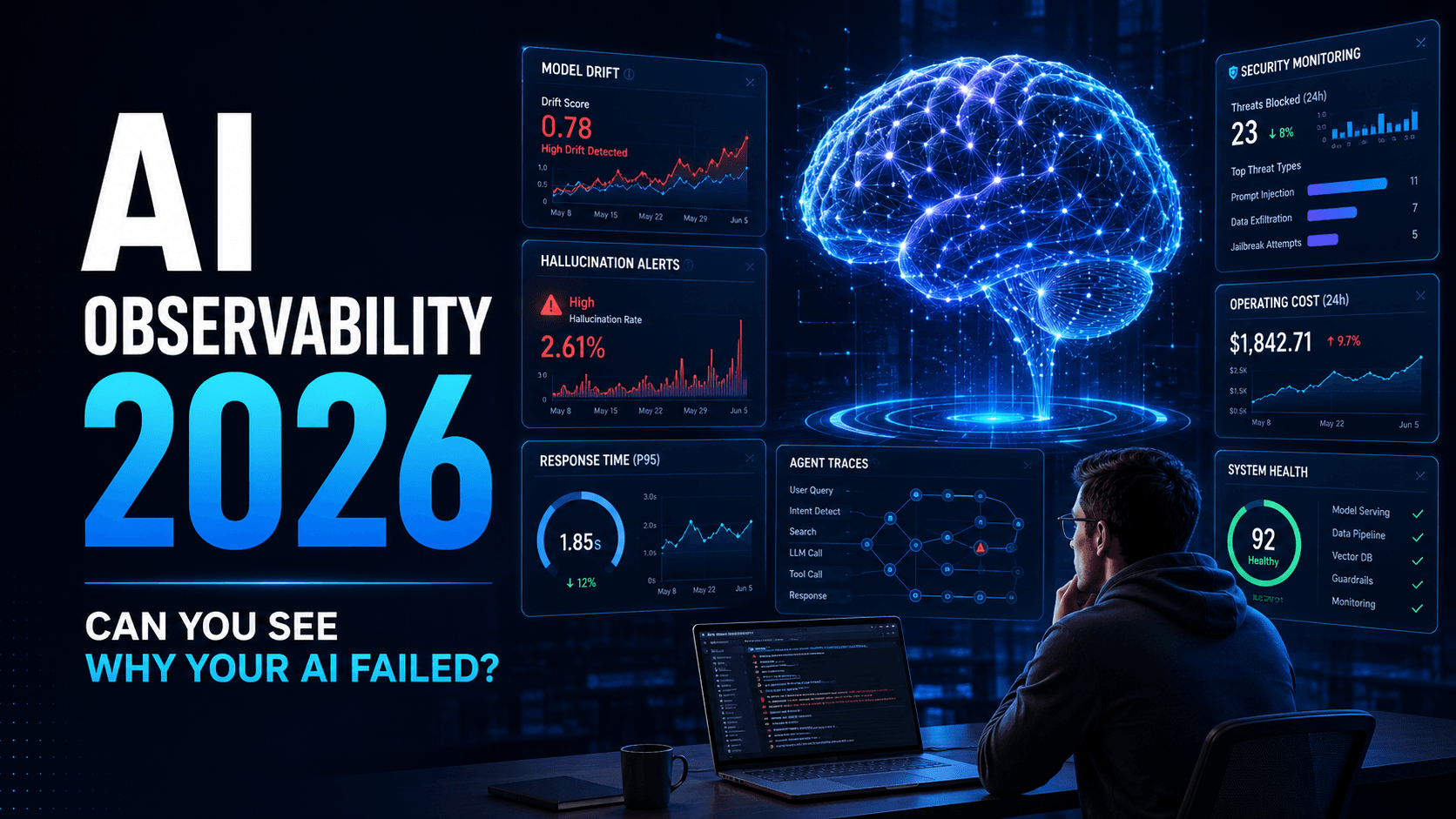
AI Observability in 2026: Why Businesses Must Monitor AI After Deployment
Launching an AI system is only the beginning. Learn how observability helps businesses detect quality, safety, security and performance problems before they affect customers.

Businesses are rapidly introducing artificial intelligence into customer service, marketing, finance, recruitment, operations and software development.
An AI assistant may answer customer questions. A predictive model may identify sales opportunities. An automated agent may update business records, prepare reports or communicate with external applications.
Before deployment, companies usually test whether the system works.
However, passing an initial test does not guarantee that an AI system will continue performing correctly after it begins interacting with real customers, changing data and connected business tools.
An AI model may become less accurate over time. A chatbot may provide confident but incorrect answers. A retrieval system may begin using outdated documents, while an AI agent may select the wrong tool or perform a task in an unexpected order.
This is where AI observability becomes essential.
AI observability provides visibility into how an artificial-intelligence system behaves in production. It helps teams understand what happened, why it happened and what should be improved.
Microsoft defines AI observability as the ability to monitor, understand and troubleshoot AI systems throughout their lifecycle using signals such as evaluations, logs, traces, model outputs and operational metrics.
In March 2026, NIST published a dedicated report on the challenges of monitoring deployed AI systems, highlighting that effective monitoring is becoming an important requirement for confident and responsible AI adoption.
At Arrowhead DigiTech, we help businesses build AI applications with monitoring, evaluation and human oversight integrated into the system rather than added only after a serious problem occurs.
What Is AI Observability?
AI observability is the process of collecting and analysing information that explains how an AI system is operating.
It goes beyond checking whether the application server is online.
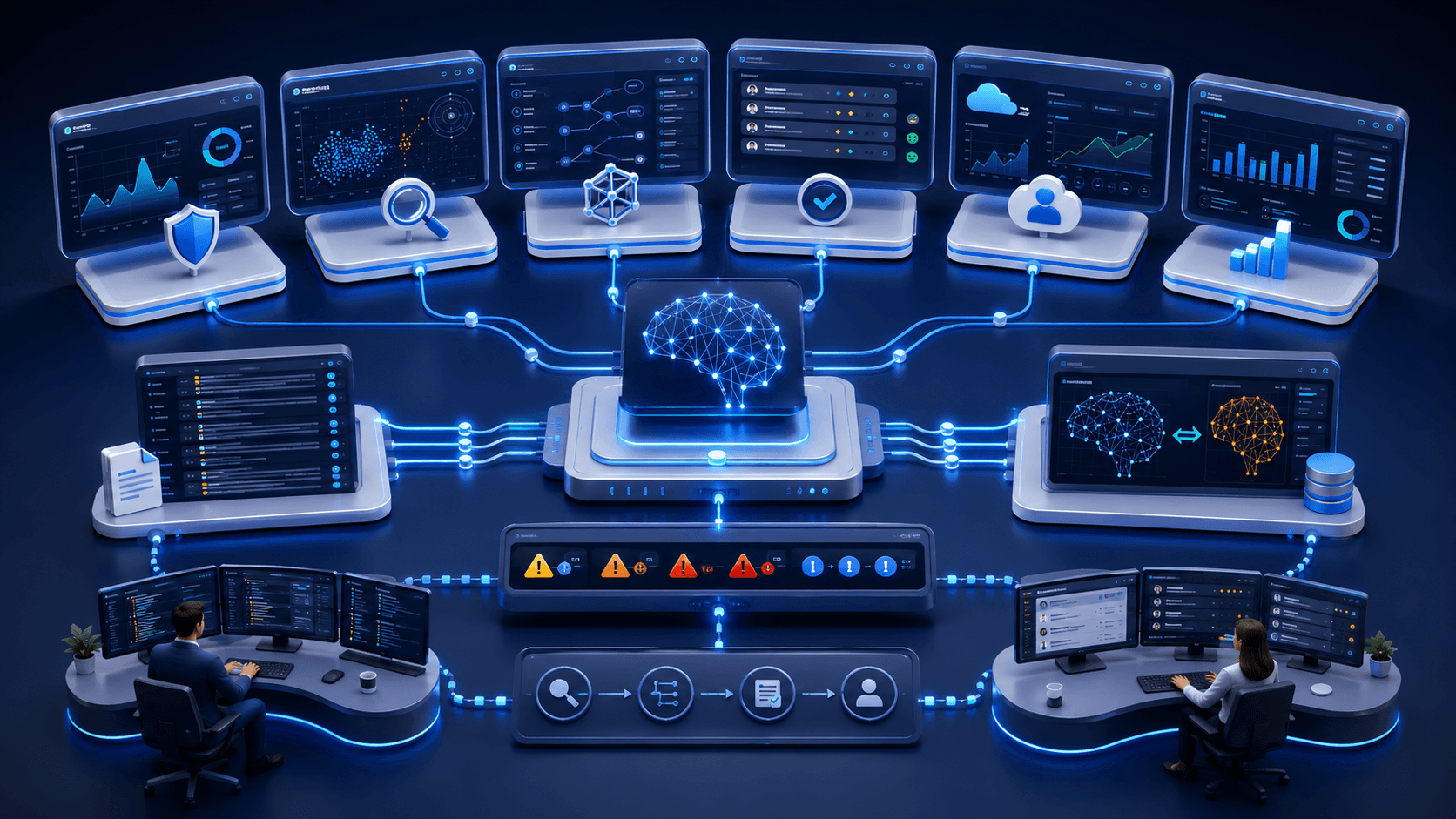
A complete observability system may examine:
- User requests
- Model inputs
- Generated answers
- Retrieved documents
- Tool calls
- Agent decisions
- Response time
- Token usage
- Operating cost
- Safety results
- Customer feedback
- Business outcomes
- Security events
The purpose is not simply to collect large quantities of logs.
The purpose is to give teams enough context to identify problems, understand their causes and decide what action to take.
For example, a customer may report that an AI support assistant provided the wrong refund instructions.
Traditional monitoring may confirm that the request completed successfully in two seconds.
AI observability should reveal:
- The customer’s question
- Which instructions were retrieved
- Which model version produced the answer
- What prompt or policy was applied
- Whether a safety rule was triggered
- Whether the assistant was uncertain
- Whether the answer was escalated to a person
Without this context, the technical system may appear healthy even though the customer experience failed.
Why Traditional Software Monitoring Is Not Enough
Traditional software usually follows predictable instructions.
When a user clicks a button, developers generally know which code path should run and what result should be returned.
Generative AI systems are probabilistic.
The same or similar request may produce different wording, reasoning paths or tool choices across separate interactions.
Microsoft explains that traditional observability methods are not sufficient by themselves for generative and agentic AI because these systems produce variable behaviours rather than one completely predictable execution path.
A traditional application failure may produce a clear error message.
An AI failure may produce a polished, professional and technically successful response that is still incorrect.
AI systems therefore require operational monitoring and quality monitoring at the same time.
Monitoring vs. Observability
Monitoring answers predefined questions.
Examples include:
- Is the AI application online?
- How many requests failed?
- What is the average response time?
- Has usage increased?
- Is the cost above the monthly limit?
Observability helps investigate problems that were not fully predicted in advance.
It may answer questions such as:
- Why are customers suddenly receiving weaker answers?
- Why did an agent choose an expensive tool?
- Which document caused an incorrect response?
- Did a model update change behaviour?
- Why are certain users receiving inconsistent results?
- Which part of a multi-agent workflow created the error?
Monitoring tells the team that something changed.
Observability helps explain the change.
Businesses generally need both.
What Can Go Wrong After AI Deployment?
Hallucinations
A hallucination occurs when generative AI produces unsupported or incorrect information.
The response may sound convincing even though it is not supported by the business’s approved data.
For a marketing brainstorming tool, this may create a minor inconvenience.
For a healthcare, financial, legal or customer-account system, an incorrect answer may create much more serious consequences.
Businesses should monitor how often outputs are unsupported, inaccurate or inconsistent with approved sources.
Data Drift
Data drift occurs when the information entering a model changes over time.
For example, customer behaviour, market conditions, product categories or fraud patterns may change after the model was trained.
Google’s model-monitoring documentation explains that monitoring systems can track differences between baseline and production data and alert teams when deviations exceed an established threshold.
A model may continue operating normally from a technical perspective while its predictions become less useful.
Model Drift
Model drift describes deterioration or change in the relationship between inputs and expected outcomes.
A sales-scoring model trained on older customer behaviour may gradually become less accurate when the market changes.
NIST’s AI Risk Management Framework resources recommend reassessing metrics as operational settings, data and model behaviour change.
Retrieval Failures
Many business AI assistants use retrieval-augmented generation to access company documents before answering a question.
Problems may occur when:
- Documents are outdated
- Files are incorrectly indexed
- Access permissions are wrong
- The wrong section is retrieved
- Important documents are missing
- Conflicting policies are returned
An observability platform should show which sources were retrieved and how strongly they influenced the answer.
Prompt and Instruction Failures
AI applications often depend on system prompts, business rules and safety instructions.
A minor prompt change may improve one type of interaction while reducing quality elsewhere.
Prompt versions should therefore be tested, recorded and connected to the production responses they generate.
Agent Tool Errors
AI agents may connect to CRM platforms, email, calendars, databases, payment systems and external APIs.
An agent may:
- Choose the wrong tool
- Use tools in the wrong order
- Repeat an action
- Exceed its authority
- Send incorrect information
- Fail before completing the workflow
Agent monitoring should capture every important step rather than recording only the final response.
Security Attacks
AI applications can be targeted through prompt injection, malicious documents, stolen API credentials and unsafe tool requests.
A harmful instruction may be hidden inside a webpage, document or customer message that the AI system processes.
Observability can help security teams identify unusual prompts, unexpected tool activity, permission failures and suspicious access patterns.
Rising Costs
An AI application may become more expensive as usage increases or workflows become unnecessarily complex.
A poorly configured agent may repeatedly call expensive models, retrieve excessive data or continue running after the task should have ended.
Teams should monitor cost per request, model, customer, workflow and business outcome.
Latency and Availability Problems
Customers may abandon an AI experience when responses take too long.
Observability should distinguish whether delays are caused by:
- The primary model
- Document retrieval
- External APIs
- Security checks
- Agent reasoning
- Database queries
- Network problems
This helps the development team improve the correct part of the system.
The Main Layers of AI Observability
Infrastructure Monitoring
Infrastructure monitoring examines:
- CPU and GPU usage
- Memory
- Network activity
- Application availability
- Errors
- Request volume
- Database health
These metrics remain essential, but they do not explain AI quality by themselves.
Model Monitoring
Model monitoring focuses on the performance and behaviour of the model.
It may include:
- Prediction accuracy
- Data drift
- Model drift
- Confidence scores
- Output consistency
- Feature distributions
- Model version comparisons
Google provides model-monitoring capabilities designed to compare production information with training or previous serving data.
LLM Quality Evaluation
Generative AI quality monitoring may evaluate:
- Relevance
- Accuracy
- Groundedness
- Completeness
- Coherence
- Instruction following
- Tone
- Safety
- Citation quality
Some evaluations can be automated, while high-impact systems may also require human review.
Microsoft’s production-monitoring guidance includes regular evaluation of generative AI applications for both safety and quality.
Agent Tracing
Agent tracing records the path taken by an AI agent.
A trace may show:
- Initial user request
- Agent plan
- Selected tools
- Tool inputs
- Tool outputs
- External API calls
- Delegated agents
- Final response
- Errors and retries
Microsoft’s agent-observability tooling uses tracing to help teams inspect execution paths, performance and multi-agent interactions.
Business Outcome Monitoring
An AI system should not be judged only by technical metrics.
Businesses should also measure whether it is producing useful results.
Examples include:
- Customer resolution rate
- Lead conversion
- Appointment bookings
- Employee time saved
- Refund errors
- Customer satisfaction
- Escalation rate
- Revenue contribution
- Operational cost
A chatbot may achieve excellent response speed while creating poor customer satisfaction.
Business metrics reveal whether technical performance is producing actual value.
Important AI Observability Signals
Logs
Logs record events such as requests, errors, policy decisions, tool activity and configuration changes.
Sensitive information should be removed or protected before logs are stored.
Metrics
Metrics provide measurable values over time.
Examples include:
- Response time
- Error rate
- Cost per interaction
- Hallucination rate
- Escalation rate
- Safety violations
- Tool success rate
Traces
Traces connect the individual steps of a complete interaction.
They are particularly valuable for retrieval systems and multi-step AI agents.
Evaluations
Evaluations score the quality, safety or usefulness of outputs.
They may be performed through:
- Rule-based checks
- Reference-answer comparison
- Human review
- Model-assisted evaluation
- Customer feedback
User Feedback
Users may identify problems that automated tests miss.
AI interfaces should provide simple ways to:
- Report an incorrect answer
- Request human assistance
- Flag harmful content
- Explain why the result was unhelpful
NIST recommends incorporating post-deployment feedback and monitoring to help organisations detect degradation, unusual behaviour, attacks and harmful impacts.
AI Observability for Customer-Service Systems
A customer-support AI system should be monitored for more than response volume.
Useful measurements may include:
- Successful issue resolution
- Human escalation
- Incorrect policy information
- Repeated customer questions
- Customer sentiment
- Response accuracy
- Unanswered requests
- Complaint rate
Businesses should review conversations in which the customer repeatedly rephrases the same question.
This behaviour may indicate that the AI response appears grammatically correct but does not actually solve the customer’s problem.
AI Observability for Predictive Models
Predictive models may support:
- Lead scoring
- Demand forecasting
- Fraud detection
- Customer churn prediction
- Inventory planning
- Risk analysis
Monitoring should compare predicted outcomes with actual results whenever possible.
For example, a lead-scoring model should be evaluated based on whether high-scoring leads actually convert.
Without outcome feedback, the business may continue trusting a model that is becoming less useful.
AI Observability for Agentic Workflows
Agentic AI creates additional monitoring requirements because the system can take actions rather than only generate text.
Businesses should monitor:
- Which agent initiated the task
- Which human or system authorised it
- Which tools were used
- What permissions were applied
- What data was accessed
- Whether human approval was requested
- Whether an action was repeated
- Whether the task completed successfully
- How the agent was stopped
Every important action should be connected to a traceable identity and business owner.
Privacy and Logging
AI observability creates a difficult balance.
Teams need detailed information to investigate errors, but logs may contain customer messages, employee data, confidential documents or financial records.
Businesses should establish rules covering:
- What information can be logged
- Which data should be removed
- How long logs are retained
- Who can access traces
- Where monitoring data is stored
- How sensitive prompts are protected
- How customers are informed
Logging everything without privacy controls can create a new security risk.
Logging too little can make serious failures impossible to investigate.
AI Observability and the EU AI Act
AI monitoring is also becoming relevant to regulatory compliance.
The European Commission explains that providers of high-risk AI systems must maintain post-market monitoring, while deployers are responsible for human oversight and monitoring during operation. Serious incidents and malfunctions may also require reporting.
Article 72 of the AI Act requires relevant providers to establish a post-market monitoring system that actively collects and analyses information about the performance and compliance of high-risk systems throughout their lifetime.
The requirements applying to a specific business depend on its role, system and jurisdiction.
AI observability does not automatically create compliance, but good logging, monitoring, ownership and incident processes can support wider governance responsibilities.
What Businesses Should Do Now
1. Create an AI System Inventory
Document every important AI application, including tools embedded inside existing business software.
For each system, record:
- Business purpose
- Provider
- Model
- Owner
- Data sources
- Users
- Integrations
- Risk level
- Monitoring process
2. Define Success Before Deployment
Businesses should decide what useful performance looks like.
A customer chatbot may require targets for accuracy, resolution, satisfaction and escalation.
An internal document assistant may require targets for grounded answers, retrieval accuracy and employee time saved.
Without clear objectives, teams may collect large quantities of data without knowing whether the system is successful.
3. Establish Baselines
Record performance during testing and early production use.
Baselines may include:
- Response quality
- Error rate
- Input distribution
- Average latency
- Cost per request
- Tool usage
- Customer feedback
Future behaviour can then be compared with this initial reference.
4. Implement End-to-End Tracing
Important AI interactions should be traceable from the initial request to the final action.
For agentic workflows, this includes model calls, retrieved data, tools, external APIs and approval decisions.
5. Monitor Quality and Safety
Create regular evaluations for accuracy, relevance, groundedness, harmful output and policy compliance.
High-impact systems should include human-reviewed samples.
6. Track Drift
Monitor changes in production inputs, model behaviour and actual outcomes.
A drift alert should trigger investigation rather than immediately causing an automatic model retraining process without review.
7. Monitor Cost and Performance
Set alerts for unusual token consumption, expensive model usage, repeated tool calls and increased latency.
8. Collect User Feedback
Provide clear reporting and escalation options inside the AI experience.
Customer complaints should be connected to the relevant trace when possible.
9. Create Incident Procedures
Define what happens when the AI system:
- Provides harmful information
- Exposes data
- Performs an unauthorised action
- Produces widespread errors
- Experiences a security attack
- Becomes unavailable
The business should know how to pause the system, revoke credentials and route customers to human support.
10. Review the System Regularly
Monitoring dashboards should support decisions.
Teams should conduct scheduled reviews of quality, safety, security, cost and business outcomes.
What Small Businesses Need to Monitor
Small businesses do not need the most complicated enterprise observability platform before launching an AI assistant.
They should begin with a focused set of measurements.
For a customer chatbot, this may include:
- Conversation volume
- Incorrect-answer reports
- Escalation rate
- Response time
- Customer satisfaction
- Monthly operating cost
For an internal AI assistant:
- Active users
- Time saved
- Failed document retrieval
- Confidential-data incidents
- Employee feedback
- Cost per user
The objective is to monitor the risks and outcomes that matter most to the business.
Common AI Observability Mistakes
Monitoring Only Availability
An online AI system may still be providing incorrect or unsafe information.
Collecting Data Without Clear Goals
Large dashboards are not useful when no one knows which metrics require action.
Ignoring User Feedback
Customers may detect quality problems before automated systems do.
Logging Sensitive Information Without Protection
Observability data should follow privacy, retention and access requirements.
Monitoring the Model but Not the Full Application
Retrieval, APIs, prompts and tools may cause failures even when the model itself works correctly.
Depending Only on Average Scores
A strong average can hide serious failures affecting a smaller group of users.
Failing to Assign Ownership
Every production AI system should have a person or team responsible for reviewing alerts and coordinating improvements.
What Arrowhead DigiTech Is Doing
At Arrowhead DigiTech, we help businesses create AI systems that remain visible, measurable and manageable after deployment.
Our approach includes:
AI System Assessments
We review AI applications, data sources, models, integrations and business objectives.
Observability Architecture
We design structured logging, metrics, traces and evaluation workflows for AI applications and agents.
AI Agent Tracing
We help record agent decisions, tool activity, API interactions and approval steps.
Model and Data Monitoring
We establish baselines and monitoring for data changes, prediction quality and model performance.
Generative AI Evaluation
We create processes for checking relevance, groundedness, safety and instruction compliance.
Business Performance Dashboards
We connect AI technical metrics with conversions, customer satisfaction, productivity and operational cost.
Security Monitoring
We help identify prompt attacks, suspicious tool activity, credential misuse and unusual access.
Human Escalation Workflows
We build clear paths for transferring difficult or high-impact cases to authorised employees.
AI Governance Integration
We connect monitoring with ownership, documentation, policy and incident-response processes.
Ongoing AI Optimization
We review production performance and improve prompts, retrieval, workflows and model selection.
Our objective is not simply to launch an AI demonstration.
We help businesses operate AI systems that can be understood, improved and controlled over time.
A Practical AI Observability Roadmap
Businesses can introduce AI observability in five stages.
Stage One: Define
Identify business goals, important risks and required outcomes.
Stage Two: Instrument
Add logs, metrics, traces, evaluation and user-feedback collection.
Stage Three: Baseline
Measure expected behaviour during testing and initial deployment.
Stage Four: Monitor
Create dashboards, alerts, incident processes and regular reviews.
Stage Five: Improve
Use production evidence to improve models, prompts, data and workflows.
This phased approach allows businesses to begin with essential visibility and expand monitoring as the AI system becomes more important.
Final Thoughts
Deploying an AI system is not the end of an AI project.
It is the beginning of its real interaction with customers, employees, changing information and connected business systems.
AI models can drift. Documents can become outdated. Agent workflows can fail, and operating costs can increase without obvious warning.
AI observability gives businesses the visibility required to identify these issues and respond before they become larger operational, security or reputational problems.
NIST’s 2026 work on deployed AI monitoring confirms that monitoring is essential but also technically challenging and highly dependent on context.
Businesses should therefore avoid relying on one generic score or dashboard.
They should combine technical telemetry, quality evaluations, security signals, human feedback and business outcomes.
Arrowhead DigiTech helps organisations build this capability through AI monitoring, agent tracing, model evaluation, secure integrations, analytics and ongoing optimization.
A business should never have to say:
“The AI made a mistake, but we do not know why.”
Frequently Asked Questions
What is AI observability?
AI observability is the ability to monitor, understand and troubleshoot AI systems through logs, metrics, traces, evaluations and user feedback.
How is AI observability different from monitoring?
Monitoring detects known problems and threshold changes. Observability provides deeper context that helps teams investigate why a problem occurred.
What is model drift?
Model drift occurs when relationships between production information and expected outcomes change, causing model performance to deteriorate.
Should businesses monitor AI-generated answers?
Yes. Businesses should evaluate important outputs for accuracy, relevance, groundedness, safety and compliance with instructions.
Why do AI agents need tracing?
Agents can perform several steps, access tools and take actions. Tracing records the complete path so errors and unauthorised behaviour can be investigated.
Can small businesses use AI observability?
Yes. Small businesses can begin with essential metrics such as accuracy reports, escalation rate, latency, cost and customer feedback.
Does observability guarantee AI compliance?
No. It can support governance and compliance by improving monitoring, documentation and incident response, but businesses must still meet all applicable requirements.
How can Arrowhead DigiTech help?
Arrowhead DigiTech provides AI assessments, model monitoring, agent tracing, evaluation systems, dashboards, security monitoring and ongoing AI optimization.