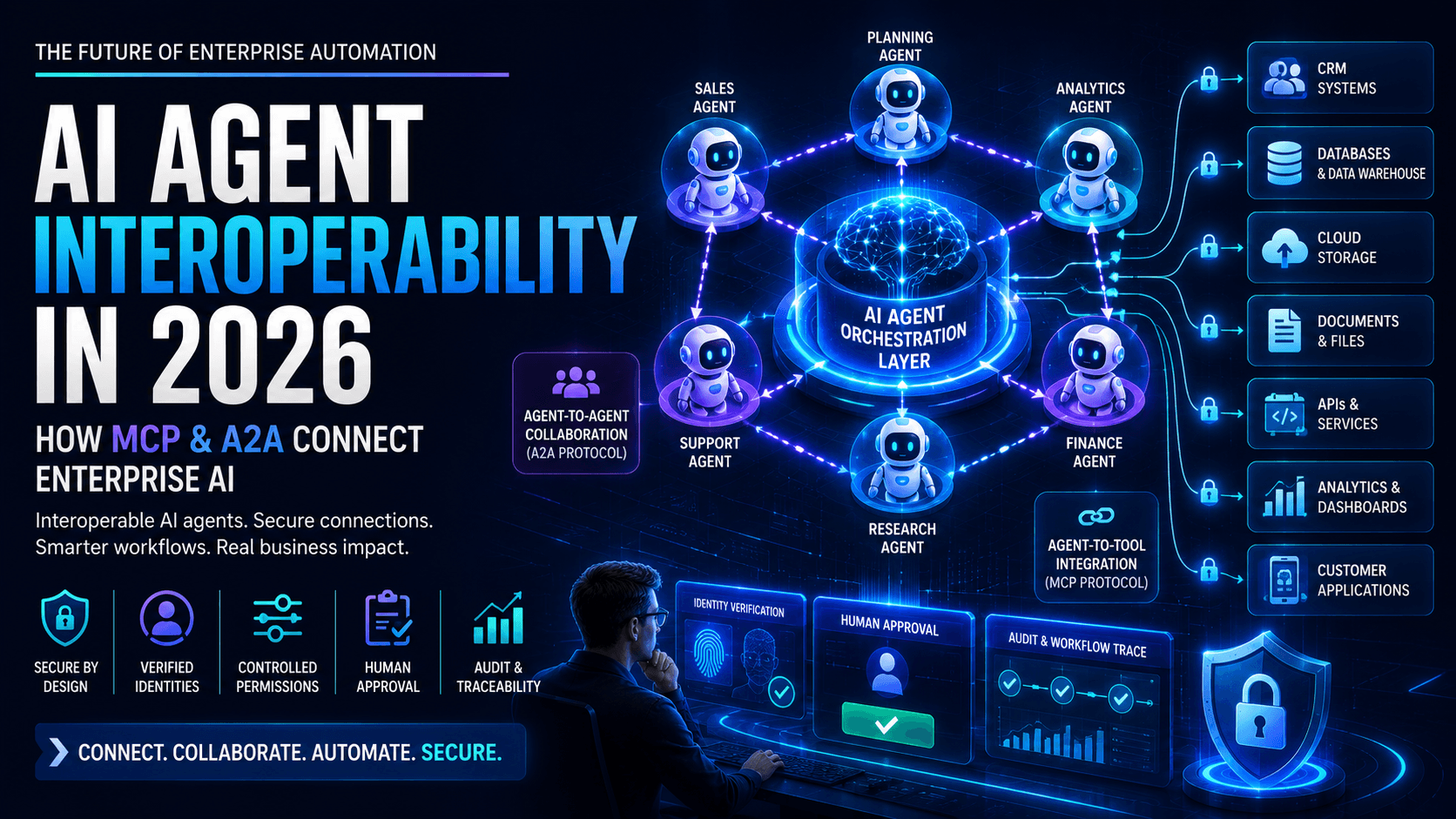
AI Agent Interoperability in 2026: How MCP and A2A Are Connecting Enterprise Automation
AI agents are moving beyond isolated chatbots. Learn how MCP and A2A enable agents to access business tools, collaborate across platforms and automate complex workflows.

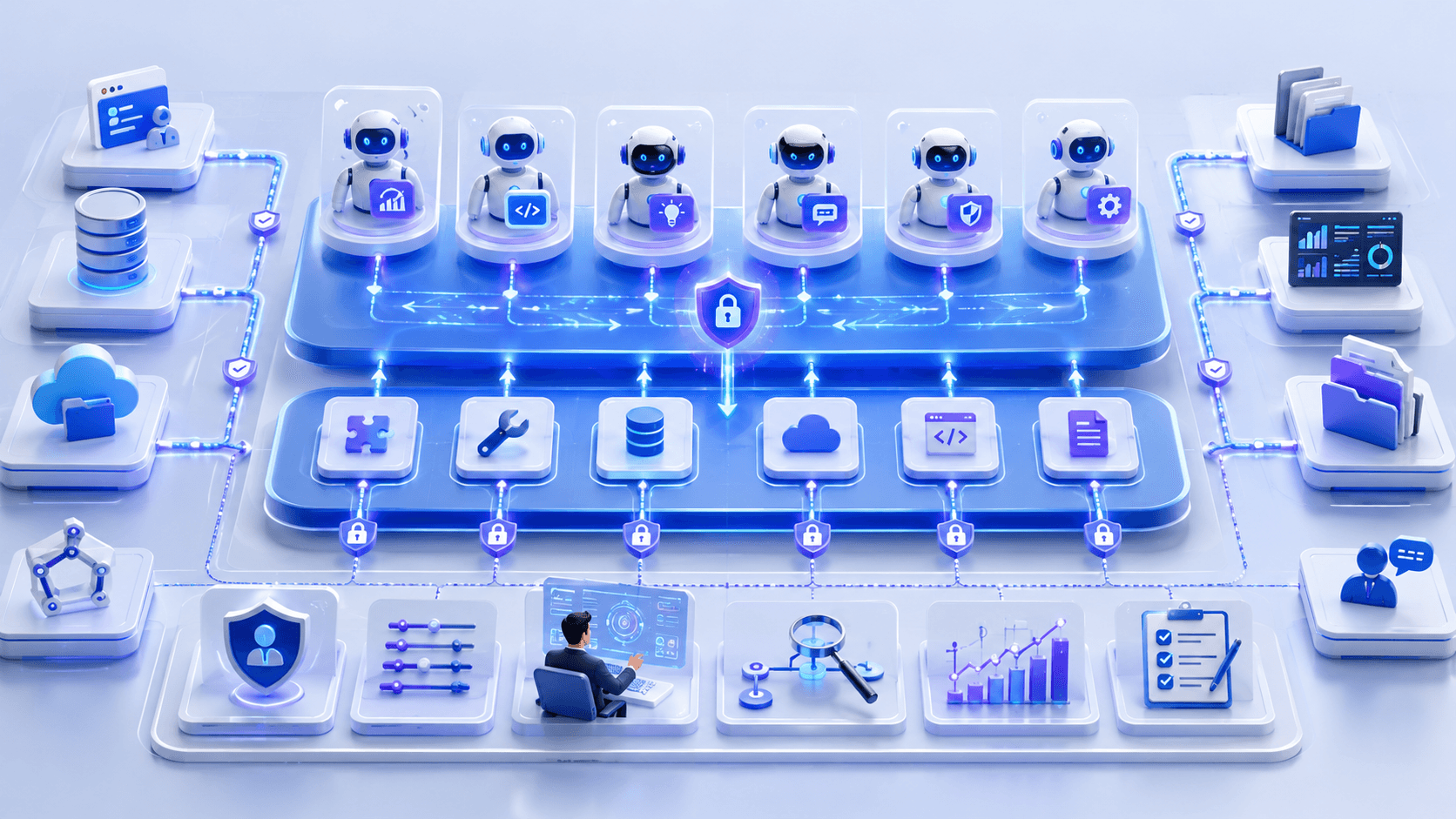
Businesses are moving from basic AI chatbots toward systems that can perform real operational work.
An AI agent may read a customer request, search company records, update a CRM, prepare a report, check inventory and coordinate with another specialist agent before presenting a final result.
However, this creates a major integration challenge.
Each AI platform, business application, database and automation tool may use a different technical framework. Without common standards, every new connection requires custom development, separate authentication and ongoing maintenance.
This is why AI agent interoperability has become one of the most important enterprise technology topics of 2026.
Two open protocols are playing a central role:
- Model Context Protocol, or MCP, which standardises how AI applications connect with tools, APIs and data.
- Agent-to-Agent Protocol, or A2A, which standardises how independent AI agents discover, communicate and collaborate with each other.
The official A2A documentation describes the two protocols as complementary rather than competing: MCP supports agent-to-tool communication, while A2A supports agent-to-agent communication.
At Arrowhead DigiTech, we help businesses design AI agents, APIs and automated workflows that can communicate securely across their existing technology environments.
What Is AI Agent Interoperability?
AI agent interoperability is the ability of independently developed agents, applications and tools to work together through consistent technical standards.
An interoperable AI agent should be able to:
- Discover available capabilities
- Connect with authorised business tools
- Exchange structured information
- Delegate tasks to another agent
- Report progress
- Return completed results
- Operate across different vendors and frameworks
For example, a customer-service agent may receive a refund request.
Instead of handling the entire process itself, it could:
- Ask an order-management agent to confirm the purchase.
- Use an MCP-connected inventory tool to check the return status.
- Ask a policy agent to confirm eligibility.
- Request human approval when the refund exceeds a defined limit.
- Update the CRM after the decision.
Interoperability allows each part of this workflow to be developed separately while still participating in one coordinated process.
Why Interoperability Matters in 2026
Many early AI projects were isolated demonstrations.
They answered questions or generated content but could not reliably interact with real business systems.
Production AI requires access to live data, applications and specialised capabilities. It also needs to coordinate tasks that may involve several departments or technology providers.
A2A version 1.0 became the protocol’s first stable specification in 2026, introducing features such as multi-protocol support, enterprise multi-tenancy, updated security flows and signed Agent Cards. The Linux Foundation reported in April 2026 that more than 150 organisations supported the protocol and that production deployments were already appearing in areas including financial services, insurance, supply chains and IT operations.
This signals a broader transition from isolated AI assistants toward connected agent ecosystems.
Businesses will increasingly need to decide not only which AI model to use, but also how agents will:
- Authenticate
- Discover one another
- Access tools
- Exchange information
- Delegate authority
- Record actions
- Handle failures
What Is the Model Context Protocol?
The Model Context Protocol is an open protocol for connecting language-model applications with external data sources, resources and tools.
The official MCP specification defines a standard communication structure involving:
- Hosts: AI applications that initiate connections
- Clients: Connectors operating within the host
- Servers: Services exposing tools, data or capabilities
MCP uses JSON-RPC messages and provides a standardised way for applications to share contextual information, expose tools and build composable AI workflows.
Before MCP, developers often needed to build a separate custom integration for every combination of model and application.
For example, connecting three AI assistants with five business platforms could require many individually maintained connectors.
With MCP, each approved business capability can be exposed through a consistent interface that compatible AI applications understand.
What Can an MCP Server Provide?
An MCP server can provide an AI application with controlled access to resources such as:
- Company documents
- Customer databases
- CRM platforms
- Cloud storage
- Project-management software
- Analytics systems
- Code repositories
- Email services
- Calendars
- Internal APIs
The AI agent does not automatically receive unrestricted access.
A properly designed MCP implementation should expose only the tools and information required for the approved business use case.
For example, a sales assistant may receive permission to read customer history and create a draft follow-up task, but it should not automatically receive permission to delete customer accounts or export the entire database.
What Is the A2A Protocol?
The Agent-to-Agent Protocol is an open standard that allows AI agents built using different frameworks and vendors to communicate and collaborate.
A2A allows agents to:
- Discover one another
- Describe their capabilities
- Exchange messages
- Delegate tasks
- Track task status
- Return structured results
- Support long-running workflows
Google originally introduced A2A in April 2025 with support from more than 50 technology partners. The protocol was later donated to the Linux Foundation to support vendor-neutral governance and broader industry collaboration.
Unlike a simple API call, A2A is designed around task-oriented communication between intelligent systems.
An agent can request work from another agent without requiring access to that agent’s internal prompts, private memory or proprietary business logic.
Agent Cards and Capability Discovery
A2A agents can publish an Agent Card describing their capabilities and connection requirements.
An Agent Card can help another system understand:
- What the agent does
- Which tasks it accepts
- Which communication methods it supports
- Which authentication method is required
- Which output formats it can produce
A2A version 1.0 introduced signed Agent Cards to support cryptographic identity verification. This helps systems confirm that the advertised agent information came from the expected source.
Capability discovery is important because businesses may eventually operate dozens of specialised agents.
Instead of hard-coding every connection, an orchestration platform can identify which authorised agent is suitable for a particular task.
MCP vs. A2A
An AI agent can use MCP to access its own tools and use A2A to collaborate with another agent.
For example, a procurement agent could communicate with a supplier-analysis agent through A2A. The supplier agent could then use MCP to access approved databases, market information and internal purchasing systems.
Business Use Cases
Customer-Service Automation
A customer-service agent can receive a request and collaborate with specialised agents responsible for orders, billing, policies and delivery.
Each specialist agent can access approved business tools through MCP.
The customer receives one coordinated response even though several agents and systems contributed to the workflow.
Sales and CRM Operations
A sales agent can:
- Review lead history
- Ask a research agent for company information
- Request product recommendations
- Prepare a follow-up email
- Create a CRM task
- Notify the account manager
Human approval can remain mandatory before external communication is sent.
Healthcare Administration
A scheduling agent could coordinate with eligibility, documentation and notification agents.
Each agent should receive only the information and permissions needed for its specific role.
Healthcare deployments require additional privacy, security and compliance review before sensitive information is processed.
Financial Operations
A finance agent may analyse an invoice while another agent verifies the supplier and a third checks budget availability.
High-impact actions such as payments should remain behind strict approval and transaction controls.
Software Development
Development agents can coordinate code review, testing, documentation and deployment.
MCP can connect them with code repositories, testing systems and project-management platforms, while A2A allows specialised agents to delegate and return work.
IT Support
A support agent may investigate a reported issue, retrieve monitoring data, consult a cybersecurity agent and create a service ticket.
The system can escalate the case to a person when the agent lacks authority or confidence.
Benefits for Businesses
Reduced Integration Complexity
Open protocols can reduce the need for one-off connections between every model, tool and agent.
This makes systems easier to extend when a business adds another platform or replaces an AI provider.
Lower Vendor Lock-In
A protocol-based architecture can make it easier to combine agents developed by different vendors.
A business is less dependent on keeping every capability inside one proprietary ecosystem.
Reusable Business Capabilities
An approved CRM connector or document-search server can potentially support several AI applications instead of being rebuilt for every project.
Specialised Agents
Businesses can create agents for specific departments or tasks rather than expecting one general agent to understand every process.
Better Scalability
Complex workflows can be divided between agents with separate responsibilities, data access and performance requirements.
Clearer Governance
Distinct agent identities and tool boundaries can make it easier to document ownership, permissions and actions.
These benefits depend on secure implementation. Open compatibility should not be confused with automatic trust.
The Main Security Risks
Excessive Tool Permissions
An MCP-connected agent may receive more authority than its task requires.
A document assistant that only needs to search approved files should not receive permission to modify or delete them.
Permissions should follow the principle of least privilege.
Weak Authorisation
MCP’s official guidance recommends OAuth 2.1-based authorisation for remote servers handling sensitive data, enterprise access, user-specific information or auditable actions. Although authorisation is optional in the protocol, it is strongly recommended for these business use cases.
Every production MCP server should have a documented decision about authentication and authorisation.
Prompt Injection
An agent may process a malicious instruction hidden inside a document, webpage, message or tool result.
The instruction may attempt to convince the agent to reveal information or use a tool in an unsafe way.
Tool access should not depend only on the model recognising malicious language.
Important actions need technical permission checks and, where appropriate, human approval.
Malicious or Compromised Servers
Installing an untrusted local MCP server may allow software to execute with the same privileges as the host application.
Official MCP security guidance recommends explicit user consent, clear display of commands, restricted system access and sandboxing for local server implementations.
Businesses should maintain an approved server registry instead of allowing employees to install arbitrary connectors.
Token Misuse
Access tokens should be issued for the correct MCP server and validated before use.
The official MCP security guidance identifies token passthrough as an unsafe pattern because it can bypass security controls, weaken auditing and allow stolen tokens to cross trust boundaries.
Unclear Delegated Authority
When one agent delegates work to another, the receiving agent needs to understand:
- Which user initiated the task
- What authority was delegated
- Which limitations apply
- How long the permission remains valid
An agent should not inherit unlimited authority simply because another agent requested the task.
Sensitive Data Leakage
Agents may exchange more context than necessary.
A support agent might share an entire customer profile when another agent needs only an order number and delivery status.
Data minimisation should apply to agent-to-agent communication as well as human workflows.
Incomplete Audit Trails
Businesses need visibility into the complete chain of activity.
A final result should be traceable back through:
- The initiating user
- The primary agent
- Delegated agents
- Tool calls
- Data accessed
- Approval decisions
- Changes made
Without end-to-end tracing, multi-agent failures can be difficult to investigate.
Enterprise-Managed MCP Authorisation
Managing separate authorisation flows for every employee and MCP server can create significant administrative friction.
In June 2026, the MCP project announced that its Enterprise-Managed Authorization extension had become stable. It allows organisations to centrally provision MCP server access through their identity provider and apply policies based on existing user groups and roles.
This can help businesses establish:
- Central access policies
- Corporate identity enforcement
- Consistent onboarding
- Unified audit records
- Faster access removal
Centralised authorisation does not eliminate the need for server-level controls, but it provides a stronger enterprise governance layer.
What Businesses Should Do Now
1. Identify the Business Workflow
Begin with a specific workflow rather than launching a general autonomous agent.
Document:
- The task to be completed
- Systems involved
- Data required
- Expected output
- Human approval points
- Actions the agent must never perform
2. Separate Tools From Agents
Decide which capabilities should be exposed as MCP tools and which responsibilities require independent agents.
A database search may be a tool.
A specialised system that evaluates information and manages a complete sub-task may be better represented as an agent.
3. Assign a Unique Identity
Every important agent, MCP server and automation service should have a unique identity.
Shared accounts weaken accountability and make permission management more difficult.
4. Apply Least-Privilege Access
Give each agent only the minimum tools, records and actions required for its approved purpose.
Read, write, update and delete permissions should be evaluated separately.
5. Verify Agents and Servers
Use trusted registries, signed metadata and controlled deployment processes.
Do not assume that a server or Agent Card is trustworthy simply because it follows an open protocol.
6. Protect Credentials
Credentials should be stored through managed secret systems rather than placed inside prompts, configuration files or source code.
Where possible, use short-lived credentials and automatic rotation.
7. Add Human Approval
Human confirmation should remain mandatory for actions involving:
- Payments
- Account deletion
- Sensitive customer changes
- Public communication
- Employee decisions
- Legal submissions
- Production-system changes
8. Monitor Complete Workflows
Observability should cover both MCP tool calls and A2A delegation.
Teams should be able to see where the workflow slowed down, failed or exceeded its authority.
9. Set Cost and Execution Limits
Multi-agent systems may create repeated model calls and tool requests.
Businesses should establish maximum:
- Agent steps
- Delegations
- Retries
- Execution time
- Token use
- Financial cost
10. Begin With a Controlled Pilot
Use one low- or moderate-risk process.
Measure accuracy, security, operating cost, employee time saved and customer impact before expanding the system.
What Small Businesses Should Understand
Small businesses do not need a large network of autonomous agents immediately.
A practical starting architecture might include:
- One customer-service agent
- One approved CRM connector
- One document-search connector
- One human escalation workflow
- One monitoring dashboard
The most important objective is reliability.
A small controlled system that completes one valuable task safely is more useful than a complex agent network that nobody can monitor.
Open protocols may also help smaller businesses avoid rebuilding integrations when they change AI models or business software.
Common Implementation Mistakes
Connecting Every Business System Immediately
Each connection expands the security and maintenance surface.
Begin only with systems required for the selected workflow.
Giving an Agent Administrator Access
Broad permissions are easier to configure but create much greater risk.
Treating Protocol Compatibility as Trust
A compatible server or agent still requires security, ownership and vendor review.
Ignoring Agent Identity
Every action should be connected to a specific agent and authorised business purpose.
Building Without Observability
Multi-step workflows need logs and traces from the first production release.
Removing Humans Too Early
Human oversight should be reduced only after reliable evidence shows that the system can operate safely within defined limits.
Allowing Unlimited Delegation
An agent should not create an uncontrolled chain of additional agents and tasks.
What Arrowhead DigiTech Is Doing
At Arrowhead DigiTech, we help businesses move from isolated AI demonstrations to connected, production-ready automation.
AI Workflow Assessments
We identify the business process, systems, risks and measurable outcomes before development begins.
MCP Server Development
We build controlled connectors that expose approved business tools and information to compatible AI applications.
A2A Agent Integration
We design multi-agent systems capable of coordinating tasks across departments, platforms and specialised agents.
API and Application Integration
We connect AI workflows with CRM, e-commerce, cloud, analytics and internal business systems.
Identity and Permission Architecture
We assign distinct identities, permissions and ownership to agents, servers and automated workloads.
Human Approval Controls
We place clear approval checkpoints around financial, customer-facing and high-impact actions.
Agent Observability
We implement tracing, logs, tool-call monitoring, performance analytics and failure reporting.
Security Testing
We review authentication, data exposure, prompt injection, server trust and excessive permissions.
Vendor-Neutral Architecture
We use modular and standards-based designs where practical to reduce unnecessary platform dependency.
Ongoing Optimisation
We monitor performance, cost and business outcomes after deployment and improve the system using production evidence.
Our objective is not to connect the largest possible number of agents.
We help businesses build controlled agent ecosystems in which every connection has a clear purpose, owner and security boundary.
A Practical Implementation Roadmap
Stage One: Discovery
Identify the workflow, applications, data and business outcome.
Stage Two: Architecture
Separate agents, tools, identities, permissions and approval requirements.
Stage Three: Pilot
Build one MCP-connected agent or limited A2A workflow.
Stage Four: Secure and Monitor
Add authorisation, tracing, cost controls, testing and incident procedures.
Stage Five: Expand
Introduce more tools or agents only when the existing workflow remains reliable and valuable.
Final Thoughts
AI agents are becoming more capable, but intelligence alone does not create a useful business system.
Agents also need trusted access to data, reliable tools and a structured way to collaborate.
MCP and A2A are helping create this foundation.
MCP provides a standard way to connect AI applications with tools and business resources. A2A allows independent agents to discover one another, delegate work and coordinate outcomes.
The protocols are complementary, but they do not remove the need for security, governance and human accountability.
Businesses should begin with controlled workflows, unique agent identities, limited permissions, approved connectors and complete monitoring.
Arrowhead DigiTech helps organisations build this foundation through AI agent development, MCP integration, A2A architecture, API connectivity, cybersecurity and ongoing optimisation.
The future of enterprise AI will not depend only on which model is the smartest.
It will depend on whether different agents and systems can work together securely, reliably and under business control.
Frequently Asked Questions
What is AI agent interoperability?
AI agent interoperability is the ability of agents, tools and applications built on different platforms to communicate and participate in shared workflows.
What is MCP?
The Model Context Protocol is an open standard that helps AI applications connect with tools, APIs, resources and business data.
What is A2A?
The Agent-to-Agent Protocol is an open standard that allows independent AI agents to discover, communicate and collaborate with each other.
Are MCP and A2A competitors?
No. MCP generally supports agent-to-tool communication, while A2A supports agent-to-agent collaboration.
Can MCP provide access to sensitive company data?
Yes, but access should be protected through appropriate authentication, authorisation, limited permissions and auditing.
Do AI agents still need human approval?
High-impact actions involving money, customer accounts, legal matters or sensitive data should normally require meaningful human approval.
Can small businesses use MCP and A2A?
Yes. Small businesses can begin with one valuable workflow and a small number of approved agents and tools.
How can Arrowhead DigiTech help?
Arrowhead DigiTech provides AI workflow assessments, MCP server development, A2A integration, API connectivity, security controls, agent monitoring and custom software development.